

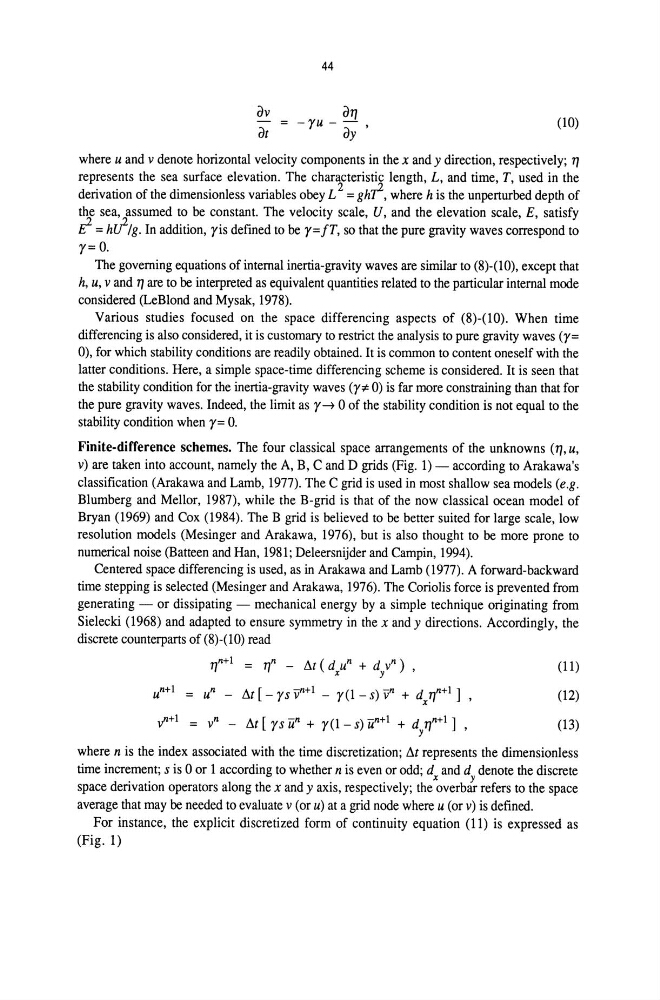
44
a1)
-ru - -
ay
(10)
where u and v denote horizontal velocity components in the x and y direction, respectively; 1)
represents the sea surface elevation. The characteristic length, L, and time, T, used in the
derivation of the dimensionless variables obey L 2 = ghT, where h is the unperturbed depth of
the sea, assumed to be constant. The velocity scale, U, and the elevation scale, E, satisfy
~ = hil"/g. In addition, ris defined to be y= fT, so that the pure gravity waves correspond to
y=O.
The governing equations of internal inertia-gravity waves are similar to (8)-00), except that
h, u, v and 1) are to be interpreted as equivalent quantities related to the particular internal mode
considered (LeBlond and Mysak, 1978).
Various studies focused on the space differencing aspects of (8)-(10). When time
differencing is also considered, it is customary to restrict the analysis to pure gravity waves (y=
0), for which stability conditions are readily obtained. It is common to content oneself with the
latter conditions. Here, a simple space-time differencing scheme is considered. It is seen that
the stability condition for the inertia-gravity waves (r* 0) is far more constraining than that for
the pure gravity waves. Indeed, the limit as r~ 0 of the stability condition is not equal to the
stability condition when r= O.
Finite-difference schemes. The four classical space arrangements of the unknowns (1), u,
v) are taken into account, namely the A, B, C and D grids (Fig. 1) - according to Arakawa's
classification (Arakawa and Lamb, 1977). The C grid is used in most shallow sea models (e.g.
Blumberg and Mellor, 1987), while the B-grid is that of the now classical ocean model of
Bryan (1969) and Cox (1984). The B grid is believed to be better suited for large scale, low
resolution models (Mesinger and Arakawa, 1976), but is also thought to be more prone to
numerical noise (Batteen and Han, 1981; Deleersnijder and Campin, 1994).
Centered space differencing is used, as in Arakawa and Lamb (977). A forward-backward
time stepping is selected (Mesinger and Arakawa, 1976). The Coriolis force is prevented from
generating - or dissipating - mechanical energy by a simple technique originating from
Sielecki (968) and adapted to ensure symmetry in the x and y directions. Accordingly, the
discrete counterparts of (8)-(10) read
1)n+l = 1)n - !1t (dxu n + d/ n ) ,
11'+1
un - ~t[ - ysv n + 1 - rO-s) v n + d 1)n+l]
x
(11)
(2)
(13)
where n is the index associated with the time discretization; !1t represents the dimensionless
time increment; s is 0 or 1 according to whether n is even or odd; d and d denote the discrete
space derivation operators along the x and y axis, respectively; the xoverbk refers to the space
average that may be needed to evaluate v (or u) at a grid node where u (or v) is defined.
For instance, the explicit discretized form of continuity equation (11) is expressed as
(Fig. I)
a1)
-ru - -
ay
(10)
where u and v denote horizontal velocity components in the x and y direction, respectively; 1)
represents the sea surface elevation. The characteristic length, L, and time, T, used in the
derivation of the dimensionless variables obey L 2 = ghT, where h is the unperturbed depth of
the sea, assumed to be constant. The velocity scale, U, and the elevation scale, E, satisfy
~ = hil"/g. In addition, ris defined to be y= fT, so that the pure gravity waves correspond to
y=O.
The governing equations of internal inertia-gravity waves are similar to (8)-00), except that
h, u, v and 1) are to be interpreted as equivalent quantities related to the particular internal mode
considered (LeBlond and Mysak, 1978).
Various studies focused on the space differencing aspects of (8)-(10). When time
differencing is also considered, it is customary to restrict the analysis to pure gravity waves (y=
0), for which stability conditions are readily obtained. It is common to content oneself with the
latter conditions. Here, a simple space-time differencing scheme is considered. It is seen that
the stability condition for the inertia-gravity waves (r* 0) is far more constraining than that for
the pure gravity waves. Indeed, the limit as r~ 0 of the stability condition is not equal to the
stability condition when r= O.
Finite-difference schemes. The four classical space arrangements of the unknowns (1), u,
v) are taken into account, namely the A, B, C and D grids (Fig. 1) - according to Arakawa's
classification (Arakawa and Lamb, 1977). The C grid is used in most shallow sea models (e.g.
Blumberg and Mellor, 1987), while the B-grid is that of the now classical ocean model of
Bryan (1969) and Cox (1984). The B grid is believed to be better suited for large scale, low
resolution models (Mesinger and Arakawa, 1976), but is also thought to be more prone to
numerical noise (Batteen and Han, 1981; Deleersnijder and Campin, 1994).
Centered space differencing is used, as in Arakawa and Lamb (977). A forward-backward
time stepping is selected (Mesinger and Arakawa, 1976). The Coriolis force is prevented from
generating - or dissipating - mechanical energy by a simple technique originating from
Sielecki (968) and adapted to ensure symmetry in the x and y directions. Accordingly, the
discrete counterparts of (8)-(10) read
1)n+l = 1)n - !1t (dxu n + d/ n ) ,
11'+1
un - ~t[ - ysv n + 1 - rO-s) v n + d 1)n+l]
x
(11)
(2)
(13)
where n is the index associated with the time discretization; !1t represents the dimensionless
time increment; s is 0 or 1 according to whether n is even or odd; d and d denote the discrete
space derivation operators along the x and y axis, respectively; the xoverbk refers to the space
average that may be needed to evaluate v (or u) at a grid node where u (or v) is defined.
For instance, the explicit discretized form of continuity equation (11) is expressed as
(Fig. I)