

43
be in the range 1-10 6 m 2 s-l, while the horizontal diffusivity generally is such that 1 m 2 s-1
SA S l(f m 2 s-l.
c
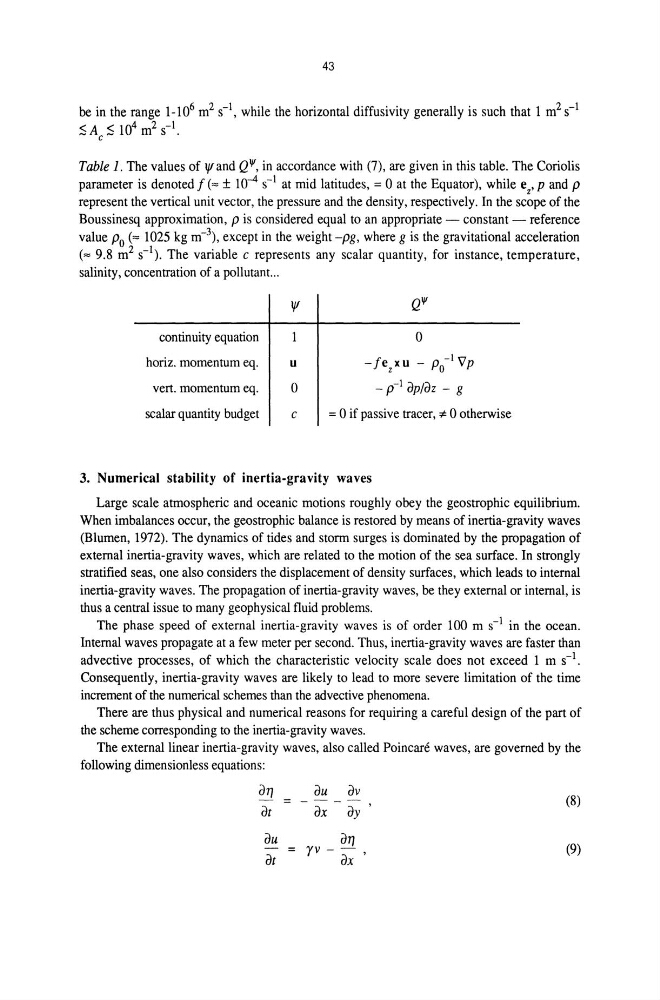
Table 1. The values of VIand Q'I', in accordance with (7), are given in this table. The Coriolis
parameter is denoted 1('" ± 10-4 S-1 at mid latitudes, = 0 at the Equator), while e z ' p and P
represent the vertical unit vector, the pressure and the density, respectively. In the scope of the
Boussinesq approximation, p is considered equal to an appropriate - constant - reference
value Po (,., 1025 kg m- 3 ), except in the weight -pg, where g is the gravitational acceleration
(,., 9.8 m 2 s-I). The variable c represents any scalar quantity, for instance, temperature,
salinity, concentration of a pollutant...
'If
Q'I'
continuity equation
0
horiz. momentum eq.
u
-Ie xu - p -IVp
z
0
vert. momentum eq.
0
_ p-l ap/dz _ g
scalar quantity budget
c
= 0 if passive tracer, "# 0 otherwise
3. Numerical stability of inertia-gravity waves
Large scale atmospheric and oceanic motions roughly obey the geostrophic equilibrium.
When imbalances occur, the geostrophic balance is restored by means of inertia-gravity waves
(Blumen, 1972). The dynamics of tides and storm surges is dominated by the propagation of
external inertia-gravity waves, which are related to the motion of the sea surface. In strongly
stratified seas, one also considers the displacement of density surfaces, which leads to internal
inertia-gravity waves. The propagation of inertia-gravity waves, be they external or internal, is
thus a central issue to many geophysical fluid problems.
The phase speed of external inertia-gravity waves is of order 100 m s-1 in the ocean.
Internal waves propagate at a few meter per second. Thus, inertia-gravity waves are faster than
advective processes, of which the characteristic velocity scale does not exceed 1 m s-l.
Consequently, inertia-gravity waves are likely to lead to more severe limitation of the time
increment of the numerical schemes than the advective phenomena.
There are thus physical and numerical reasons for requiring a careful design of the part of
the scheme corresponding to the inertia-gravity waves.
The external linear inertia-gravity waves, also called Poincare waves, are governed by the
following dimensionless equations:
(1)
au av
(8)
-
-
at
ax ay
au yv _ (1)
(9)
-
at
ax
be in the range 1-10 6 m 2 s-l, while the horizontal diffusivity generally is such that 1 m 2 s-1
SA S l(f m 2 s-l.
c
Table 1. The values of VIand Q'I', in accordance with (7), are given in this table. The Coriolis
parameter is denoted 1('" ± 10-4 S-1 at mid latitudes, = 0 at the Equator), while e z ' p and P
represent the vertical unit vector, the pressure and the density, respectively. In the scope of the
Boussinesq approximation, p is considered equal to an appropriate - constant - reference
value Po (,., 1025 kg m- 3 ), except in the weight -pg, where g is the gravitational acceleration
(,., 9.8 m 2 s-I). The variable c represents any scalar quantity, for instance, temperature,
salinity, concentration of a pollutant...
'If
Q'I'
continuity equation
0
horiz. momentum eq.
u
-Ie xu - p -IVp
z
0
vert. momentum eq.
0
_ p-l ap/dz _ g
scalar quantity budget
c
= 0 if passive tracer, "# 0 otherwise
3. Numerical stability of inertia-gravity waves
Large scale atmospheric and oceanic motions roughly obey the geostrophic equilibrium.
When imbalances occur, the geostrophic balance is restored by means of inertia-gravity waves
(Blumen, 1972). The dynamics of tides and storm surges is dominated by the propagation of
external inertia-gravity waves, which are related to the motion of the sea surface. In strongly
stratified seas, one also considers the displacement of density surfaces, which leads to internal
inertia-gravity waves. The propagation of inertia-gravity waves, be they external or internal, is
thus a central issue to many geophysical fluid problems.
The phase speed of external inertia-gravity waves is of order 100 m s-1 in the ocean.
Internal waves propagate at a few meter per second. Thus, inertia-gravity waves are faster than
advective processes, of which the characteristic velocity scale does not exceed 1 m s-l.
Consequently, inertia-gravity waves are likely to lead to more severe limitation of the time
increment of the numerical schemes than the advective phenomena.
There are thus physical and numerical reasons for requiring a careful design of the part of
the scheme corresponding to the inertia-gravity waves.
The external linear inertia-gravity waves, also called Poincare waves, are governed by the
following dimensionless equations:
(1)
au av
(8)
-
-
at
ax ay
au yv _ (1)
(9)
-
at
ax