

42
As first suggested by Boussinesq (1877), Fourier-Fick-type parameterizations may be
resorted to, yielding
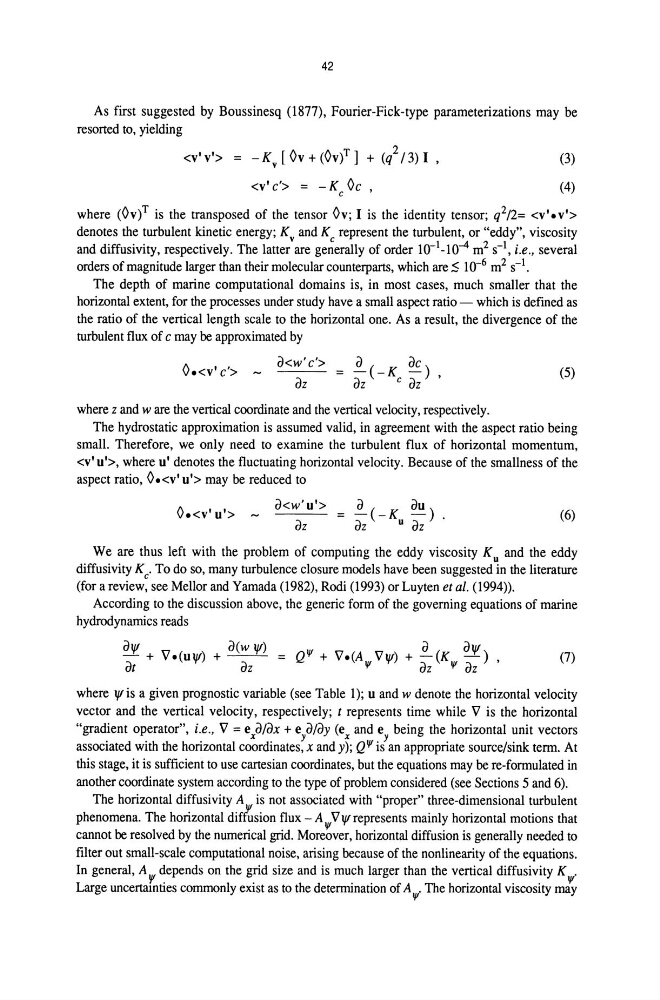
(3)
=-KcOc,
(4)
where (Ov)T is the transposed of the tensor Ov; I is the identity tensor; q2/2=
denotes the turbulent kinetic energy; Kv and Kc represent the turbulent, or "eddy", viscosity
and diffusivity, respectively. The latter are generally of order 10- 1 _10-4 m 2 s-l, i.e., several
orders of magnitude larger than their molecular counterparts, which are $ 10- 6 m 2 s-l.
The depth of marine computational domains is, in most cases, much smaller that the
horizontal extent, for the processes under study have a small aspect ratio - which is defined as
the ratio of the vertical length scale to the horizontal one. As a result, the divergence of the
turbulent flux of c may be approximated by
a = ~(-K ac),
az
az
c az
O.
(5)
where z and w are the vertical coordinate and the vertical velocity, respectively.
The hydrostatic approximation is assumed valid, in agreement with the aspect ratio being
small. Therefore, we only need to examine the turbulent flux of horizontal momentum,
, where u' denotes the fluctuating horizontal velocity. Because of the smallness of the
aspect ratio, O. may be reduced to
a = ~(-K au) .
az
az
u az
O.
(6)
We are thus left with the problem of computing the eddy viscosity K u and the eddy
diffusivity Kc. To do so, many turbulence closure models have been suggested in the literature
(for a review, see Mellor and Yamada (1982), Rodi (1993) or Luyten et al. (1994)).
According to the discussion above, the generic form of the governing equations of marine
hydrodynamics reads
aljl
a(w 1jI)
a
aljl
- + V.(uljI) + - - = Q'" + V.(A VIjI) + -(K - ) ,
at
az
'II
az 'II az
(7)
where ljIis a given prognostic variable (see Table 1); u and w denote the horizontal velocity
vector and the vertical velocity, respectively; t represents time while V is the horizontal
"gradient operator", i.e., V = e a/ax + e a/ay (e and e being the horizontal unit vectors
associated with the horizontal co~rdinates; x and y); Q'" ii an appropriate source/sink term. At
this stage, it is sufficient to use cartesian coordinates, but the equations may be re-formulated in
another coordinate system according to the type of problem considered (see Sections 5 and 6).
The horizontal diffusivity A is not associated with "proper" three-dimensional turbulent
phenomena. The horizontal dift~sion flux - A Vljlrepresents mainly horizontal motions that
cannot be resolved by the numerical grid. More6ver, horizontal diffusion is generally needed to
filter out small-scale computational noise, arising because of the nonlinearity of the equations.
In general, A depends on the grid size and is much larger than the vertical diffusivity K .
Large uncertainties commonly exist as to the determination of AlJI The horizontal viscosity m:;'
As first suggested by Boussinesq (1877), Fourier-Fick-type parameterizations may be
resorted to, yielding
(3)
(4)
where (Ov)T is the transposed of the tensor Ov; I is the identity tensor; q2/2=
denotes the turbulent kinetic energy; Kv and Kc represent the turbulent, or "eddy", viscosity
and diffusivity, respectively. The latter are generally of order 10- 1 _10-4 m 2 s-l, i.e., several
orders of magnitude larger than their molecular counterparts, which are $ 10- 6 m 2 s-l.
The depth of marine computational domains is, in most cases, much smaller that the
horizontal extent, for the processes under study have a small aspect ratio - which is defined as
the ratio of the vertical length scale to the horizontal one. As a result, the divergence of the
turbulent flux of c may be approximated by
a
az
az
c az
O.
(5)
where z and w are the vertical coordinate and the vertical velocity, respectively.
The hydrostatic approximation is assumed valid, in agreement with the aspect ratio being
small. Therefore, we only need to examine the turbulent flux of horizontal momentum,
aspect ratio, O.
a
az
az
u az
O.
(6)
We are thus left with the problem of computing the eddy viscosity K u and the eddy
diffusivity Kc. To do so, many turbulence closure models have been suggested in the literature
(for a review, see Mellor and Yamada (1982), Rodi (1993) or Luyten et al. (1994)).
According to the discussion above, the generic form of the governing equations of marine
hydrodynamics reads
aljl
a(w 1jI)
a
aljl
- + V.(uljI) + - - = Q'" + V.(A VIjI) + -(K - ) ,
at
az
'II
az 'II az
(7)
where ljIis a given prognostic variable (see Table 1); u and w denote the horizontal velocity
vector and the vertical velocity, respectively; t represents time while V is the horizontal
"gradient operator", i.e., V = e a/ax + e a/ay (e and e being the horizontal unit vectors
associated with the horizontal co~rdinates; x and y); Q'" ii an appropriate source/sink term. At
this stage, it is sufficient to use cartesian coordinates, but the equations may be re-formulated in
another coordinate system according to the type of problem considered (see Sections 5 and 6).
The horizontal diffusivity A is not associated with "proper" three-dimensional turbulent
phenomena. The horizontal dift~sion flux - A Vljlrepresents mainly horizontal motions that
cannot be resolved by the numerical grid. More6ver, horizontal diffusion is generally needed to
filter out small-scale computational noise, arising because of the nonlinearity of the equations.
In general, A depends on the grid size and is much larger than the vertical diffusivity K .
Large uncertainties commonly exist as to the determination of AlJI The horizontal viscosity m:;'