

421
accounts for a small fraction (about 20%) of the summer rate of heat storage, but Oort
and Vonder Haar (1976) obtained comparable values of atmospheric heat influx density
and oceanic heat transport divergence (with zonal averages up to 100 W 1m 2 ). Oort and
Vonder Haar (1976) and Carissimo et al. (1985) also found that global meridional oceanic
heat transport experiences very large seasonal variations (up to 5 PW in the subtropics,
similar to the seasonal heat flux from the atmosphere to the oceans; their estimated error
bars are large, about 1-2 PW, but still suggest these results to be significative).
With the above type of calculations, however, it is not possible to directly compute
both the seasonal rate of heat storage and the heat transport divergence. In order to
obtain these terms it is necessary to use subsurface temperature and velocity data for all
seasons. Such velocity data, with adequate spatial and temporal coverage, is currently
not available. An alternate option, yet to be done, would be to use the velocity field
estimated with inverse techniques from available observations, either from hydrographic
data (Martel and Wunsch 1993) or from buoy trajectories (Mercier et al. 1993). The lack
of velocity data has caused that all direct estimates of oceanic heat transports approximate
the velocity field as the linear combination of Ekman and geostrophic velocities, which are
estimated from wind and hydrographic data, respectively. A simple but realistic approach
is to combine this with a two-layer representation of the ocean. Assuming that (i) both
seasonal rate of heat storage and heat transport divergence take place over the mixed
layer depth h, (ii) the mixed layer temperature 8 is depth-independent and 68 larger than
the temperature in the layer underneath, and (iii) the vertical velocity varies linearly from
Wh at the base of the mixed layer to zero at the free surface (eg. Bryan and Schroeder
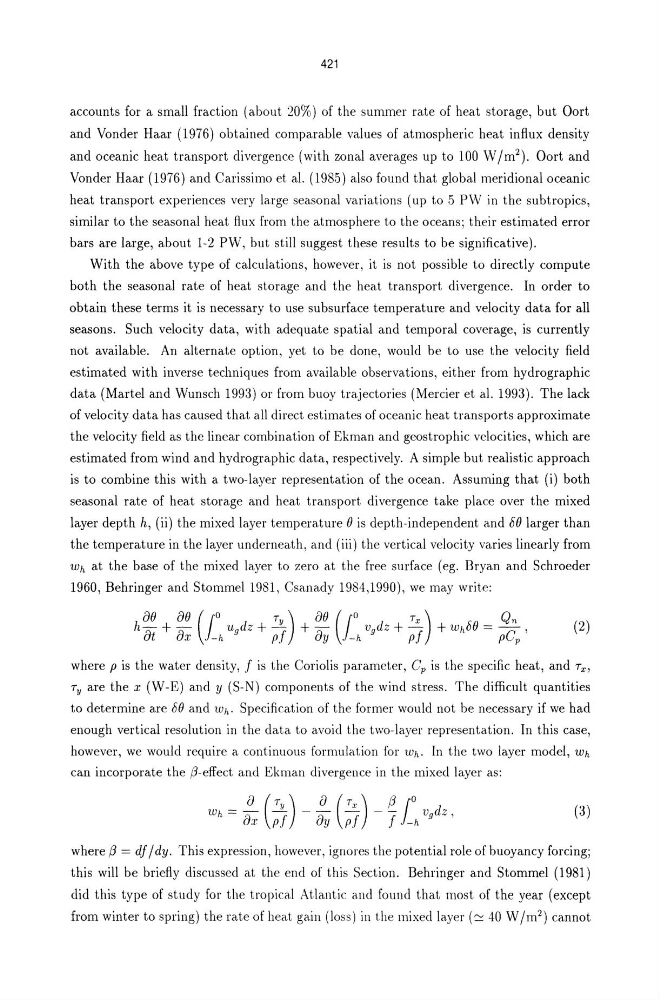
1960, Behringer and Stommel 1981, Csanady 1984,1990), we may write:
(2)
where p is the water density, f is the Coriolis parameter, Cp is the specific heat, and Tx ,
Ty are the x (W-E) and y (S-N) components of the wind stress. The difficult quantities
to determine are 68 and Wh. Specification of the former would not be necessary if we had
enough vertical resolution in the data to avoid the two-layer representation. In this case,
however, we would require a continuous formulation for Who In the two layer model, Wh
can incorporate the /1-effect and Ekman divergence in the mixed layer as:
Wh = .!!..- (3L) - .!!..- (Tx) _ fi 1° v dz,
ax pf ay pf f -h 9
(3)
where /1 = df Idy. This expression, however, ignores the potential role of buoyancy forcing;
this will be briefly discussed at the end of this Section. Behringer and Stommel (1981)
did this type of study for the tropical Atlantic and found that most of the year (except
from winter to spring) the rate of heat gain (loss) in the mixed layer (~ 40 W 1m 2 ) cannot
accounts for a small fraction (about 20%) of the summer rate of heat storage, but Oort
and Vonder Haar (1976) obtained comparable values of atmospheric heat influx density
and oceanic heat transport divergence (with zonal averages up to 100 W 1m 2 ). Oort and
Vonder Haar (1976) and Carissimo et al. (1985) also found that global meridional oceanic
heat transport experiences very large seasonal variations (up to 5 PW in the subtropics,
similar to the seasonal heat flux from the atmosphere to the oceans; their estimated error
bars are large, about 1-2 PW, but still suggest these results to be significative).
With the above type of calculations, however, it is not possible to directly compute
both the seasonal rate of heat storage and the heat transport divergence. In order to
obtain these terms it is necessary to use subsurface temperature and velocity data for all
seasons. Such velocity data, with adequate spatial and temporal coverage, is currently
not available. An alternate option, yet to be done, would be to use the velocity field
estimated with inverse techniques from available observations, either from hydrographic
data (Martel and Wunsch 1993) or from buoy trajectories (Mercier et al. 1993). The lack
of velocity data has caused that all direct estimates of oceanic heat transports approximate
the velocity field as the linear combination of Ekman and geostrophic velocities, which are
estimated from wind and hydrographic data, respectively. A simple but realistic approach
is to combine this with a two-layer representation of the ocean. Assuming that (i) both
seasonal rate of heat storage and heat transport divergence take place over the mixed
layer depth h, (ii) the mixed layer temperature 8 is depth-independent and 68 larger than
the temperature in the layer underneath, and (iii) the vertical velocity varies linearly from
Wh at the base of the mixed layer to zero at the free surface (eg. Bryan and Schroeder
1960, Behringer and Stommel 1981, Csanady 1984,1990), we may write:
(2)
where p is the water density, f is the Coriolis parameter, Cp is the specific heat, and Tx ,
Ty are the x (W-E) and y (S-N) components of the wind stress. The difficult quantities
to determine are 68 and Wh. Specification of the former would not be necessary if we had
enough vertical resolution in the data to avoid the two-layer representation. In this case,
however, we would require a continuous formulation for Who In the two layer model, Wh
can incorporate the /1-effect and Ekman divergence in the mixed layer as:
Wh = .!!..- (3L) - .!!..- (Tx) _ fi 1° v dz,
ax pf ay pf f -h 9
(3)
where /1 = df Idy. This expression, however, ignores the potential role of buoyancy forcing;
this will be briefly discussed at the end of this Section. Behringer and Stommel (1981)
did this type of study for the tropical Atlantic and found that most of the year (except
from winter to spring) the rate of heat gain (loss) in the mixed layer (~ 40 W 1m 2 ) cannot