

422
be explained by heat transport divergence (~ 10 W/m 2 ), being mainly due to heat flux
density from (to) the atmosphere. Stramma and Isemer (1988) did a similar study for
the eastern NASG, which included the coastal upwelling region, and found even larger
heat influx density values (~ 80 W 1m 2 ) from April to September; they also found that
at 30 0 N there is significant southward heat transport (about 0.7 PW) all year long.
Gill and Niiler (1973) used scaling arguments to defend the thesis that the main effect
of seasonal changes is to store heat in the ocean. They estimated, for length scales
comparable to the subtropical gyre, that heat transport divergence due to geostrophic
currents and Ekman transport is one order of magnitude smaller than the rate of heat
storage, and supported their analysis with data from four ocean weather stations. Other
studies (Behringer and Stommel 1981 , Stramma and Isemer 1988) have indeed suggested
that for all seasons the largest terms are incoming radiation flux density and outgoing
latent heat flux density, while oceanic heat transport divergence is relatively small (of the
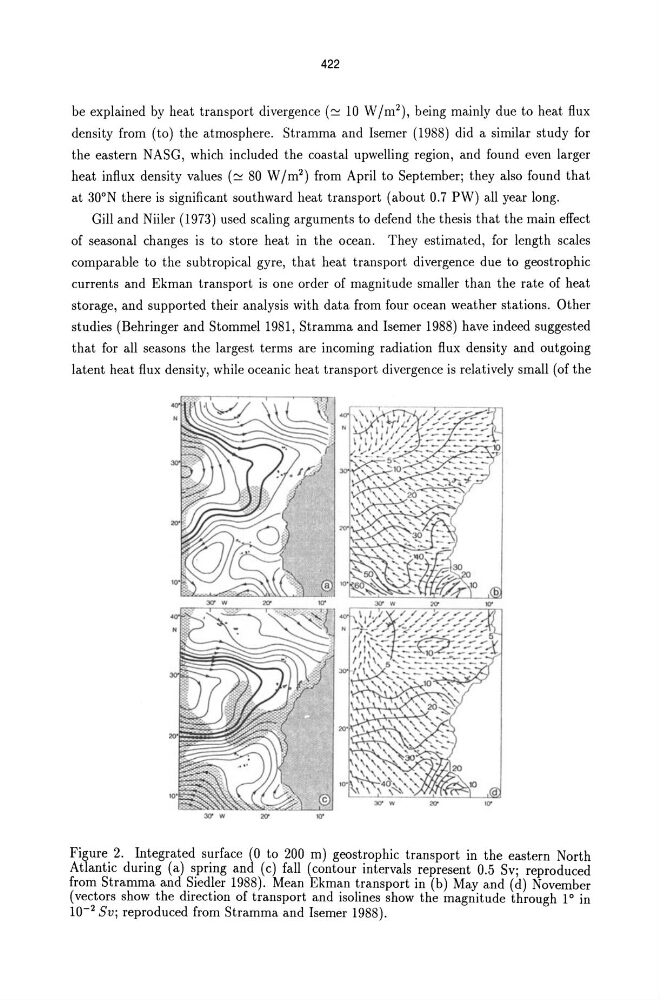
Figure 2. Integrated surface (0 to 200 m) geostrophic transport in the eastern North
Atlantic during (a) spring and (c) fall (contour intervals represent 0.5 Sv; reproduced
from Stramma and ?iedl.er 1988). Mean Ekm~n t.ransport in (b) May and (d) November
(vectors show the directIOn of transport and Isolmes show the magnitude through 1 ° in
10- 2 Sv; reproduced from Stramma and Isemer 1988).
be explained by heat transport divergence (~ 10 W/m 2 ), being mainly due to heat flux
density from (to) the atmosphere. Stramma and Isemer (1988) did a similar study for
the eastern NASG, which included the coastal upwelling region, and found even larger
heat influx density values (~ 80 W 1m 2 ) from April to September; they also found that
at 30 0 N there is significant southward heat transport (about 0.7 PW) all year long.
Gill and Niiler (1973) used scaling arguments to defend the thesis that the main effect
of seasonal changes is to store heat in the ocean. They estimated, for length scales
comparable to the subtropical gyre, that heat transport divergence due to geostrophic
currents and Ekman transport is one order of magnitude smaller than the rate of heat
storage, and supported their analysis with data from four ocean weather stations. Other
studies (Behringer and Stommel 1981 , Stramma and Isemer 1988) have indeed suggested
that for all seasons the largest terms are incoming radiation flux density and outgoing
latent heat flux density, while oceanic heat transport divergence is relatively small (of the
Figure 2. Integrated surface (0 to 200 m) geostrophic transport in the eastern North
Atlantic during (a) spring and (c) fall (contour intervals represent 0.5 Sv; reproduced
from Stramma and ?iedl.er 1988). Mean Ekm~n t.ransport in (b) May and (d) November
(vectors show the directIOn of transport and Isolmes show the magnitude through 1 ° in
10- 2 Sv; reproduced from Stramma and Isemer 1988).