

384
3.3 The general model
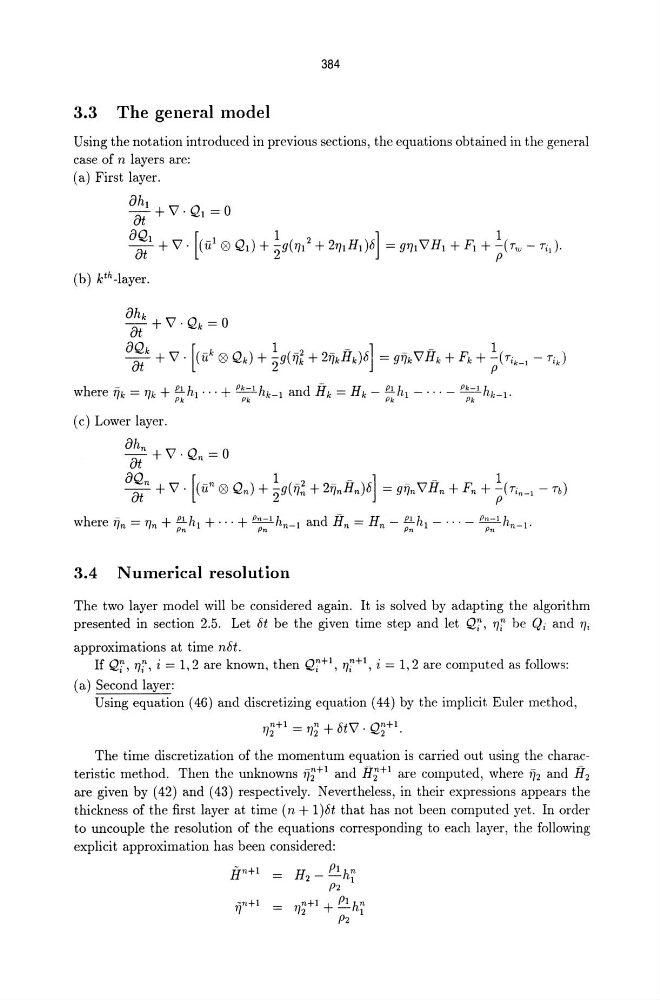
Using the notation introduced in previous sections, the equations obtained in the general
case of n layers are:
(a) First layer.
8h1
-at+\7·Q1=O
8Q1
[ -1
1
2 ]
1
&+\7. (u 0Q1)+2"g('71 +2'71H1)O =g'71\7H1+F1+r;(Tw-TiJ.
(b) kth-Iayer.
8hk
-at + \7. Qk = 0
8Qk
[ -k
1 -2
_ - ]
_
-
1
& + \7. (u 0 Qk) + 2"g('7k + 2'7k Hk)O = g'7k \7Hk + Fk + r;( Tik_1 - Tik)
where ijk = '7k + E1..h1 ... + Pk-l hk- 1 and ih = Hk - E1..h1 - ... - Pk-l hk- 1.
Pk
Pk
Pk
Pk
( c) Lower layer.
8h n + \7. Q = 0
8t
n
8;;n + \7 . [Oln 0 Qn) + ~g(ij; + 2ijnHn)O] = gijn \7 Hn + Fn + ~(Tin_l - Tb)
where ii =., + .E1..h1 + ... + Pn-l h -1 and H = H - .E1..h1 - ... - Pn-l h -1'
'In
',n
Pn
Pn
n
n
n
Pn
Pn
n
3.4 Numerical resolution
The two layer model will be considered again. It is solved by adapting the algorithm
presented in section 2.5. Let c5t be the given time step and let Q;', '7:' be Q i and '7i
approximations at time not.
If Q;', '7:" i = 1,2 are known, then Q;,+1, '7;'+1, i = 1,2 are computed as follows:
( a) Second layer:
Using equation (46) and discretizing equation (44) by the implicit Euler method,
17;+1 = '7; + c5t\7 . Q;+l.
The time discretization of the momentum equation is carried out using the characteristic method. Then the unknowns ij;+1 and H;+1 are computed, where 112 and H2
are given by (42) and (43) respectively. Nevertheless, in their expressions appears the
thickness of the first layer at time (n + 1 )ot that has not been computed yet. In order
to uncouple the resolution of the equations corresponding to each layer, the following
explicit approximation has been considered:
3.3 The general model
Using the notation introduced in previous sections, the equations obtained in the general
case of n layers are:
(a) First layer.
8h1
-at+\7·Q1=O
8Q1
[ -1
1
2 ]
1
&+\7. (u 0Q1)+2"g('71 +2'71H1)O =g'71\7H1+F1+r;(Tw-TiJ.
(b) kth-Iayer.
8hk
-at + \7. Qk = 0
8Qk
[ -k
1 -2
_ - ]
_
-
1
& + \7. (u 0 Qk) + 2"g('7k + 2'7k Hk)O = g'7k \7Hk + Fk + r;( Tik_1 - Tik)
where ijk = '7k + E1..h1 ... + Pk-l hk- 1 and ih = Hk - E1..h1 - ... - Pk-l hk- 1.
Pk
Pk
Pk
Pk
( c) Lower layer.
8h n + \7. Q = 0
8t
n
8;;n + \7 . [Oln 0 Qn) + ~g(ij; + 2ijnHn)O] = gijn \7 Hn + Fn + ~(Tin_l - Tb)
where ii =., + .E1..h1 + ... + Pn-l h -1 and H = H - .E1..h1 - ... - Pn-l h -1'
'In
',n
Pn
Pn
n
n
n
Pn
Pn
n
3.4 Numerical resolution
The two layer model will be considered again. It is solved by adapting the algorithm
presented in section 2.5. Let c5t be the given time step and let Q;', '7:' be Q i and '7i
approximations at time not.
If Q;', '7:" i = 1,2 are known, then Q;,+1, '7;'+1, i = 1,2 are computed as follows:
( a) Second layer:
Using equation (46) and discretizing equation (44) by the implicit Euler method,
17;+1 = '7; + c5t\7 . Q;+l.
The time discretization of the momentum equation is carried out using the characteristic method. Then the unknowns ij;+1 and H;+1 are computed, where 112 and H2
are given by (42) and (43) respectively. Nevertheless, in their expressions appears the
thickness of the first layer at time (n + 1 )ot that has not been computed yet. In order
to uncouple the resolution of the equations corresponding to each layer, the following
explicit approximation has been considered: