

385
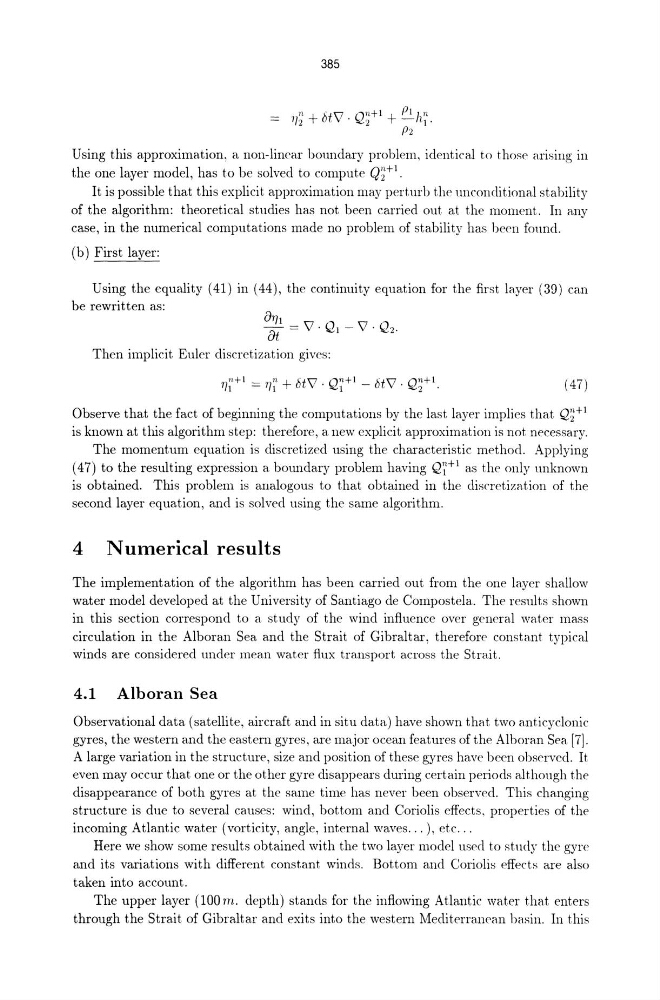
= 1)~ + bt'V. Q~+1 + PI h~.
P2
Using this approximation, a non-linear boundary problem, identical to those arising in
the one layer model, has to be solved to compute Q~+I.
It is possible that this explicit approximation may perturb the unconditional stability
of the algorithm: theoretical studies has not been carried out at the moment. In any
case, in the numerical computations made no problem of stability has been found.
(b) First layer:
Using the equality (41) in (44), the continuity equation for the first layer (39) can
be rewritten as:
81)1
at = 'V . QI - 'V . Q2.
Then implicit Euler discretization gives:
(47)
Observe that the fact of beginning the computations by the last layer implies that Q~+I
is known at this algorithm step: therefore, a new explicit approximation is not necessary.
The momentum equation is discretized using the characteristic method. Applying
( 4 7) to the resulting expression a boundary problem having Q~+ I as the only unknown
is obtained. This problem is analogous to that obtained in the discretization of the
second layer equation, and is solved using the same algorithm.
4 Numerical results
The implementation of the algorithm has been carried out from the one layer shallow
water model developed at the University of Santiago de Compostela. The results shown
in this section correspond to a study of the wind influence over general water mass
circulation in the Alboran Sea and the Strait of Gibraltar, therefore constant typical
winds are considered under mean water flux transport across the Strait.
4.1 Alboran Sea
Observational data (satellite, aircraft and in situ data) have shown that two anticyclonic
gyres, the western and the eastern gyres, are major ocean features of the Alboran Sea [7].
A large variation in the structure, size and position of these gyres have been observed. It
even may occur that one or the other gyre disappears during certain periods although the
disappearance of both gyres at the same time has never been observed. This changing
structure is due to several causes: wind, bottom and Coriolis effects, properties of the
incoming Atlantic water (vorticity, angle, internal waves ... ), etc ...
Here we show some results obtained with the two layer model used to st1ldy the gyre
and its variations with different constant winds. Bottom and Coriolis effects are also
taken into account.
The upper layer (100 m.. depth) stands for the inftowing Atlantic water that enters
through the Strait of Gibraltar and exits into the western Mediterranean basin. In this
= 1)~ + bt'V. Q~+1 + PI h~.
P2
Using this approximation, a non-linear boundary problem, identical to those arising in
the one layer model, has to be solved to compute Q~+I.
It is possible that this explicit approximation may perturb the unconditional stability
of the algorithm: theoretical studies has not been carried out at the moment. In any
case, in the numerical computations made no problem of stability has been found.
(b) First layer:
Using the equality (41) in (44), the continuity equation for the first layer (39) can
be rewritten as:
81)1
at = 'V . QI - 'V . Q2.
Then implicit Euler discretization gives:
(47)
Observe that the fact of beginning the computations by the last layer implies that Q~+I
is known at this algorithm step: therefore, a new explicit approximation is not necessary.
The momentum equation is discretized using the characteristic method. Applying
( 4 7) to the resulting expression a boundary problem having Q~+ I as the only unknown
is obtained. This problem is analogous to that obtained in the discretization of the
second layer equation, and is solved using the same algorithm.
4 Numerical results
The implementation of the algorithm has been carried out from the one layer shallow
water model developed at the University of Santiago de Compostela. The results shown
in this section correspond to a study of the wind influence over general water mass
circulation in the Alboran Sea and the Strait of Gibraltar, therefore constant typical
winds are considered under mean water flux transport across the Strait.
4.1 Alboran Sea
Observational data (satellite, aircraft and in situ data) have shown that two anticyclonic
gyres, the western and the eastern gyres, are major ocean features of the Alboran Sea [7].
A large variation in the structure, size and position of these gyres have been observed. It
even may occur that one or the other gyre disappears during certain periods although the
disappearance of both gyres at the same time has never been observed. This changing
structure is due to several causes: wind, bottom and Coriolis effects, properties of the
incoming Atlantic water (vorticity, angle, internal waves ... ), etc ...
Here we show some results obtained with the two layer model used to st1ldy the gyre
and its variations with different constant winds. Bottom and Coriolis effects are also
taken into account.
The upper layer (100 m.. depth) stands for the inftowing Atlantic water that enters
through the Strait of Gibraltar and exits into the western Mediterranean basin. In this