

383
F2 is the Coriolis force;
Tb is the bottom drag stress;
T; is the drag stress between the two layer of fluid.
In this case, the equality
(46)
remains true, because h2 - '12 is constant and therefore the first layer has no influence
over the second layer continuity equation, but it does over the momentum equation,
through pressure and friction terms.
As in the one layer model, the boundary conditions can be classified into two different
groups:
(a) Normal component of the flux given:
where ii is the outward unit vector.
(b) Elevation given:
Finally, the following initial conditions are imposed:
hi(x,0)=h~(x),i=1,2;
inDo
tr(x, 0) = ifo(x),i = 1,2; in D.
Therefore, a hyperbolic system consisting of four nonlinear equations has been obtained. Its properties are strongly related with those described in section 2.4. In particular, there are supercritical and sub critical flows, bores, depression waves, ...
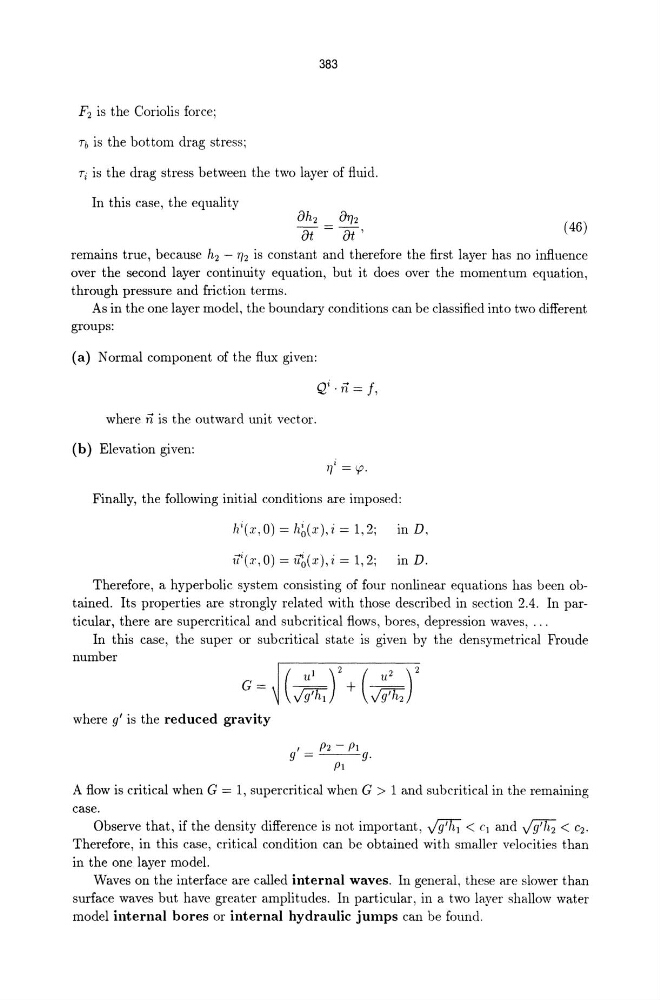
In this case, the super or sub critical state is given by the densymetrical Froude
number
where g' is the reduced gravity
, P2 - PI
9 = - - g .
PI
A flow is critical when G = 1, supercritical when G > 1 and subcritical in the remaining
case.
Observe that, if the density difference is not important, ..;g;r:;; < CI and j'ij'1i:; < C2'
Therefore, in this case, critical condition can be obtained with smaller velocities than
in the one layer model.
Waves on the interface are called internal waves. In general, these are slower than
surface waves but have greater amplitudes. In particular, in a two layer shallow water
model internal bores or internal hydraulic jumps can be found.
F2 is the Coriolis force;
Tb is the bottom drag stress;
T; is the drag stress between the two layer of fluid.
In this case, the equality
(46)
remains true, because h2 - '12 is constant and therefore the first layer has no influence
over the second layer continuity equation, but it does over the momentum equation,
through pressure and friction terms.
As in the one layer model, the boundary conditions can be classified into two different
groups:
(a) Normal component of the flux given:
where ii is the outward unit vector.
(b) Elevation given:
Finally, the following initial conditions are imposed:
hi(x,0)=h~(x),i=1,2;
inDo
tr(x, 0) = ifo(x),i = 1,2; in D.
Therefore, a hyperbolic system consisting of four nonlinear equations has been obtained. Its properties are strongly related with those described in section 2.4. In particular, there are supercritical and sub critical flows, bores, depression waves, ...
In this case, the super or sub critical state is given by the densymetrical Froude
number
where g' is the reduced gravity
, P2 - PI
9 = - - g .
PI
A flow is critical when G = 1, supercritical when G > 1 and subcritical in the remaining
case.
Observe that, if the density difference is not important, ..;g;r:;; < CI and j'ij'1i:; < C2'
Therefore, in this case, critical condition can be obtained with smaller velocities than
in the one layer model.
Waves on the interface are called internal waves. In general, these are slower than
surface waves but have greater amplitudes. In particular, in a two layer shallow water
model internal bores or internal hydraulic jumps can be found.