

370
be the free sea surface boundary. TJ denotes the elevation of the free surface from
a constant reference level A, so that
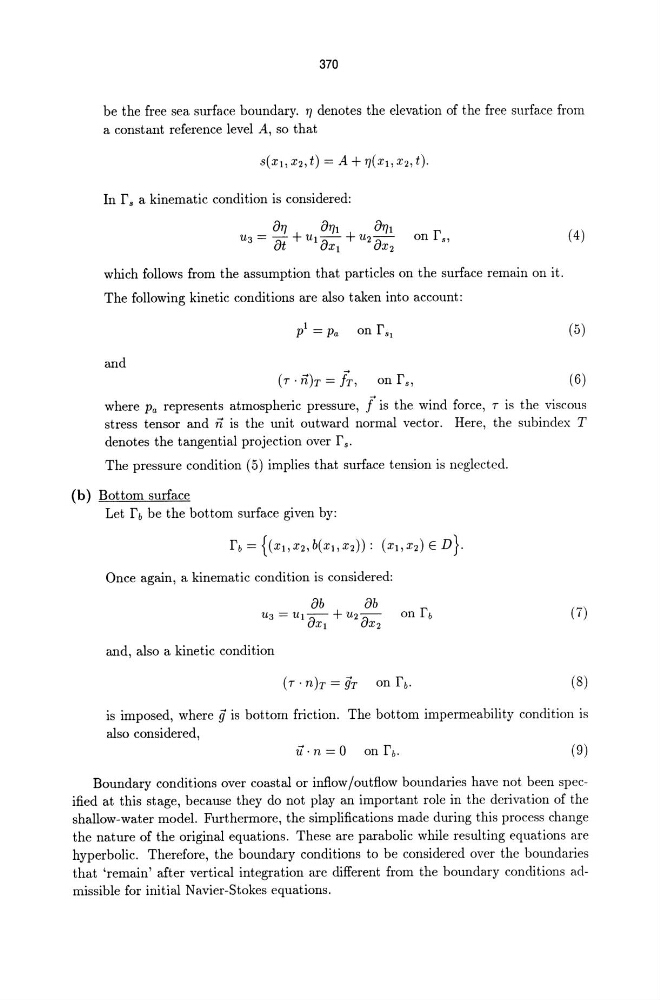
In r s a kinematic condition is considered:
which follows from the assumption that particles on the surface remain on it.
The following kinetic conditions are also taken into account:
pl = pa on r s ,
and
(T . ii)r = j-;', on r S)
(4)
(5)
(6)
where Pa represents atmospheric pressure, r is the wind force, T is the viscous
stress tensor and ii is the unit outward normal vector. Here, the subindex T
denotes the tangential projection over r s'
The pressure condition (5) implies that surface tension is neglected.
(b) Bottom surface
Let rb be the bottom surface given by:
Once again, a kinematic condition is considered:
(7)
and, also a kinetic condition
(8)
is imposed, where 9 is bottom friction. The bottom impermeability condition is
also considered,
ii· n = 0 on r b.
(9)
Boundary conditions over coastal or inflow/outflow boundaries have not been specified at this stage, because they do not play an important role in the deriva.tion of the
shallow-water model. Furthermore, the simplifications made during this process change
the nature of the original equations. These are parabolic while resulting equations are
hyperbolic. Therefore, the boundary conditions to be considered over the boundaries
that 'remain' after vertical integration are different from the boundary conditions admissible for initial Navier-Stokes equations.
be the free sea surface boundary. TJ denotes the elevation of the free surface from
a constant reference level A, so that
In r s a kinematic condition is considered:
which follows from the assumption that particles on the surface remain on it.
The following kinetic conditions are also taken into account:
pl = pa on r s ,
and
(T . ii)r = j-;', on r S)
(4)
(5)
(6)
where Pa represents atmospheric pressure, r is the wind force, T is the viscous
stress tensor and ii is the unit outward normal vector. Here, the subindex T
denotes the tangential projection over r s'
The pressure condition (5) implies that surface tension is neglected.
(b) Bottom surface
Let rb be the bottom surface given by:
Once again, a kinematic condition is considered:
(7)
and, also a kinetic condition
(8)
is imposed, where 9 is bottom friction. The bottom impermeability condition is
also considered,
ii· n = 0 on r b.
(9)
Boundary conditions over coastal or inflow/outflow boundaries have not been specified at this stage, because they do not play an important role in the deriva.tion of the
shallow-water model. Furthermore, the simplifications made during this process change
the nature of the original equations. These are parabolic while resulting equations are
hyperbolic. Therefore, the boundary conditions to be considered over the boundaries
that 'remain' after vertical integration are different from the boundary conditions admissible for initial Navier-Stokes equations.