

371
2.2 Simplifications
The boundary-value problem obtained in last sertion presents serious diffirulties. both
from the mathematical and the numf'rical point of view: free surface. 3D geometrically
complex domains, turbulent regimes, boundary layers, ...
In order to obtain a simpler mathematical model, some hypothesis allowing the
reduction of some difficulties can be made. For instance, usually the shallow water
approximation is accepted: it consists in the assumption that the vertical acceleration
of fluid particles has a negligible effect on the pressure p, so that the vertical component
of momentum equation becomes:
Dp
Dz = -pg;
(10)
or, equivalently, that the pressure p is given as in hydrostatics.
Whether this approximation is valid or not depends not only on the ratio between
typical lengths in the vertical and the horizontal directions of the domain, hut in the
ratio between the depth and the typical wavelengths of the phenomena heing considered.
More precisely, this is valid when
H < o.on
(11)
where H is the typical depth of the undisturbed water and A is the wavelength of s1ll'face
waves. Waves satisfying (11) are called shallow water waves.
If turbulent effects arc not important (as will he accepted hereafter), some stress
tensor components can be suppressed. However. if wind and bottom effects have to be
taken into account, some vertical components lllust be retained. Here. only the TU and
T2,3 terms will be retained.
The Coriolis term can also be simplified. A dimensional analysis shows that some
terms are negligible, so that. the Coriolis force ran be approached as follows:
where
f = 21DIsinO
is the Coriolis parameter, which varies with latitude. O. However, this variation is only
important for phenomena having very long temporal or spatial scales. Here .f is assumed
to be constant, by taking the mean latitude of the region under study 00 , This is the
so-called f-plane approximation.
Finally, density variations are assumed to be negligible, i.e.
p = po·
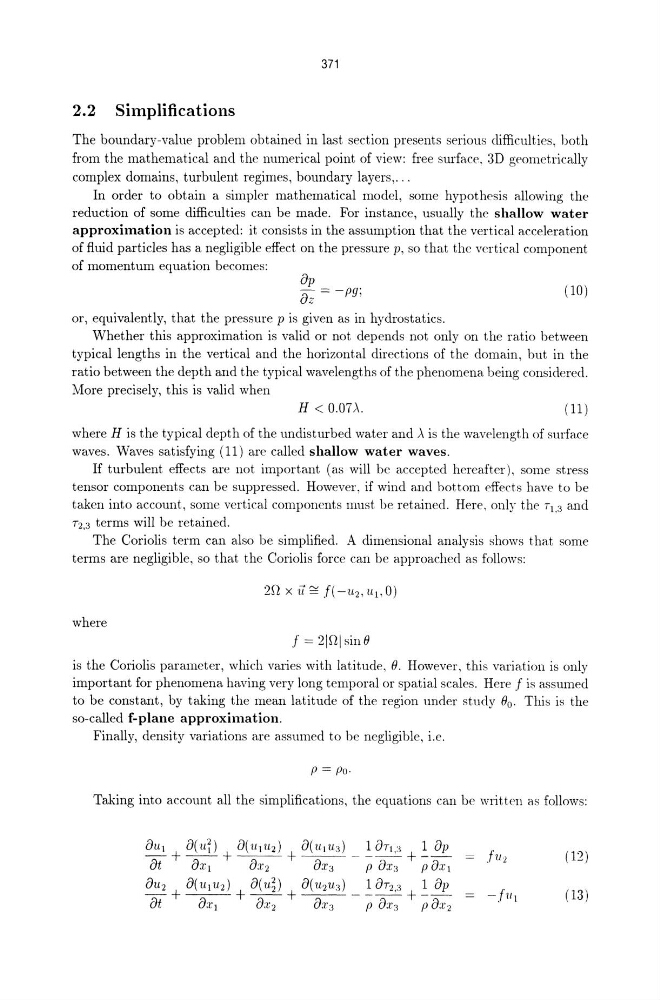
Taking into account all the simplificat.ions, the equations can be written as follows:
( 12)
(13)
2.2 Simplifications
The boundary-value problem obtained in last sertion presents serious diffirulties. both
from the mathematical and the numf'rical point of view: free surface. 3D geometrically
complex domains, turbulent regimes, boundary layers, ...
In order to obtain a simpler mathematical model, some hypothesis allowing the
reduction of some difficulties can be made. For instance, usually the shallow water
approximation is accepted: it consists in the assumption that the vertical acceleration
of fluid particles has a negligible effect on the pressure p, so that the vertical component
of momentum equation becomes:
Dp
Dz = -pg;
(10)
or, equivalently, that the pressure p is given as in hydrostatics.
Whether this approximation is valid or not depends not only on the ratio between
typical lengths in the vertical and the horizontal directions of the domain, hut in the
ratio between the depth and the typical wavelengths of the phenomena heing considered.
More precisely, this is valid when
H < o.on
(11)
where H is the typical depth of the undisturbed water and A is the wavelength of s1ll'face
waves. Waves satisfying (11) are called shallow water waves.
If turbulent effects arc not important (as will he accepted hereafter), some stress
tensor components can be suppressed. However. if wind and bottom effects have to be
taken into account, some vertical components lllust be retained. Here. only the TU and
T2,3 terms will be retained.
The Coriolis term can also be simplified. A dimensional analysis shows that some
terms are negligible, so that. the Coriolis force ran be approached as follows:
where
f = 21DIsinO
is the Coriolis parameter, which varies with latitude. O. However, this variation is only
important for phenomena having very long temporal or spatial scales. Here .f is assumed
to be constant, by taking the mean latitude of the region under study 00 , This is the
so-called f-plane approximation.
Finally, density variations are assumed to be negligible, i.e.
p = po·
Taking into account all the simplificat.ions, the equations can be written as follows:
( 12)
(13)