

369
2.1 Primary Equations
In Oceanography, it is usually accepted that water mass circulation is governed by the
equations:
ap _ n
- + l I ' vp
at
-~\lp+F-pgk, in at
Po
po
° in at
0,
in at
(1)
(2)
(3)
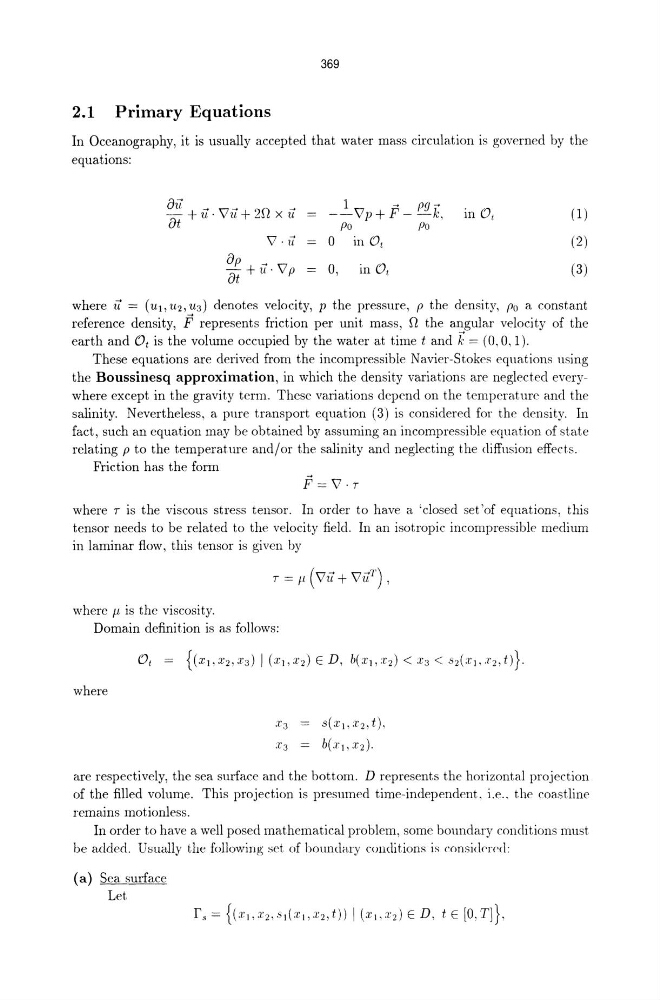
where i1 = (lib lI2, lI3) denotes velocity, p the pressure, p the density, Po a constant
reference density, F represents friction per unit mass, n the angular velocity of the
earth and at is the volume occupied by the water at time t and k = (0,0,1).
These equations are derived from the incompressible Navier-Stokes equations using
the Boussinesq approximation, in which the density variations are neglected everywhere except in the gravity term. These variations depend on the temperature and the
salinity. Nevertheless, a pure transport equation (3) is considered for the density. In
fact, such an equation may be obtained by assuming an incompressible equation of state
relating p to the temperature and/or the salinity and neglecting the diffusion effects.
Friction has the form
where T is the viscous stress tensor. In order to have a 'closed set 'of equations, this
tensor needs to be related to the velocity field. In an isotropic incompressible medium
in laminar flow, this tensor is given by
where 11 is the viscosity.
Domain definition is as follows:
where
;1::3
s(Xj, :r2, t),
:r3
b(:rj,x2)'
are respectively, the sea surface and the bottom. D represents the horizontal projection
of the filled volume. This projection is presumed time-independent, i.e., the coastline
remains motionless.
In order to have a well posed mathematical problem, some boundary conditions must
be added. Usually the following set of boundary C'Ouditions is eonsi(lPr('ci:
(a) Sea surface
Let
2.1 Primary Equations
In Oceanography, it is usually accepted that water mass circulation is governed by the
equations:
ap _ n
- + l I ' vp
at
-~\lp+F-pgk, in at
Po
po
° in at
0,
in at
(1)
(2)
(3)
where i1 = (lib lI2, lI3) denotes velocity, p the pressure, p the density, Po a constant
reference density, F represents friction per unit mass, n the angular velocity of the
earth and at is the volume occupied by the water at time t and k = (0,0,1).
These equations are derived from the incompressible Navier-Stokes equations using
the Boussinesq approximation, in which the density variations are neglected everywhere except in the gravity term. These variations depend on the temperature and the
salinity. Nevertheless, a pure transport equation (3) is considered for the density. In
fact, such an equation may be obtained by assuming an incompressible equation of state
relating p to the temperature and/or the salinity and neglecting the diffusion effects.
Friction has the form
where T is the viscous stress tensor. In order to have a 'closed set 'of equations, this
tensor needs to be related to the velocity field. In an isotropic incompressible medium
in laminar flow, this tensor is given by
where 11 is the viscosity.
Domain definition is as follows:
where
;1::3
s(Xj, :r2, t),
:r3
b(:rj,x2)'
are respectively, the sea surface and the bottom. D represents the horizontal projection
of the filled volume. This projection is presumed time-independent, i.e., the coastline
remains motionless.
In order to have a well posed mathematical problem, some boundary conditions must
be added. Usually the following set of boundary C'Ouditions is eonsi(lPr('ci:
(a) Sea surface
Let