

348
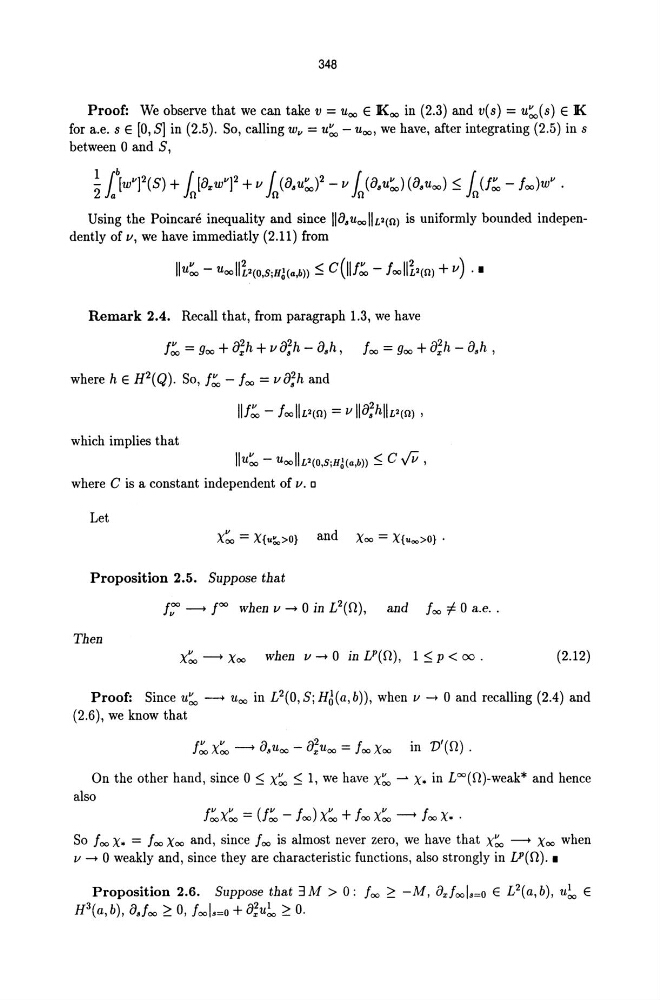
Proof: We observe that we can take v = Uoo E Koo in (2.3) and v(s) = u~(s) E K
for a.e. s E [0, SI in (2.5). So, calling w" = u~ - U OO , we have, after integrating (2.5) in s
between 0 and S,
Using the Poincare inequality and since 118.uoo ll£2(0) is uniformly bounded independently of v, we have immediatly (2.11) from
lIu~ - uooIl12(0,s;HJ(a,b)) ~ C(lIf~ - fooIl12(0) + v) .•
Remark 2.4. Recall that, from paragraph 1.3, we have
f~ = goo + 8;h + v8;h - 8sh, foo = goo + a;h - ash,
where h E H2(Q). SO, f~ - foo = va;h and
which implies that
Ilu~ - U oo ll£2(O,S;HJ(a,b» ~ C Vv ,
where C is a constant independent of v. 0
Let
X~ = X{u~>O} and Xoo = X{uoo>O} .
Proposition 2.5. Suppose that
r: ---+ foo when v -+ 0 in L2(0), and foo i- 0 a.e ..
Then
X~ ---+ Xoo when v -+ 0 in U(O), 1 ~ p < 00 .
(2.12)
Proof: Since u~ ---+ U oo in L2(0, S; HJ(a, b)), when v -+ 0 and recalling (2.4) and
(2.6), we know that
On the other hand, since 0 ~ X~ ~ 1, we have X~ ~ X. in Loo(O)-weak* and hence
also
f~x~ = (f~ - foo) X~ + foo X~ ---+ foo x •.
So foo x. = foo Xoo and, since foo is almost never zero, we have that X~ ---+ Xoo when
v -+ 0 weakly and, since they are characteristic functions, also strongly in U'(O) .•
Proposition 2.6. Suppose that 3M > 0: 100 2: -M, axlools=o E L2(a,b), u~ E
H 3 (a, b), asfoo 2: 0, lools=o + a;u~ 2: o.
Proof: We observe that we can take v = Uoo E Koo in (2.3) and v(s) = u~(s) E K
for a.e. s E [0, SI in (2.5). So, calling w" = u~ - U OO , we have, after integrating (2.5) in s
between 0 and S,
Using the Poincare inequality and since 118.uoo ll£2(0) is uniformly bounded independently of v, we have immediatly (2.11) from
lIu~ - uooIl12(0,s;HJ(a,b)) ~ C(lIf~ - fooIl12(0) + v) .•
Remark 2.4. Recall that, from paragraph 1.3, we have
f~ = goo + 8;h + v8;h - 8sh, foo = goo + a;h - ash,
where h E H2(Q). SO, f~ - foo = va;h and
which implies that
Ilu~ - U oo ll£2(O,S;HJ(a,b» ~ C Vv ,
where C is a constant independent of v. 0
Let
X~ = X{u~>O} and Xoo = X{uoo>O} .
Proposition 2.5. Suppose that
r: ---+ foo when v -+ 0 in L2(0), and foo i- 0 a.e ..
Then
X~ ---+ Xoo when v -+ 0 in U(O), 1 ~ p < 00 .
(2.12)
Proof: Since u~ ---+ U oo in L2(0, S; HJ(a, b)), when v -+ 0 and recalling (2.4) and
(2.6), we know that
On the other hand, since 0 ~ X~ ~ 1, we have X~ ~ X. in Loo(O)-weak* and hence
also
f~x~ = (f~ - foo) X~ + foo X~ ---+ foo x •.
So foo x. = foo Xoo and, since foo is almost never zero, we have that X~ ---+ Xoo when
v -+ 0 weakly and, since they are characteristic functions, also strongly in U'(O) .•
Proposition 2.6. Suppose that 3M > 0: 100 2: -M, axlools=o E L2(a,b), u~ E
H 3 (a, b), asfoo 2: 0, lools=o + a;u~ 2: o.