

347
and define
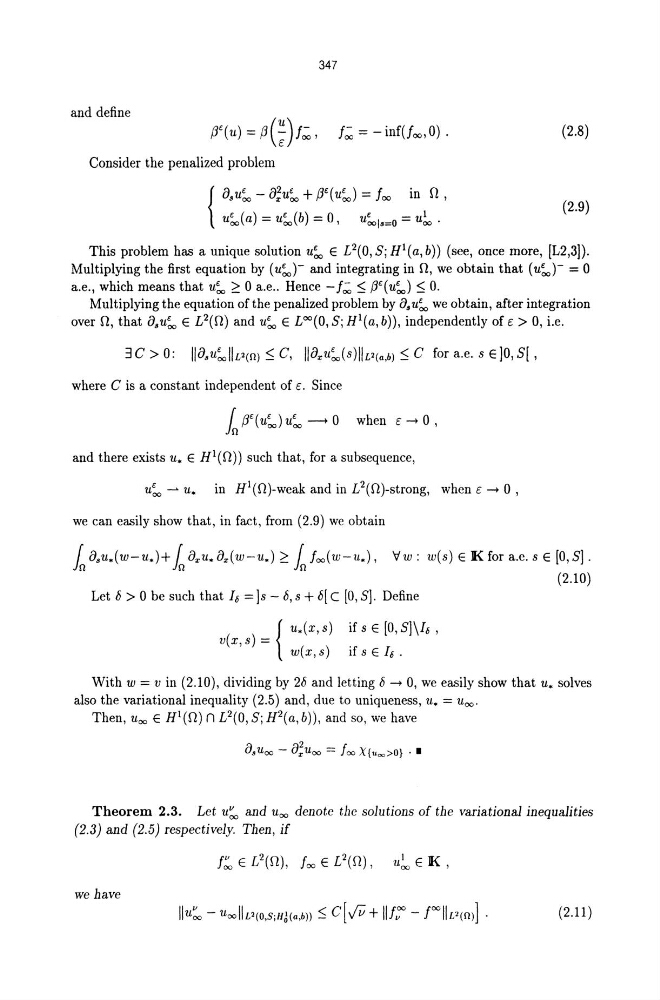
{j!(u) = {j(i)/~, I~ = -inf(foo,O).
Consider the penalized problem
{
o.u~ - o~u~ + {j£(u~) = 100 in n,
u~(a) = u~(b) = 0, u~I'=o = u~ .
(2.8)
(2.9)
This problem has a unique solution u~ E L2(O, S; Hl(a, b)) (see, once more, [L2,3]).
Multiplying the first equation by (u~t and integrating in 0, we obtain that (u~t = 0
a.e., which means that u~ ~ 0 a.e .. Hence - f;;, ~ jj«u~) ~ O.
Multiplying the equation of the penalized problem by a. u~ we obtain, after integration
over 0, that a.u~ E L2(O) and u~ E LOO(O, S; Hl(a, b)), independently of c > 0, i.e.
3C > 0: lIo.u~II£2(n) ~ C, Iloxu~(s)II£2(4,b) ~ C for a.e. s E]O, S[,
where C is a constant independent of c. Since
{ {j!(u! )u! --+ 0 when c - 0,
in
00
00
and there exists u. E Hl(O)) such that, for a subsequence,
u~ ~ u. in Hl(O)-weak and in L 2 (O)-strong, when c - 0 ,
we can easily show that, in fact, from (2.9) we obtain
10 o.u.(w-u.)+ 10 a",u.o",(w-u.) ~ 1ofoo(W-u.) , Vw: w(s) E Kfor a.e. s E to,S].
(2.10)
Let 8 > 0 be such that I. =]s - 8, s + 8[ C [0, S]. Define
{
u.(x,s) if s E [O,S]\1.,
v(x,s) = w( x, s) if s E Io .
With W = v in (2.10), dividing by 28 and letting 8 - 0, we easily show that u. solves
also the variational inequality (2.5) and, due to uniqueness, u. = U oo .
Then, Uoo E Hl(O) n L2(0, S; H 2 (a, b)), and so, we have
Theorem 2.3. Let u::O and U oo denote the solutions of the variational inequalities
(2.3) and (2.5) respectively. Then, if
we have
(2.11 )
and define
{j!(u) = {j(i)/~, I~ = -inf(foo,O).
Consider the penalized problem
{
o.u~ - o~u~ + {j£(u~) = 100 in n,
u~(a) = u~(b) = 0, u~I'=o = u~ .
(2.8)
(2.9)
This problem has a unique solution u~ E L2(O, S; Hl(a, b)) (see, once more, [L2,3]).
Multiplying the first equation by (u~t and integrating in 0, we obtain that (u~t = 0
a.e., which means that u~ ~ 0 a.e .. Hence - f;;, ~ jj«u~) ~ O.
Multiplying the equation of the penalized problem by a. u~ we obtain, after integration
over 0, that a.u~ E L2(O) and u~ E LOO(O, S; Hl(a, b)), independently of c > 0, i.e.
3C > 0: lIo.u~II£2(n) ~ C, Iloxu~(s)II£2(4,b) ~ C for a.e. s E]O, S[,
where C is a constant independent of c. Since
{ {j!(u! )u! --+ 0 when c - 0,
in
00
00
and there exists u. E Hl(O)) such that, for a subsequence,
u~ ~ u. in Hl(O)-weak and in L 2 (O)-strong, when c - 0 ,
we can easily show that, in fact, from (2.9) we obtain
10 o.u.(w-u.)+ 10 a",u.o",(w-u.) ~ 1ofoo(W-u.) , Vw: w(s) E Kfor a.e. s E to,S].
(2.10)
Let 8 > 0 be such that I. =]s - 8, s + 8[ C [0, S]. Define
{
u.(x,s) if s E [O,S]\1.,
v(x,s) = w( x, s) if s E Io .
With W = v in (2.10), dividing by 28 and letting 8 - 0, we easily show that u. solves
also the variational inequality (2.5) and, due to uniqueness, u. = U oo .
Then, Uoo E Hl(O) n L2(0, S; H 2 (a, b)), and so, we have
Theorem 2.3. Let u::O and U oo denote the solutions of the variational inequalities
(2.3) and (2.5) respectively. Then, if
we have
(2.11 )