

349
Proof: We consider the penalized equation (2.9) with u~(a) = u~(b) = e and
u~I.=o = u~ + e, now with {J" ~ 0 where in!itead of (2.8) we set {JE(U) = M {J(~).
Differentiating the first equation in order to s and calling w = 8.u~, we have
{
8.w - 8~w + {JE'W = 8./00' in n,
w(a) = w(b) = 0, wl.=o = 1001.=0 + 8~u~ .
(2.13)
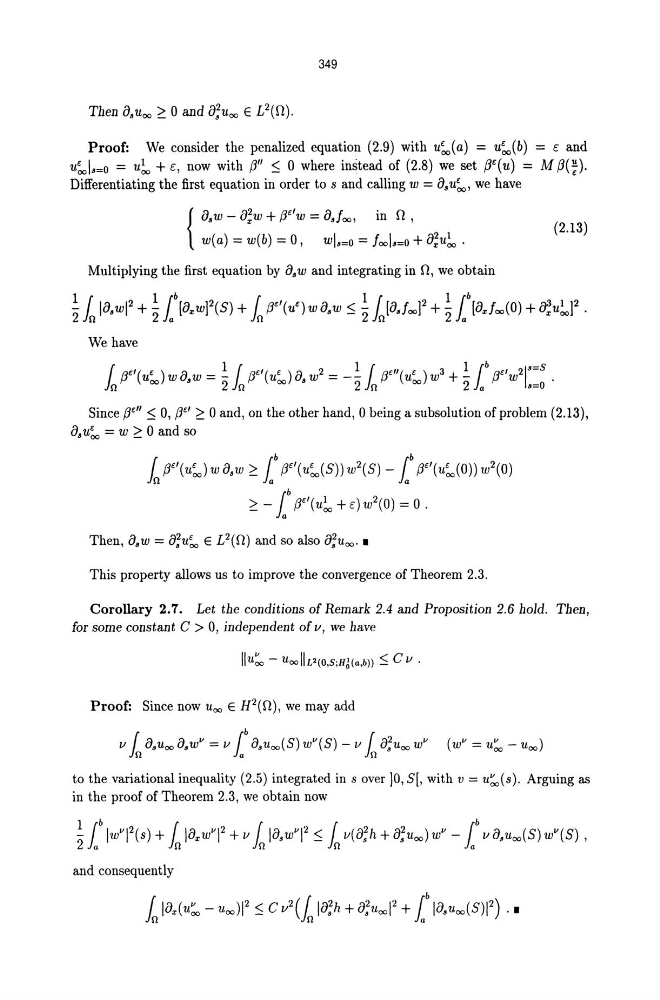
Multiplying the first equation by 8.w and integrating in n, we obtain
We have
Since {JEll ~ 0, {JE' ~ 0 and, on the other hand, 0 being a subsolution of problem (2.13),
8.u~ = w ~ 0 and so
k{JE'(U~)w88W ~ t {JE'(u~(S))w2(S) - t {JE'(U~(0))w2(0)
~ -t {JE'(U~ +e)w 2 (0) = O.
Then, 88 w = 8~u~ E L2(n) and so also o~uoo .•
This property allows us to improve the convergence of Theorem 2.3.
Corollary 2.7. Let the conditions of Remark 2.4 and Proposition 2.6 hold. Then,
for some constant C > 0, independent of I), we have
lIu:;" - uoollL'(o,s;HJ(a,b)) ~ C I) •
Proof: Since now Uoo E H2(n), we may add
I) 10 o.uooo.w" = I) lo.uoo(S)w"(S) - I ) 10 o~uoow" (w" = u:;., - uoo )
to the variational inequality (2.5) integrated in s over ]0, Sf, with v = u~( s). Arguing as
in the proof of Theorem 2.3, we obtain now
and consequently
Proof: We consider the penalized equation (2.9) with u~(a) = u~(b) = e and
u~I.=o = u~ + e, now with {J" ~ 0 where in!itead of (2.8) we set {JE(U) = M {J(~).
Differentiating the first equation in order to s and calling w = 8.u~, we have
{
8.w - 8~w + {JE'W = 8./00' in n,
w(a) = w(b) = 0, wl.=o = 1001.=0 + 8~u~ .
(2.13)
Multiplying the first equation by 8.w and integrating in n, we obtain
We have
Since {JEll ~ 0, {JE' ~ 0 and, on the other hand, 0 being a subsolution of problem (2.13),
8.u~ = w ~ 0 and so
k{JE'(U~)w88W ~ t {JE'(u~(S))w2(S) - t {JE'(U~(0))w2(0)
~ -t {JE'(U~ +e)w 2 (0) = O.
Then, 88 w = 8~u~ E L2(n) and so also o~uoo .•
This property allows us to improve the convergence of Theorem 2.3.
Corollary 2.7. Let the conditions of Remark 2.4 and Proposition 2.6 hold. Then,
for some constant C > 0, independent of I), we have
lIu:;" - uoollL'(o,s;HJ(a,b)) ~ C I) •
Proof: Since now Uoo E H2(n), we may add
I) 10 o.uooo.w" = I) lo.uoo(S)w"(S) - I ) 10 o~uoow" (w" = u:;., - uoo )
to the variational inequality (2.5) integrated in s over ]0, Sf, with v = u~( s). Arguing as
in the proof of Theorem 2.3, we obtain now
and consequently