

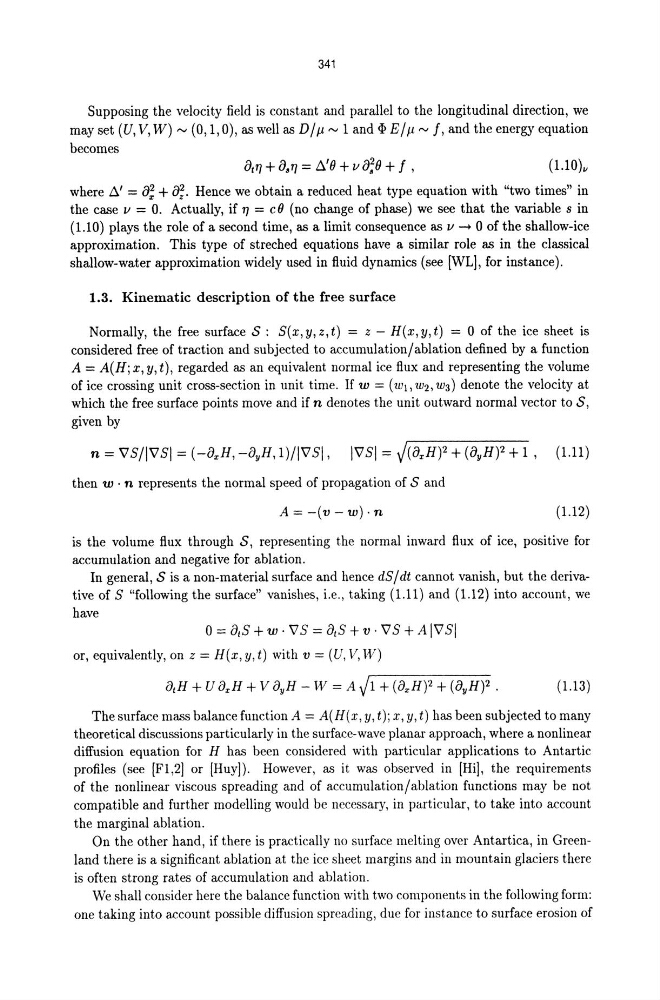
341
Supposing the velocity field is constant and parallel to the longitudinal direction, we
may set (U, V, W),..., (0,1,0), as well as D/ J..l"'" 1 and 41 E/ J..l"'" j, and the energy equation
becomes
where III = a; + a;. Hence we obtain a reduced heat type equation with "two times" in
the case v = O. Actually, if 1] = cO (no change of phase) we see that the variable s in
(1.10) plays the role of a second time, as a limit consequence as v -+ 0 of the shallow-ice
approximation. This type of streched equations have a similar role as in the classical
shallow-water approximation widely used in fluid dynamics (see [WLJ, for instance).
1.3. Kinematic description of the free surface
Normally, the free surface 5: S(x,y,z,t) = z - H(x,y,t) = 0 of the ice sheet is
considered free of traction and subjected to accumulation/ablation defined by a function
A = A(H; x, y, t), regarded as an equivalent normal ice flux and representing the volume
of ice crossing unit cross-section in unit time. If w = (WI, W2, W3) denote the velocity at
which the free surface points move and if n denotes the unit outward normal vector to 5,
given by
then w . n represents the normal speed of propagation of 5 and
A=-(v-w).n
(1.12)
is the volume flux through 5, representing the normal inward flux of ice, positive for
accumulation and negative for ablation.
In general, 5 is a non-material surface and hence dS/dt cannot vanish, but the derivative of S "following the surface" vanishes, i.e., taking (1.11) and (1.12) into account, we
have
0= GtS + w . 'il S = GtS + v . 'il S + A l'il SI
or, equivalently, on z = H(x, y, t) with v = (U, V, W)
OtH + U oxH + V oyH - W = A JI + (oxH)2 + (OyH)2 .
(1.13)
The surface mass balance function A = A(H(x, y, t); x, y, t) has been subjected to many
theoretical discussions particularly in the surface-wave planar approach, where a nonlinear
diffusion equation for H has been considered with particular applications to Antartic
profiles (see [Fl,2] or [Huyl). However, as it was observed in [Hi], the requirements
of the nonlinear viscous spreading and of accumulation/ablation functions may be not
compatible and further modelling would be necessary, in particular, to take into account
the marginal ablation.
On the other hand, if there is practically no surface melting over Antartica, in Greenland there is a significant ablation at the ice sheet margins and in mountain glaciers there
is often strong rates of accumulation and ablation.
We shall consider here the balance function with two components in the following form:
one taking into account possible diffusion spreading, due for instance to surface erosion of
Supposing the velocity field is constant and parallel to the longitudinal direction, we
may set (U, V, W),..., (0,1,0), as well as D/ J..l"'" 1 and 41 E/ J..l"'" j, and the energy equation
becomes
where III = a; + a;. Hence we obtain a reduced heat type equation with "two times" in
the case v = O. Actually, if 1] = cO (no change of phase) we see that the variable s in
(1.10) plays the role of a second time, as a limit consequence as v -+ 0 of the shallow-ice
approximation. This type of streched equations have a similar role as in the classical
shallow-water approximation widely used in fluid dynamics (see [WLJ, for instance).
1.3. Kinematic description of the free surface
Normally, the free surface 5: S(x,y,z,t) = z - H(x,y,t) = 0 of the ice sheet is
considered free of traction and subjected to accumulation/ablation defined by a function
A = A(H; x, y, t), regarded as an equivalent normal ice flux and representing the volume
of ice crossing unit cross-section in unit time. If w = (WI, W2, W3) denote the velocity at
which the free surface points move and if n denotes the unit outward normal vector to 5,
given by
then w . n represents the normal speed of propagation of 5 and
A=-(v-w).n
(1.12)
is the volume flux through 5, representing the normal inward flux of ice, positive for
accumulation and negative for ablation.
In general, 5 is a non-material surface and hence dS/dt cannot vanish, but the derivative of S "following the surface" vanishes, i.e., taking (1.11) and (1.12) into account, we
have
0= GtS + w . 'il S = GtS + v . 'il S + A l'il SI
or, equivalently, on z = H(x, y, t) with v = (U, V, W)
OtH + U oxH + V oyH - W = A JI + (oxH)2 + (OyH)2 .
(1.13)
The surface mass balance function A = A(H(x, y, t); x, y, t) has been subjected to many
theoretical discussions particularly in the surface-wave planar approach, where a nonlinear
diffusion equation for H has been considered with particular applications to Antartic
profiles (see [Fl,2] or [Huyl). However, as it was observed in [Hi], the requirements
of the nonlinear viscous spreading and of accumulation/ablation functions may be not
compatible and further modelling would be necessary, in particular, to take into account
the marginal ablation.
On the other hand, if there is practically no surface melting over Antartica, in Greenland there is a significant ablation at the ice sheet margins and in mountain glaciers there
is often strong rates of accumulation and ablation.
We shall consider here the balance function with two components in the following form:
one taking into account possible diffusion spreading, due for instance to surface erosion of