

342
the glacier, which is supposed proportional to the mean curvature of the boundary surface;
the other one is given by a prescribed external ablation/accumulation rate a(x,y,t); i.e.
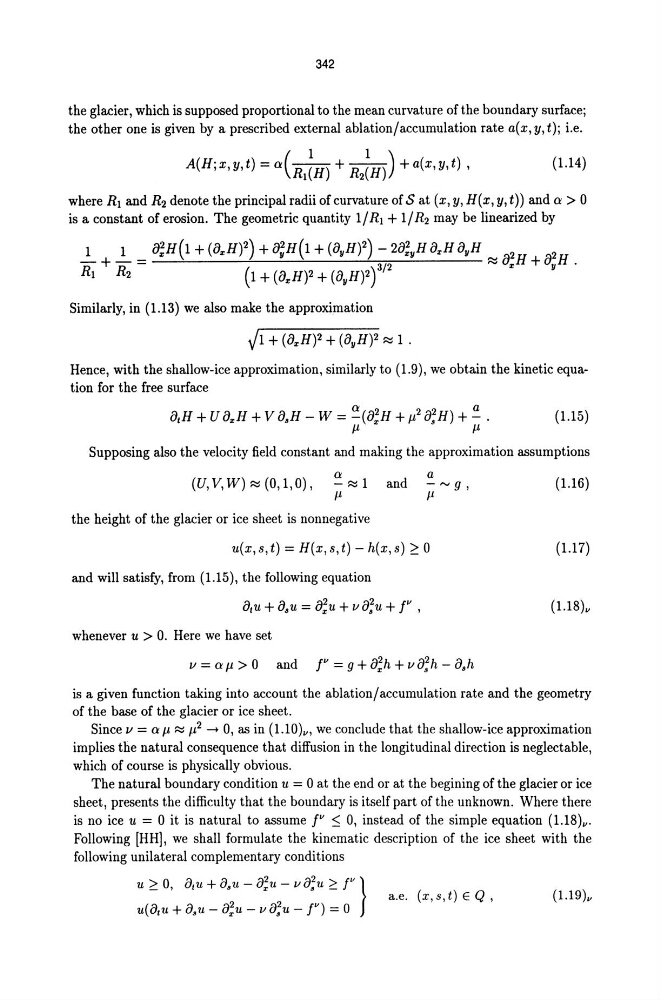
A(H; x, y, t) = (};(Rl~H) + R2~H)) + a(x, y, t) ,
(1.14)
where Rl and R2 denote the principal radii of curvature of S at (x, y, H(x, y, t)) and (}; > 0
is a constant of erosion. The geometric quantity 1/ Rl + 1/ R2 may be linearized by
Similarly, in (1.13) we also make the approximation
Hence, with the shallow-ice approximation, similarly to (1.9), we obtain the kinetic equation for the free surface
Q( 2
2 2
a
OtH + U o",H + V o.H - W = - o",H + fJ o. H) + - .
fJ
fJ
(1.15)
Supposing also the velocity field constant and making the approximation assumptions
(U, V, W) ~ (0,1,0) , ~ ~ 1 and
fJ
the height of the glacier or ice sheet is nonnegative
u(x,s,t) = H(x,s,t) - h(x,s) ~ 0
and will satisfy, from (1.15), the following equation
OtU + O.U = o;u + vo;u + f" ,
whenever u > O. Here we have set
(1.16)
(1.17)
is a given function taking into account the ablation/accumulation rate and the geometry
of the base of the glacier or ice sheet.
Since v = Q fJ ~ fJ2 -+ 0, as in (1.10)", we conclude that the shallow-ice approximation
implies the natural consequence that diffusion in the longitudinal direction is neglectable,
which of course is physically obvious.
The natural boundary condition u = 0 at the end or at the begining of the glacier or ice
sheet, presents the difficulty that the boundary is itself part of the unknown. Where there
is no ice u = 0 it is natural to assume f" ~ 0, instead of the simple equation (1.18)".
Following [HH], we shall formulate the kinematic description of the ice sheet with the
following unilateral complementary conditions
u ~ 0, OtU + O.U - o;u - vo;u ~ r} a.e. (x,s,t) E Q,
u(OtU + o.u - o;u - vo;u - r) = 0
the glacier, which is supposed proportional to the mean curvature of the boundary surface;
the other one is given by a prescribed external ablation/accumulation rate a(x,y,t); i.e.
A(H; x, y, t) = (};(Rl~H) + R2~H)) + a(x, y, t) ,
(1.14)
where Rl and R2 denote the principal radii of curvature of S at (x, y, H(x, y, t)) and (}; > 0
is a constant of erosion. The geometric quantity 1/ Rl + 1/ R2 may be linearized by
Similarly, in (1.13) we also make the approximation
Hence, with the shallow-ice approximation, similarly to (1.9), we obtain the kinetic equation for the free surface
Q( 2
2 2
a
OtH + U o",H + V o.H - W = - o",H + fJ o. H) + - .
fJ
fJ
(1.15)
Supposing also the velocity field constant and making the approximation assumptions
(U, V, W) ~ (0,1,0) , ~ ~ 1 and
fJ
the height of the glacier or ice sheet is nonnegative
u(x,s,t) = H(x,s,t) - h(x,s) ~ 0
and will satisfy, from (1.15), the following equation
OtU + O.U = o;u + vo;u + f" ,
whenever u > O. Here we have set
(1.16)
(1.17)
is a given function taking into account the ablation/accumulation rate and the geometry
of the base of the glacier or ice sheet.
Since v = Q fJ ~ fJ2 -+ 0, as in (1.10)", we conclude that the shallow-ice approximation
implies the natural consequence that diffusion in the longitudinal direction is neglectable,
which of course is physically obvious.
The natural boundary condition u = 0 at the end or at the begining of the glacier or ice
sheet, presents the difficulty that the boundary is itself part of the unknown. Where there
is no ice u = 0 it is natural to assume f" ~ 0, instead of the simple equation (1.18)".
Following [HH], we shall formulate the kinematic description of the ice sheet with the
following unilateral complementary conditions
u ~ 0, OtU + O.U - o;u - vo;u ~ r} a.e. (x,s,t) E Q,
u(OtU + o.u - o;u - vo;u - r) = 0