

340
the crustal deformation at the base; secondly, supposing prescribed the geometry of the
glacier or ice-sheet, the temperature distribution in presence of a phase change.
In both reduced models we shall consider the shallow-ice approximation, since we
assume they correspond to physical processes in which important length scales in the
longitudinal direction are large, as compared to those in the transverse directions (see
[Hul, Chap. 5). The shallow-ice approximation consists in the introduction of a streching
transformation in terms of a small parameter /-L, 0 < /-L
If we denote by x, 'fj, z and t the original coordinates after the scaling corresponding
to the dimensionless forms of the field equations, we introduce the transformation
(1.6)
and, following [HuJ, we rescale velocities and time according to
1
U = - 'ih , V = V2 ,
/-L
(1.7)
In fact, it is to be expected that transverse and vertical velocities, respectively VI and
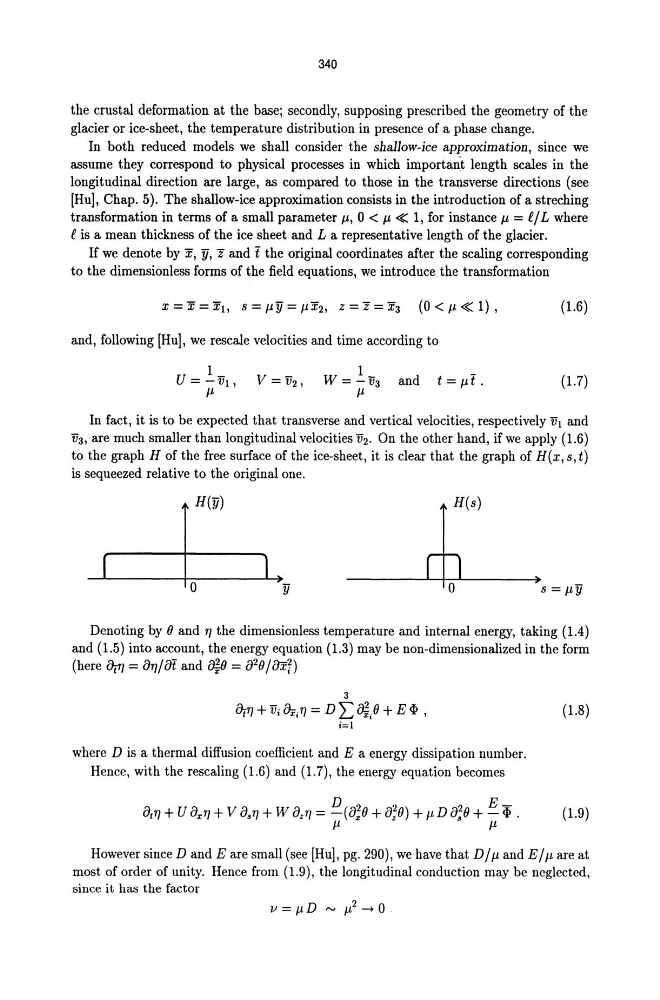
V3, are much smaller than longitudinal velocities V2. On the other hand, if we apply (1.6)
to the graph H of the free surface of the ice-sheet, it is clear that the graph of H(x, s, t)
is sequeezed relative to the original one.
)
)
y
s =/-L'fj
Denoting by 8 and", the dimensionless temperature and internal energy, taking (1.4)
and (1.5) into account, the energy equation (1.3) may be non-dimensionalized in the form
(here 8r7 = o",/ot and 0i0 = o28/axn
3
q",+v;Oxi",=D'£~i8+EiI> ,
(1.8)
;=1
where D is a thermal diffusion coefficient and E a energy dissipation number.
Hence, with the rescaling (l.6) and (1.7), the energy equation becomes
However since D and E are small (see [HuJ, pg. 290), we have that D / /-L and E / /-L are at
most of order of unity. Hence from (l.9), the longitudinal conduction may be neglected,
since it has the factor
the crustal deformation at the base; secondly, supposing prescribed the geometry of the
glacier or ice-sheet, the temperature distribution in presence of a phase change.
In both reduced models we shall consider the shallow-ice approximation, since we
assume they correspond to physical processes in which important length scales in the
longitudinal direction are large, as compared to those in the transverse directions (see
[Hul, Chap. 5). The shallow-ice approximation consists in the introduction of a streching
transformation in terms of a small parameter /-L, 0 < /-L
If we denote by x, 'fj, z and t the original coordinates after the scaling corresponding
to the dimensionless forms of the field equations, we introduce the transformation
(1.6)
and, following [HuJ, we rescale velocities and time according to
1
U = - 'ih , V = V2 ,
/-L
(1.7)
In fact, it is to be expected that transverse and vertical velocities, respectively VI and
V3, are much smaller than longitudinal velocities V2. On the other hand, if we apply (1.6)
to the graph H of the free surface of the ice-sheet, it is clear that the graph of H(x, s, t)
is sequeezed relative to the original one.
)
)
y
s =/-L'fj
Denoting by 8 and", the dimensionless temperature and internal energy, taking (1.4)
and (1.5) into account, the energy equation (1.3) may be non-dimensionalized in the form
(here 8r7 = o",/ot and 0i0 = o28/axn
3
q",+v;Oxi",=D'£~i8+EiI> ,
(1.8)
;=1
where D is a thermal diffusion coefficient and E a energy dissipation number.
Hence, with the rescaling (l.6) and (1.7), the energy equation becomes
However since D and E are small (see [HuJ, pg. 290), we have that D / /-L and E / /-L are at
most of order of unity. Hence from (l.9), the longitudinal conduction may be neglected,
since it has the factor