

339
The field equations, expressing the balance of mass momentum and internal energy,
are
div v = 0 (or p == constant) ,
p ~~ = - grad p + div S + P 9 ,
de n. d'
p dt = 'l! - IVq,
(1.1)
(1.2)
(1.3)
where v = (Vl' V2, va) is the velocity field, p the density of ice, p the pressure, S the
Cauchy stress deviator, 9 the vector of external forces, e the internal energy, internal frictional heating caused by deformation and q the heat flux. If we assume the
Fourier law and denote by T the temperature and k the heat conductivity, we shall have
q=-kgradT.
(1.4)
In (1.2)-(1.3) we denote by d/ dt the material derivative, which, in Cartesian coordinates x = (Xi) has the expression (with summation on i = 1,2,3)
d
0
-d =;:) + v . \7 = Ot + Vj ax'
t ut
.
(1.5)
For very slow flows of ice masses the acceleration terms in (1.2) are negligible, which
simplifies significantly the model. Nevertheless, it is not the purpose of this work to
consider the full problem, but only two partial aspects supposing the velocity given as a
constant mean velocity parallel to the y-axis of the Cartesian coordinate system, which
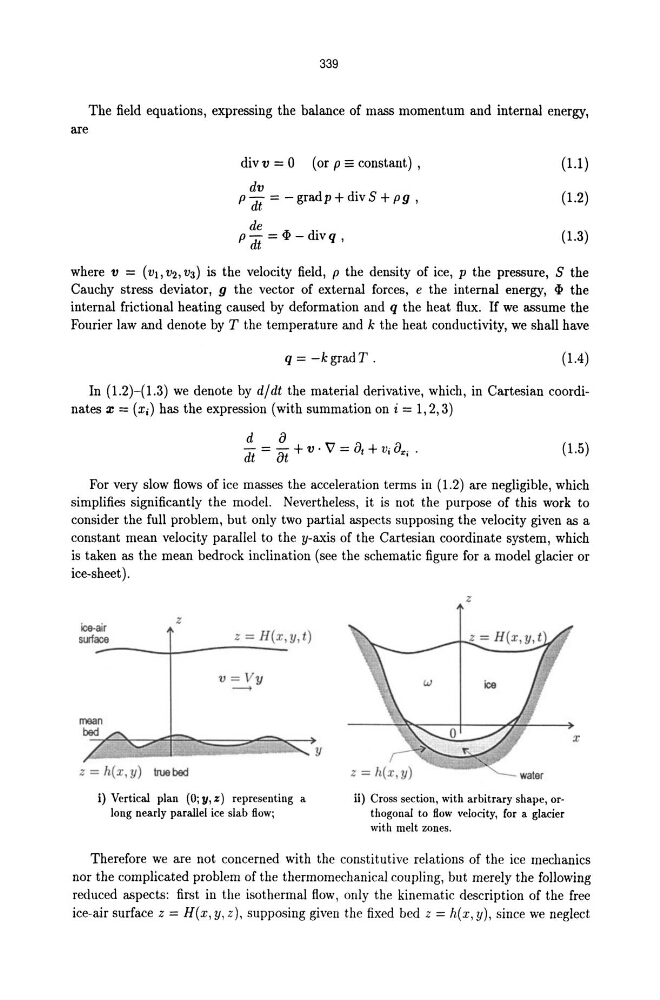
is taken as the mean bedrock inclination (see the schematic figure for a model glacier or
ice-sheet) .
joo.air
surface
z
z = H(x,y,t)
v = Vy
- >
/-_~--l------"'Y
z = h(x, y) truebed
i) Vertical plan (OJ y, z) representing a
long nearly parallel ice slab flow;
z
ii) Cross section, with arbitrary shape, orthogonal to flow velocity, for a glacier
with melt zones.
Therefore we are not concerned with the constitutive relations of the ice mechanics
nor the complicated problem of the thermomechanical coupling, but merely the following
reduced aspects: first in the isothermal flow , only the kinematic description of the free
ice-air surface z = H(x , y, z), supposing given the fixed bed z = h(x, y), since we neglect
The field equations, expressing the balance of mass momentum and internal energy,
are
div v = 0 (or p == constant) ,
p ~~ = - grad p + div S + P 9 ,
de n. d'
p dt = 'l! - IVq,
(1.1)
(1.2)
(1.3)
where v = (Vl' V2, va) is the velocity field, p the density of ice, p the pressure, S the
Cauchy stress deviator, 9 the vector of external forces, e the internal energy, internal frictional heating caused by deformation and q the heat flux. If we assume the
Fourier law and denote by T the temperature and k the heat conductivity, we shall have
q=-kgradT.
(1.4)
In (1.2)-(1.3) we denote by d/ dt the material derivative, which, in Cartesian coordinates x = (Xi) has the expression (with summation on i = 1,2,3)
d
0
-d =;:) + v . \7 = Ot + Vj ax'
t ut
.
(1.5)
For very slow flows of ice masses the acceleration terms in (1.2) are negligible, which
simplifies significantly the model. Nevertheless, it is not the purpose of this work to
consider the full problem, but only two partial aspects supposing the velocity given as a
constant mean velocity parallel to the y-axis of the Cartesian coordinate system, which
is taken as the mean bedrock inclination (see the schematic figure for a model glacier or
ice-sheet) .
joo.air
surface
z
z = H(x,y,t)
v = Vy
- >
/-_~--l------"'Y
z = h(x, y) truebed
i) Vertical plan (OJ y, z) representing a
long nearly parallel ice slab flow;
z
ii) Cross section, with arbitrary shape, orthogonal to flow velocity, for a glacier
with melt zones.
Therefore we are not concerned with the constitutive relations of the ice mechanics
nor the complicated problem of the thermomechanical coupling, but merely the following
reduced aspects: first in the isothermal flow , only the kinematic description of the free
ice-air surface z = H(x , y, z), supposing given the fixed bed z = h(x, y), since we neglect