

320
law would be
(2.59)
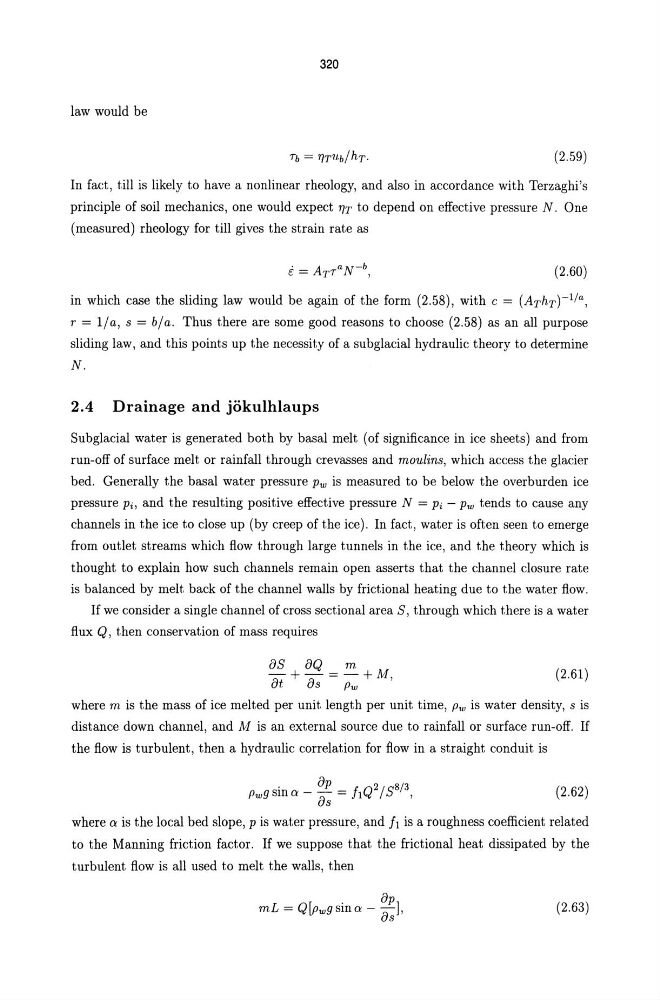
In fact, till is likely to have a nonlinear rheology, and also in accordance with Terzaghi's
principle of soil mechanics, one would expect 'T/T to depend on effective pressure N. One
(measured) rheology for till gives the strain rate as
(2.60)
in which case the sliding law would be again of the form (2.58), with c = (AThT )-l/a,
r = l/a, s = b/a. Thus there are some good reasons to choose (2.58) as an all purpose
sliding law, and this points up the necessity of a subglacial hydraulic theory to determine
N.
2.4 Drainage and jokulhlaups
Subglacial water is generated both by basal melt (of significance in ice sheets) and from
run-off of surface melt or rainfall through crevasses and moulins, which access the glacier
bed. Generally the basal water pressure Pw is measured to be below the overburden ice
pressure Pi, and the resulting positive effective pressure N = Pi - Pw tends to cause any
channels in the ice to close up (by creep of the ice). In fact, water is often seen to emerge
from outlet streams which flow through large tunnels in the ice, and the theory which is
thought to explain how such channels remain open asserts that the channel closure rate
is balanced by melt back of the channel walls by frictional heating due to the water flow.
If we consider a single channel of cross sectional area S, through which there is a water
flux Q, then conservation of mass requires
as aQ m
-+-=-+M at as Pw '
(2.61 )
where m is the mass of ice melted per unit length per unit time, Pw is water density, s is
distance down channel, and M is an external source due to rainfall or surface run-off. If
the flow is turbulent, then a hydraulic correlation for flow in a straight conduit is
(2.62)
where a is the local bed slope, P is water pressure, and II is a roughness coefficient related
to the Manning friction factor. If we suppose that the frictional heat dissipated by the
turbulent flow is all used to melt the walls, then
(2.63)
law would be
(2.59)
In fact, till is likely to have a nonlinear rheology, and also in accordance with Terzaghi's
principle of soil mechanics, one would expect 'T/T to depend on effective pressure N. One
(measured) rheology for till gives the strain rate as
(2.60)
in which case the sliding law would be again of the form (2.58), with c = (AThT )-l/a,
r = l/a, s = b/a. Thus there are some good reasons to choose (2.58) as an all purpose
sliding law, and this points up the necessity of a subglacial hydraulic theory to determine
N.
2.4 Drainage and jokulhlaups
Subglacial water is generated both by basal melt (of significance in ice sheets) and from
run-off of surface melt or rainfall through crevasses and moulins, which access the glacier
bed. Generally the basal water pressure Pw is measured to be below the overburden ice
pressure Pi, and the resulting positive effective pressure N = Pi - Pw tends to cause any
channels in the ice to close up (by creep of the ice). In fact, water is often seen to emerge
from outlet streams which flow through large tunnels in the ice, and the theory which is
thought to explain how such channels remain open asserts that the channel closure rate
is balanced by melt back of the channel walls by frictional heating due to the water flow.
If we consider a single channel of cross sectional area S, through which there is a water
flux Q, then conservation of mass requires
as aQ m
-+-=-+M at as Pw '
(2.61 )
where m is the mass of ice melted per unit length per unit time, Pw is water density, s is
distance down channel, and M is an external source due to rainfall or surface run-off. If
the flow is turbulent, then a hydraulic correlation for flow in a straight conduit is
(2.62)
where a is the local bed slope, P is water pressure, and II is a roughness coefficient related
to the Manning friction factor. If we suppose that the frictional heat dissipated by the
turbulent flow is all used to melt the walls, then
(2.63)