

319
0.5
o. ,
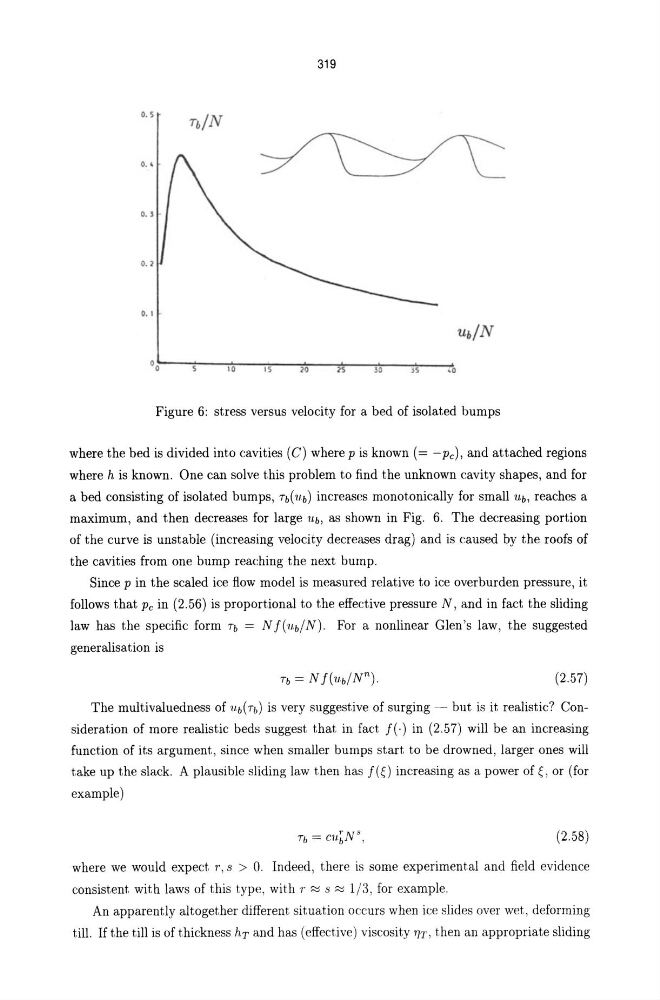
Figure 6: stress versus velocity for a bed of isolated bumps
where the bed is divided into cavities (C) where P is known (= -Pc), and attached regions
where h is known. One can solve this problem to find the unknown cavity shapes, and for
a bed consisting of isolated bumps, Tb( 1i.b) increases monotonically for small Ub , reaches a
maximum, and then decreases for large 1i.b, as shown in Fig. 6. The decreasing portion
of the curve is unstable (increasing velocity decreases drag) and is caused by the roofs of
the cavities from one bump reaching the next bump.
Since P in the scaled ice flow model is measured relative to ice overburden pressure, it
follows that Pc in (2.56) is proportional to the effective pressure N, and in fact the sliding
law has the specific form Tb = Nj(lJ'b/N). For a nonlinear Glen's law, the suggested
generalisation is
(2.57)
The multivaluedness of Ub( Tb) is very suggestive of surging - but is it realistic? Consideration of more realistic beds suggest that in fact f(·) in (2.57) will be an increasing
function of its argument , since when smaller bumps start to be drowned, larger ones will
take up the slack. A plausible sliding law then has f(~) increasing as a power of~ , or (for
example)
TiJ = Cll.'bNs,
(2.58)
where we would expect T , S > O. Indeed, there is some experimental and field evidence
consistent with laws of this type, with T ~ S ~ 1/ 3, for example.
An apparently altogether different situation occurs when ice slides over wet, deforming
till. If the till is of thickness hr and has (effective) viscosity l)r, then an appropriate sliding
0.5
o. ,
Figure 6: stress versus velocity for a bed of isolated bumps
where the bed is divided into cavities (C) where P is known (= -Pc), and attached regions
where h is known. One can solve this problem to find the unknown cavity shapes, and for
a bed consisting of isolated bumps, Tb( 1i.b) increases monotonically for small Ub , reaches a
maximum, and then decreases for large 1i.b, as shown in Fig. 6. The decreasing portion
of the curve is unstable (increasing velocity decreases drag) and is caused by the roofs of
the cavities from one bump reaching the next bump.
Since P in the scaled ice flow model is measured relative to ice overburden pressure, it
follows that Pc in (2.56) is proportional to the effective pressure N, and in fact the sliding
law has the specific form Tb = Nj(lJ'b/N). For a nonlinear Glen's law, the suggested
generalisation is
(2.57)
The multivaluedness of Ub( Tb) is very suggestive of surging - but is it realistic? Consideration of more realistic beds suggest that in fact f(·) in (2.57) will be an increasing
function of its argument , since when smaller bumps start to be drowned, larger ones will
take up the slack. A plausible sliding law then has f(~) increasing as a power of~ , or (for
example)
TiJ = Cll.'bNs,
(2.58)
where we would expect T , S > O. Indeed, there is some experimental and field evidence
consistent with laws of this type, with T ~ S ~ 1/ 3, for example.
An apparently altogether different situation occurs when ice slides over wet, deforming
till. If the till is of thickness hr and has (effective) viscosity l)r, then an appropriate sliding