

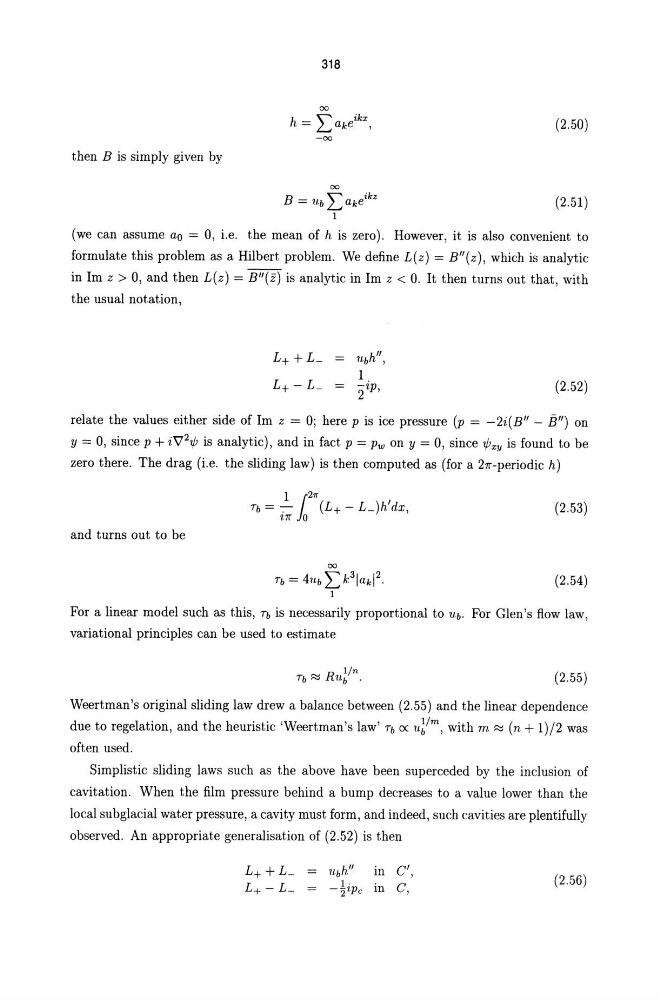
then B is simply given by
318
00
h
"
ikx
,= ~ake ,
-00
00
B
" i k z
= 1/'b ~ake
1
(2,50)
(2,51)
(we can assume ao = 0, Le, the mean of h is zero), However, it is also convenient to
formulate this problem as a Hilbert problem, We define L(z) = B"(Z), which is analytic
in 1m z > 0, and then L(z) = BII(Z) is analytic in 1m z < 0, It then turns out that, with
the usual notation,
1
"2 ip ,
(2,52)
relate the values either side of 1m z = 0; here p is ice pressure (p = -2i(B" - 13") on
y = 0, since p + i"V2'ljJ is analytic), and in fact p = Pw on Y = 0, since 'ljJxy is found to be
zero there, The drag (Le, the sliding law) is then computed as (for a 27r-periodic h)
and turns out to be
00
Tb = 4U,b I:: k 3 lakl 2 ,
1
(2,53)
(2,54)
For a linear model such as this, Tb is necessarily proportional to 1/,b, For Glen's flow law,
variational principles can be used to estimate
(2,55)
Weertman's original sliding law drew a balance between (2,55) and the linear dependence
due to regelation, and the heuristic 'Weertman's law' Tb oc l},i/ m , with m ~ (71, + 1)/2 was
often used,
Simplistic sliding laws such as the above have been superceded by the inclusion of
cavitation, When the film pressure behind a bump decreases to a value lower than the
local subglacial water pressure, a cavity must form, and indeed, such cavities are plentifully
observed, An appropriate generalisation of (2,52) is then
jJ'bh"
in C',
-~ipc III C,
(2.56)
318
00
h
"
ikx
,= ~ake ,
-00
00
B
" i k z
= 1/'b ~ake
1
(2,50)
(2,51)
(we can assume ao = 0, Le, the mean of h is zero), However, it is also convenient to
formulate this problem as a Hilbert problem, We define L(z) = B"(Z), which is analytic
in 1m z > 0, and then L(z) = BII(Z) is analytic in 1m z < 0, It then turns out that, with
the usual notation,
1
"2 ip ,
(2,52)
relate the values either side of 1m z = 0; here p is ice pressure (p = -2i(B" - 13") on
y = 0, since p + i"V2'ljJ is analytic), and in fact p = Pw on Y = 0, since 'ljJxy is found to be
zero there, The drag (Le, the sliding law) is then computed as (for a 27r-periodic h)
and turns out to be
00
Tb = 4U,b I:: k 3 lakl 2 ,
1
(2,53)
(2,54)
For a linear model such as this, Tb is necessarily proportional to 1/,b, For Glen's flow law,
variational principles can be used to estimate
(2,55)
Weertman's original sliding law drew a balance between (2,55) and the linear dependence
due to regelation, and the heuristic 'Weertman's law' Tb oc l},i/ m , with m ~ (71, + 1)/2 was
often used,
Simplistic sliding laws such as the above have been superceded by the inclusion of
cavitation, When the film pressure behind a bump decreases to a value lower than the
local subglacial water pressure, a cavity must form, and indeed, such cavities are plentifully
observed, An appropriate generalisation of (2,52) is then
jJ'bh"
in C',
-~ipc III C,
(2.56)