

317
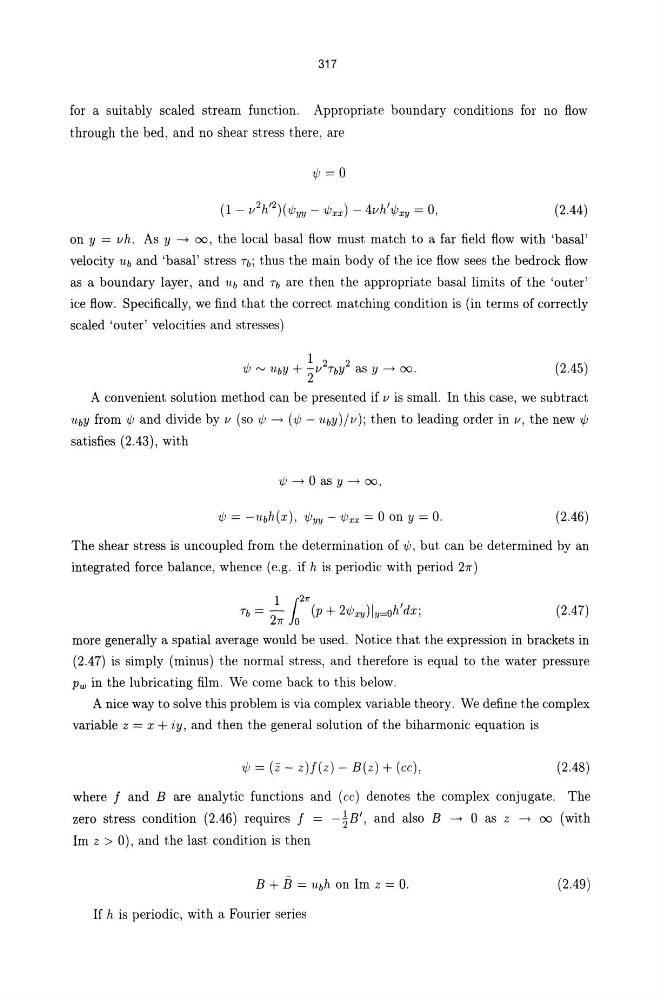
for a suitably scaled stream function. Appropriate boundary conditions for no flow
through the bed, and no shear stress there, are
(2.44)
on y = vh. As y ---+ 00, the local basal flow must match to a far field flow with 'basal'
velocity U,b and 'basal' stress Tb; thus the main body of the ice flow sees the bedrock flow
as a boundary layer, and U,b and Tb are then the appropriate basal limits of the 'outer'
ice flow. Specifically, we find that the correct matching condition is (in terms of correctly
scaled 'outer' velocities and stresses)
(2.45)
A convenient solution method can be presented if v is small. In this case, we subtract
U,bY from 'tj; and divide by v (so 'tj; ---+ (tj; - U,bY) / v); then to leading order in v, the new ' t/J
satisfies (2.43), with
' 1jJ ---+ 0 as Y ---+ 00,
(2.46)
The shear stress is uncoupled from the determination of 'tj;, but can be determined by an
integrated force balance, whence (e.g. if h is periodic with period 21T)
1 1021T
Tb = -
(p + 2'tj;x,,)I'I=oh'dx;
21T 0
" .
(2.47)
more generally a spatial average would be used. Notice that the expression in brackets in
(2.47) is simply (minus) the normal stress, and therefore is equal to the water pressure
Pw in the lubricating film. We come back to this below.
A nice way to solve this problem is via complex variable theory. We define the complex
variable z = x + iy, and then the general solution of the biharmonic equation is
'tj; = (2 - z)f(z) - B(z) + (cc),
(2.48)
where f and B are analytic functions and (cc) denotes the complex conjugate. The
zero stress condition (2.46) requires f = -!B', and also B ---+ 0 as z ---+ 00 (with
1m z > 0), and the last condition is then
B + B = 1J,bh on 1m z = O.
(2.49)
If h is periodic, with a Fourier series
for a suitably scaled stream function. Appropriate boundary conditions for no flow
through the bed, and no shear stress there, are
(2.44)
on y = vh. As y ---+ 00, the local basal flow must match to a far field flow with 'basal'
velocity U,b and 'basal' stress Tb; thus the main body of the ice flow sees the bedrock flow
as a boundary layer, and U,b and Tb are then the appropriate basal limits of the 'outer'
ice flow. Specifically, we find that the correct matching condition is (in terms of correctly
scaled 'outer' velocities and stresses)
(2.45)
A convenient solution method can be presented if v is small. In this case, we subtract
U,bY from 'tj; and divide by v (so 'tj; ---+ (tj; - U,bY) / v); then to leading order in v, the new ' t/J
satisfies (2.43), with
' 1jJ ---+ 0 as Y ---+ 00,
(2.46)
The shear stress is uncoupled from the determination of 'tj;, but can be determined by an
integrated force balance, whence (e.g. if h is periodic with period 21T)
1 1021T
Tb = -
(p + 2'tj;x,,)I'I=oh'dx;
21T 0
" .
(2.47)
more generally a spatial average would be used. Notice that the expression in brackets in
(2.47) is simply (minus) the normal stress, and therefore is equal to the water pressure
Pw in the lubricating film. We come back to this below.
A nice way to solve this problem is via complex variable theory. We define the complex
variable z = x + iy, and then the general solution of the biharmonic equation is
'tj; = (2 - z)f(z) - B(z) + (cc),
(2.48)
where f and B are analytic functions and (cc) denotes the complex conjugate. The
zero stress condition (2.46) requires f = -!B', and also B ---+ 0 as z ---+ 00 (with
1m z > 0), and the last condition is then
B + B = 1J,bh on 1m z = O.
(2.49)
If h is periodic, with a Fourier series