

314
2.2 Using the equations
Nonlinear diffusion
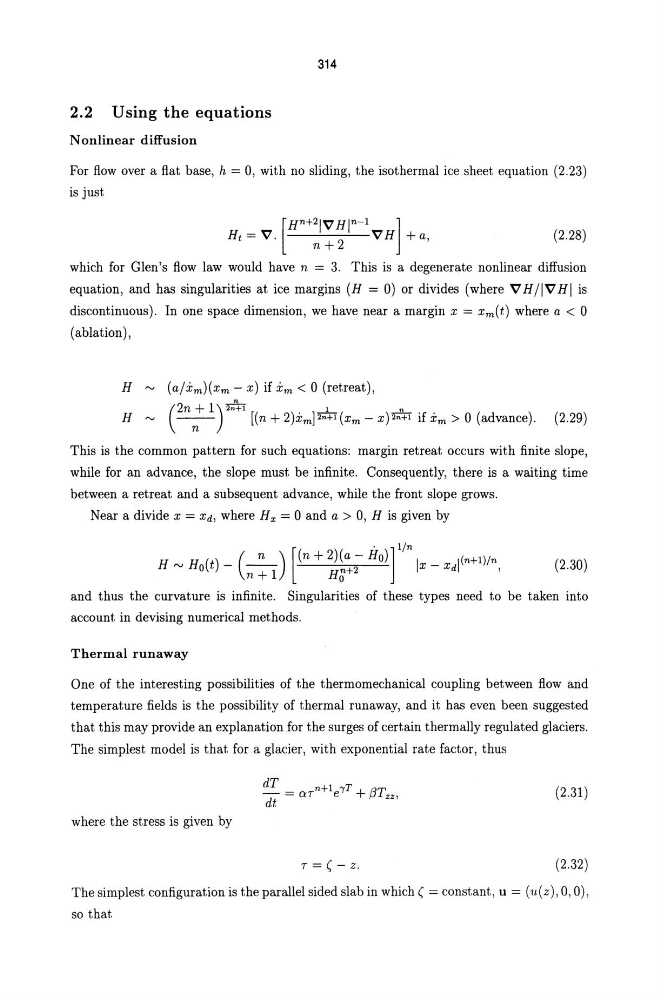
For flow over a flat base, h = 0, with no sliding, the isothermal ice sheet equation (2.23)
is just
(2.28)
which for Glen's flow law would have n = 3. This is a degenerate nonlinear diffusion
equation, and has singularities at ice margins (H = 0) or divides (where VH/IVHI is
discontinuous). In one space dimension, we have near a margin x = xm(t) where a < 0
( ablation),
H
(a/Xm)(Xm - x) if xm < 0 (retreat),
H
( 2n + 1)2n+1
1
n
-n[(n + 2)Xm]2n+1(Xm - X)2n+1 if Xm > 0 (advance). (2.29)
This is the common pattern for such equations: margin retreat occurs with finite slope,
while for an advance, the slope must be infinite. Consequently, there is a waiting time
between a retreat and a subsequent advance, while the front slope grows.
Near a divide x = Xd, where Hx = 0 and a > 0, H is given by
(2.30)
and thus the curvature is infinite. Singularities of these types need to be taken into
account in devising numerical methods.
Thermal runaway
One of the interesting possibilities of the thermomechanical coupling between flow and
temperature fields is the possibility of thermal runaway, and it has even been suggested
that this may provide an explanationJor the surges of certain thermally regulated glaciers.
The simplest model is that for a glacier, with exponential rate factor, thus
(2.31 )
where the stress is given by
T = ( - z.
(2.32)
The simplest configuration is the parallel sided slab in which ( = constant, u = (u(z), 0, 0),
so that
2.2 Using the equations
Nonlinear diffusion
For flow over a flat base, h = 0, with no sliding, the isothermal ice sheet equation (2.23)
is just
(2.28)
which for Glen's flow law would have n = 3. This is a degenerate nonlinear diffusion
equation, and has singularities at ice margins (H = 0) or divides (where VH/IVHI is
discontinuous). In one space dimension, we have near a margin x = xm(t) where a < 0
( ablation),
H
(a/Xm)(Xm - x) if xm < 0 (retreat),
H
( 2n + 1)2n+1
1
n
-n[(n + 2)Xm]2n+1(Xm - X)2n+1 if Xm > 0 (advance). (2.29)
This is the common pattern for such equations: margin retreat occurs with finite slope,
while for an advance, the slope must be infinite. Consequently, there is a waiting time
between a retreat and a subsequent advance, while the front slope grows.
Near a divide x = Xd, where Hx = 0 and a > 0, H is given by
(2.30)
and thus the curvature is infinite. Singularities of these types need to be taken into
account in devising numerical methods.
Thermal runaway
One of the interesting possibilities of the thermomechanical coupling between flow and
temperature fields is the possibility of thermal runaway, and it has even been suggested
that this may provide an explanationJor the surges of certain thermally regulated glaciers.
The simplest model is that for a glacier, with exponential rate factor, thus
(2.31 )
where the stress is given by
T = ( - z.
(2.32)
The simplest configuration is the parallel sided slab in which ( = constant, u = (u(z), 0, 0),
so that