

315
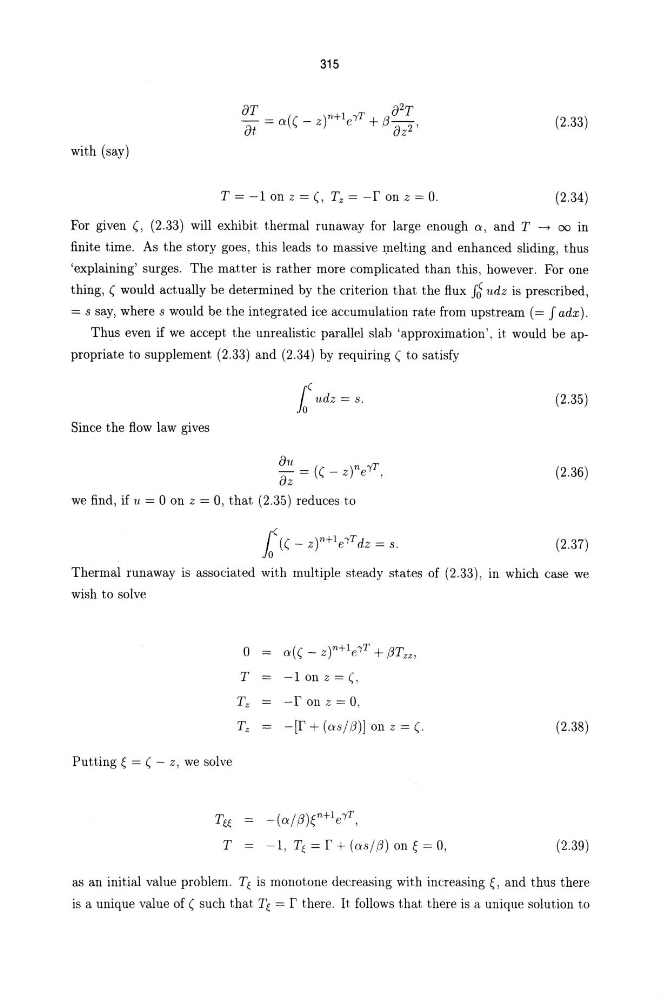
(2.33)
with (say)
T = -Ion z = (, Tz = -r on z = O.
(2.34)
For given (, (2.33) will exhibit thermal runaway for large enough Q, and T --> 00 in
finite time. As the story goes, this leads to massive r.nelting and enhanced sliding, thus
'explaining' surges. The matter is rather more complicated than this, however. For one
thing, ( would actually be determined by the criterion that the flux f~ ndz is prescribed,
= s say, where s would be the integrated ice accumulation rate from upstream (= f adx).
Thus even if we accept the unrealistic parallel slab 'approximation', it would be appropriate to supplement (2.33) and (2.34) by requiring ( to satisfy
Since the flow law gives
011
(
)n ~T
oz = ( - z e' ,
we find, if 11 = 0 on z = 0, that (2.35) reduces to
(2.35)
(2.36)
(2.37)
Thermal runaway is associated with multiple steady states of (2.33), in which case we
wish to solve
Putting ~ = ( - z, we solve
T~~
T
o
Q((-zr+le'YT +fJTzZ)
T
-Ion z = (,
Tz
-fonz=O,
-[f + (Qs/fJ)] on z = (.
_(Qj8)C+ 1 e'YT,
-1, T~ = r + (cYs/(J) on ~ = 0,
(2.38)
(2.39)
as an initial value problem. T~ is monotone decreasing with increasing ~, and thus there
is a unique value of ( such that T~ = r there. It follows that there is a unique solution to
(2.33)
with (say)
T = -Ion z = (, Tz = -r on z = O.
(2.34)
For given (, (2.33) will exhibit thermal runaway for large enough Q, and T --> 00 in
finite time. As the story goes, this leads to massive r.nelting and enhanced sliding, thus
'explaining' surges. The matter is rather more complicated than this, however. For one
thing, ( would actually be determined by the criterion that the flux f~ ndz is prescribed,
= s say, where s would be the integrated ice accumulation rate from upstream (= f adx).
Thus even if we accept the unrealistic parallel slab 'approximation', it would be appropriate to supplement (2.33) and (2.34) by requiring ( to satisfy
Since the flow law gives
011
(
)n ~T
oz = ( - z e' ,
we find, if 11 = 0 on z = 0, that (2.35) reduces to
(2.35)
(2.36)
(2.37)
Thermal runaway is associated with multiple steady states of (2.33), in which case we
wish to solve
Putting ~ = ( - z, we solve
T~~
T
o
Q((-zr+le'YT +fJTzZ)
T
-Ion z = (,
Tz
-fonz=O,
-[f + (Qs/fJ)] on z = (.
_(Qj8)C+ 1 e'YT,
-1, T~ = r + (cYs/(J) on ~ = 0,
(2.38)
(2.39)
as an initial value problem. T~ is monotone decreasing with increasing ~, and thus there
is a unique value of ( such that T~ = r there. It follows that there is a unique solution to