

313
Temperature
Although the isothermal models are mathematically nice, they are not quantitatively very
realistic. For a glacier, probably the neglect of variation of the rate parameter A(T) in
the flow law is as important as the assumption of a two-dimensional flow, although the
possible coupling of temperature to water production and basal sliding is also significant.
For ice sheets, temperature variation is unquestionably significant, and cannot in practice
be neglected.
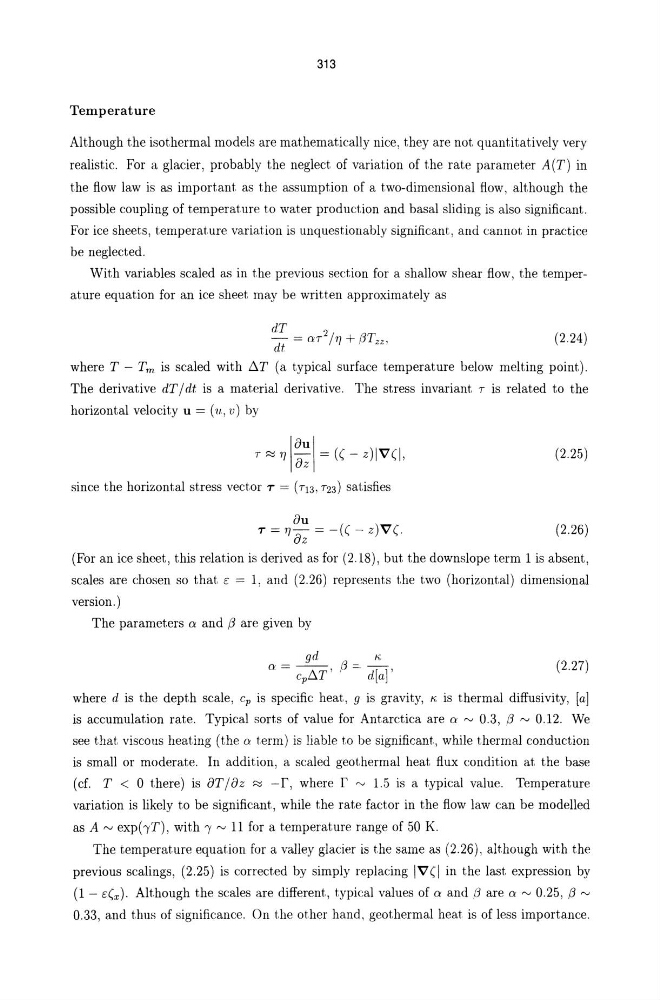
With variables scaled as in the previous section for a shallow shear flow, the temperature equation for an ice sheet may be written approximately as
dT
2
-d = aT /1] + {3Tzz ,
,t
(2.24)
where T - Tm is scaled with flT (a typical surface temperature below melting point).
The derivative dT / dt is a material derivative. The stress invariant T is related to the
horizontal velocity u = (11., v) by
T ~ 1] I~:I = (( - z)IV(I,
(2.25)
since the horizontal stress vector 7"' = (T13, T23) satisfies
8u
7"' = 1] 8z = -(( - z)V(.
(2.26)
(For an ice sheet, this relation is derived as for (2.18), but the downslope term 1 is absent,
scales are chosen so that E = 1, and (2.26) represents the two (horizontal) dimensional
version.)
The parameters a and {3 are given by
gd
K,
a = cpflT' {3 = d[aJ'
(2.27)
where d is the depth scale, cp is specific heat, g is gravity, K, is thermal diffusivity, [aJ
is accumulation rate. Typical sorts of value for Antarctica are a 'V 0.3, {3 'V 0.12. We
see that viscous heating (the a term) is liable to be significant, while thermal conduction
is small or moderate. In addition, a scaled geothermal heat flux condition at the base
(cf. T < 0 there) is 8T/8z ~ -r, where r 'V 1.5 is a typical value. Temperature
variation is likely to be significant, while the rate factor in the flow law can be modelled
as A 'V exp(-yT), with ' Y 'V 11 for a temperature range of 50 K.
The temperature equation for a valley glacier is the same as (2.26), although wit.h the
previous scalings, (2.25) is corrected by simply replacing IV (I in the last expression by
(1 - E(x). Although the scales are different, typical values of a and {3 are a 'V 0.25, {3 'V
0.33, and thus of significance. On the other hand, geothermal heat is of less importance.
Temperature
Although the isothermal models are mathematically nice, they are not quantitatively very
realistic. For a glacier, probably the neglect of variation of the rate parameter A(T) in
the flow law is as important as the assumption of a two-dimensional flow, although the
possible coupling of temperature to water production and basal sliding is also significant.
For ice sheets, temperature variation is unquestionably significant, and cannot in practice
be neglected.
With variables scaled as in the previous section for a shallow shear flow, the temperature equation for an ice sheet may be written approximately as
dT
2
-d = aT /1] + {3Tzz ,
,t
(2.24)
where T - Tm is scaled with flT (a typical surface temperature below melting point).
The derivative dT / dt is a material derivative. The stress invariant T is related to the
horizontal velocity u = (11., v) by
T ~ 1] I~:I = (( - z)IV(I,
(2.25)
since the horizontal stress vector 7"' = (T13, T23) satisfies
8u
7"' = 1] 8z = -(( - z)V(.
(2.26)
(For an ice sheet, this relation is derived as for (2.18), but the downslope term 1 is absent,
scales are chosen so that E = 1, and (2.26) represents the two (horizontal) dimensional
version.)
The parameters a and {3 are given by
gd
K,
a = cpflT' {3 = d[aJ'
(2.27)
where d is the depth scale, cp is specific heat, g is gravity, K, is thermal diffusivity, [aJ
is accumulation rate. Typical sorts of value for Antarctica are a 'V 0.3, {3 'V 0.12. We
see that viscous heating (the a term) is liable to be significant, while thermal conduction
is small or moderate. In addition, a scaled geothermal heat flux condition at the base
(cf. T < 0 there) is 8T/8z ~ -r, where r 'V 1.5 is a typical value. Temperature
variation is likely to be significant, while the rate factor in the flow law can be modelled
as A 'V exp(-yT), with ' Y 'V 11 for a temperature range of 50 K.
The temperature equation for a valley glacier is the same as (2.26), although wit.h the
previous scalings, (2.25) is corrected by simply replacing IV (I in the last expression by
(1 - E(x). Although the scales are different, typical values of a and {3 are a 'V 0.25, {3 'V
0.33, and thus of significance. On the other hand, geothermal heat is of less importance.