

17
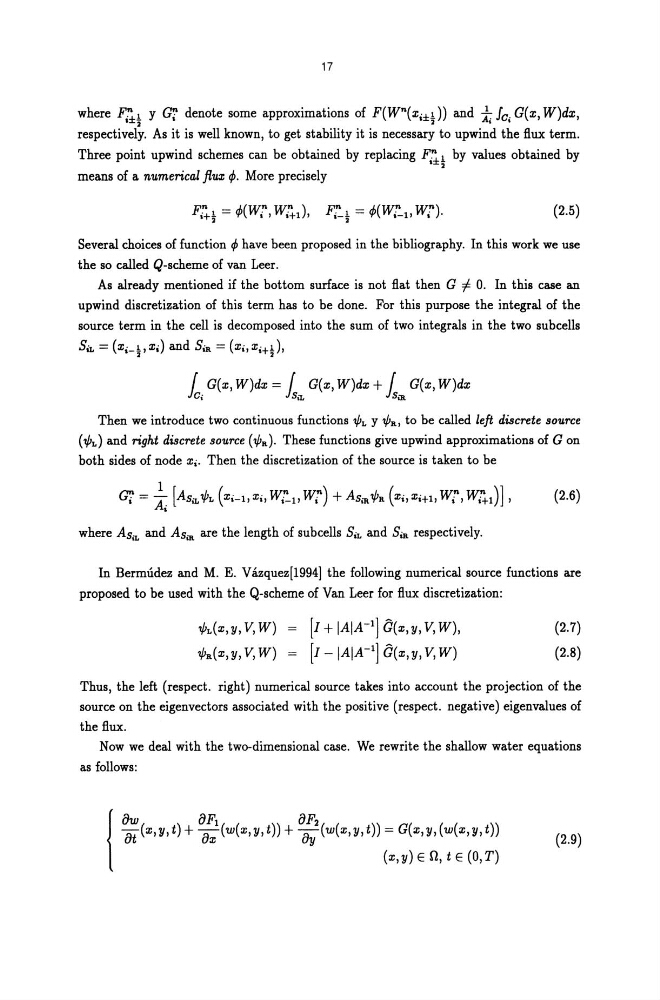
where ~~ y ar: denote some approximations of F(wn(xi±~)) and i fCi G(x, W)dx,
respectively. As it is well known, to get stability it is necessary to upwind the flux term.
Three point upwind schemes can be obtained by replacing ~1 by values obtained by
2
means of a numerical flux ifJ. More precisely
(2.5)
Several choices of function i fJ have been proposed in the bibliography. In this work we use
the so called Q-scheme of van Leer.
As already mentioned if the bottom surface is not flat then G f= O. In this case an
upwind discretization of this term has to be done. For this purpose the integral of the
source term in the cell is decomposed into the sum of two integrals in the two sub cells
SiL = (Xi_1,Xi) and SiR = (Xi'Xi+1),
2
2
[ G(z, W)dx = [ G(x, W)dx + [ G(x, W)dx
lCi
lSiL
lSiR
Then we introduce two continuous functions 1f;.. y ' ifJa, to be called left discrete source
(1f;..) and right discrete source ('ifJa). These functions give upwind approximations of G on
both sides of node Xi. Then the discretization of the source is taken to be
where ASiL and ASiR are the length of sub cells SiL and SiR respectively.
In Bermudez and M. E. Vazquez[1994] the following numerical source functions are
proposed to be used with the Q-scheme of Van Leer for flux discretization:
1f;..(x,y, v, W)
'ifJa(z,y, V, W)
[1 + IAIA- I ] G(z,y, V, W),
[1 -IAIKI] G(x,y, V, W)
(2.7)
(2.8)
Thus, the left (respect. right) numerical source takes into account the projection of the
source on the eigenvectors associated with the positive (respect. negative) eigenvalues of
the flux.
Now we deal with the two-dimensional case. We rewrite the shallow water equations
as follows:
l
ow
OFI
oF2
"8t(X,y, t) + a;(W(X,y, t)) + 81/(W(X' y, t)) = G(x, y, (w(:z:, y, t))
(x,y) E fl, t E (O,T)
(2.9)
where ~~ y ar: denote some approximations of F(wn(xi±~)) and i fCi G(x, W)dx,
respectively. As it is well known, to get stability it is necessary to upwind the flux term.
Three point upwind schemes can be obtained by replacing ~1 by values obtained by
2
means of a numerical flux ifJ. More precisely
(2.5)
Several choices of function i fJ have been proposed in the bibliography. In this work we use
the so called Q-scheme of van Leer.
As already mentioned if the bottom surface is not flat then G f= O. In this case an
upwind discretization of this term has to be done. For this purpose the integral of the
source term in the cell is decomposed into the sum of two integrals in the two sub cells
SiL = (Xi_1,Xi) and SiR = (Xi'Xi+1),
2
2
[ G(z, W)dx = [ G(x, W)dx + [ G(x, W)dx
lCi
lSiL
lSiR
Then we introduce two continuous functions 1f;.. y ' ifJa, to be called left discrete source
(1f;..) and right discrete source ('ifJa). These functions give upwind approximations of G on
both sides of node Xi. Then the discretization of the source is taken to be
where ASiL and ASiR are the length of sub cells SiL and SiR respectively.
In Bermudez and M. E. Vazquez[1994] the following numerical source functions are
proposed to be used with the Q-scheme of Van Leer for flux discretization:
1f;..(x,y, v, W)
'ifJa(z,y, V, W)
[1 + IAIA- I ] G(z,y, V, W),
[1 -IAIKI] G(x,y, V, W)
(2.7)
(2.8)
Thus, the left (respect. right) numerical source takes into account the projection of the
source on the eigenvectors associated with the positive (respect. negative) eigenvalues of
the flux.
Now we deal with the two-dimensional case. We rewrite the shallow water equations
as follows:
l
ow
OFI
oF2
"8t(X,y, t) + a;(W(X,y, t)) + 81/(W(X' y, t)) = G(x, y, (w(:z:, y, t))
(x,y) E fl, t E (O,T)
(2.9)