

16
done in some more recent papers (Fennema and Chaudhry[1990]' Alcrudo and GarciaNavarro[1993], Glaister[1994]). In Bermudez & Vazquez [1994] some flux vector and flux
difference splitting methods, introduced in the last decade for solving the Euler equations,
are extended to solve systems of nonlinear hyperbolics equations with source and in particular to the shallow water equations for a variable-depth domain. We summarize this
work in what follows.
2.1.1 Finite volume methods
Let us notice that the shallow water equations is a nonlinear system of hyperbolic partial
differential equations and hence similar to the Euler equations for aerodynamics. However,
if bottom is not flat, they include a source term even if Coriolis, wind stress and bottom
friction effects are neglected.
This source term is responsible for the presence of spurious numerical waves when
it is discretized in a centred way. This phenomena has been shown in Bermudez and
Vazquez[1994] where an upwind discretization of the source term has been proposed as
a remedy. In some sense, the source term is upwinded in a similar way as the numerical
flux so it leads to different expressions for each method. For the sake of simplicity we
give first the basic ideas in the one dimensional case and neglect Coriolis, wind stress and
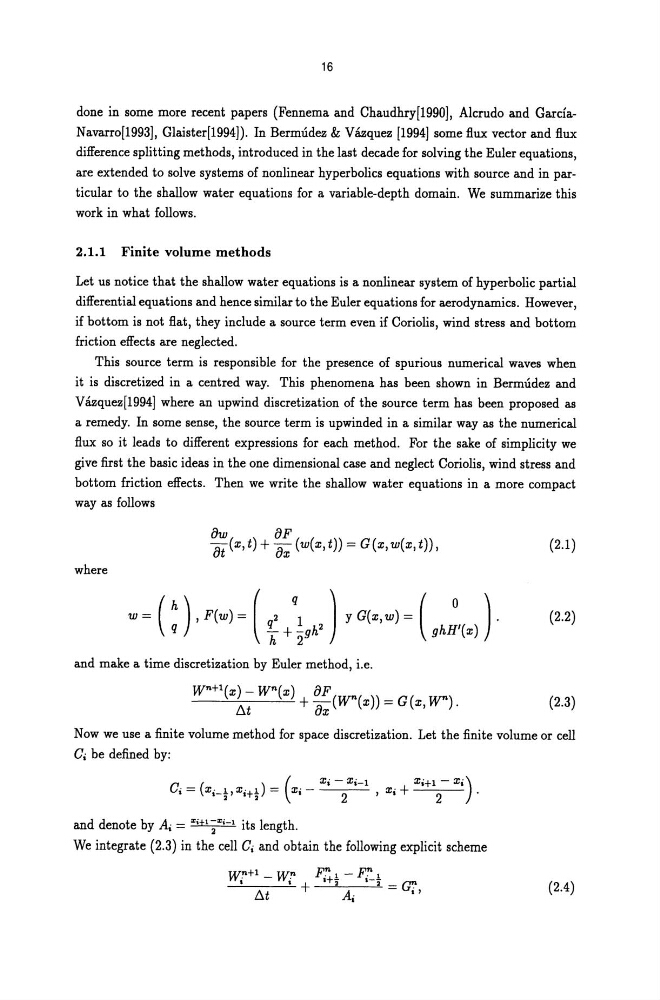
bottom friction effects. Then we write the shallow water equations in a more compact
way as follows
Ow
of
&(:c,t)+ o:c (w(:c,t)) = G(:c,w(:c,t)),
(2.1 )
where
w = ( h ) , F(w) = (q2 q1 ) y G(x,w) = ( 0 ) .
(2.2)
q
- + _gh 2
ghH'(x)
h
2
and make a time discretization by Euler method, i.e.
(2.3)
Now we use a finite volume method for space discretization. Let the finite volume or cell
Ci be defined by:
and denote by Ai = "'itl ;"'i-I its length.
We integrate (2.3) in the cell Ci and obtain the following explicit scheme
(2.4)
done in some more recent papers (Fennema and Chaudhry[1990]' Alcrudo and GarciaNavarro[1993], Glaister[1994]). In Bermudez & Vazquez [1994] some flux vector and flux
difference splitting methods, introduced in the last decade for solving the Euler equations,
are extended to solve systems of nonlinear hyperbolics equations with source and in particular to the shallow water equations for a variable-depth domain. We summarize this
work in what follows.
2.1.1 Finite volume methods
Let us notice that the shallow water equations is a nonlinear system of hyperbolic partial
differential equations and hence similar to the Euler equations for aerodynamics. However,
if bottom is not flat, they include a source term even if Coriolis, wind stress and bottom
friction effects are neglected.
This source term is responsible for the presence of spurious numerical waves when
it is discretized in a centred way. This phenomena has been shown in Bermudez and
Vazquez[1994] where an upwind discretization of the source term has been proposed as
a remedy. In some sense, the source term is upwinded in a similar way as the numerical
flux so it leads to different expressions for each method. For the sake of simplicity we
give first the basic ideas in the one dimensional case and neglect Coriolis, wind stress and
bottom friction effects. Then we write the shallow water equations in a more compact
way as follows
Ow
of
&(:c,t)+ o:c (w(:c,t)) = G(:c,w(:c,t)),
(2.1 )
where
w = ( h ) , F(w) = (q2 q1 ) y G(x,w) = ( 0 ) .
(2.2)
q
- + _gh 2
ghH'(x)
h
2
and make a time discretization by Euler method, i.e.
(2.3)
Now we use a finite volume method for space discretization. Let the finite volume or cell
Ci be defined by:
and denote by Ai = "'itl ;"'i-I its length.
We integrate (2.3) in the cell Ci and obtain the following explicit scheme
(2.4)