

290
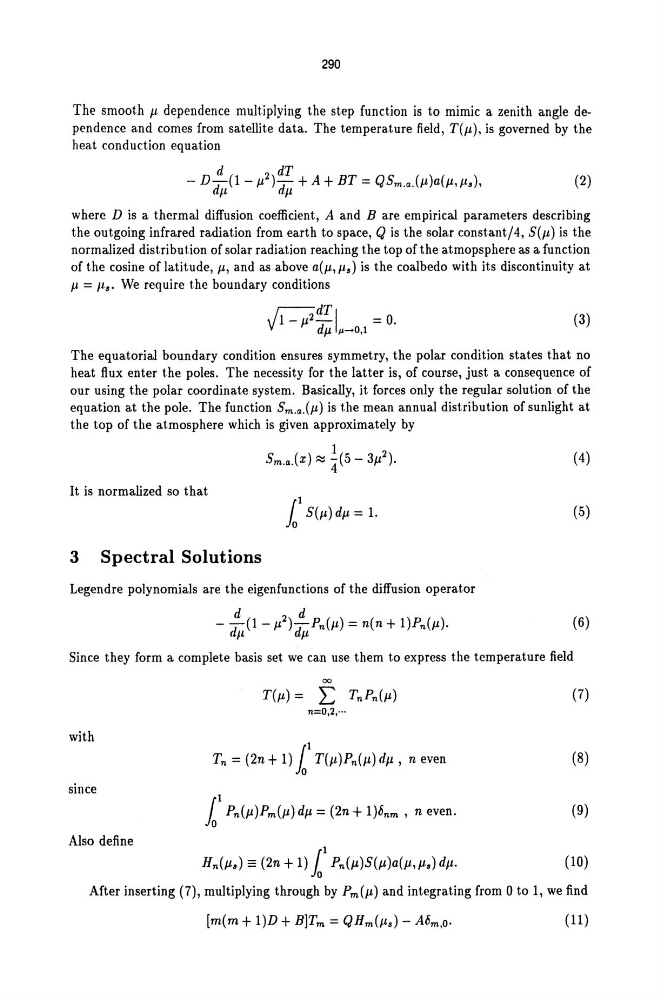
The smooth Jl dependence multiplying the step function is to mimic a zenith angle dependence and comes from satellite data. The temperature field, T(Jl), is governed by the
heat conduction equation
d
2 dT
-DdJl(l-p )dp +A+BT=QSm.a.(p)a(p,Jt.),
(2)
where D is a thermal diffusion coefficient, A and B are empirical parameters describing
the outgoing infrared radiation from earth to space, Q is the sola,r constant/4, S(p) is the
normalized distribut.ion of solar radiation reaching the top of the atmopsphere as a function
of the cosine of latitude, p, and as above a(p, Jt.) is the coalbedo with its discontinuity at
p = J1 •• We require the boundary conditions
~dTI
=0.
V 1 - p- dp 1'-0,1
(3)
The equatorial boundary condition ensures symmetry, the polar condition states that no
heat flux enter the poles. The necessity for the latter is, of course, just a consequence of
our using the polar coordinate system. Basically, it forces only the regular solution of the
equation at the pole. The function Sm.a.(P) is the mean annual distribution of sunlight at
the top of the atmosphere which is given approximately by
(4)
It is normalized so that
l S(p)dp= 1.
(5)
3 Spectral Solutions
Legendre polynomials are the eigenfunctions of the diffusion operator
(6)
Since they form a complete basis set we can use them to express the temperature field
with
since
Also define
00
T(p) = E TnPn(P)
n=O,2,··
Tn = (2n + 1) l T(p)Pn(P) dJl , n even
l Pn(p)Pm(P) dJL = (2n + 1)6nm , n even.
Hn(JL.) == (2n + 1) l Pn(Jl)S(JL)a(JL,Jl.)dJL.
(7)
(8)
(9)
(10)
After inserting (7), multiplying through by Pm(Jl) and integrating from 0 to 1, we find
[m(m + l)D + B]Tm = QHm(Jl.) - Ac5m,o.
(11)
The smooth Jl dependence multiplying the step function is to mimic a zenith angle dependence and comes from satellite data. The temperature field, T(Jl), is governed by the
heat conduction equation
d
2 dT
-DdJl(l-p )dp +A+BT=QSm.a.(p)a(p,Jt.),
(2)
where D is a thermal diffusion coefficient, A and B are empirical parameters describing
the outgoing infrared radiation from earth to space, Q is the sola,r constant/4, S(p) is the
normalized distribut.ion of solar radiation reaching the top of the atmopsphere as a function
of the cosine of latitude, p, and as above a(p, Jt.) is the coalbedo with its discontinuity at
p = J1 •• We require the boundary conditions
~dTI
=0.
V 1 - p- dp 1'-0,1
(3)
The equatorial boundary condition ensures symmetry, the polar condition states that no
heat flux enter the poles. The necessity for the latter is, of course, just a consequence of
our using the polar coordinate system. Basically, it forces only the regular solution of the
equation at the pole. The function Sm.a.(P) is the mean annual distribution of sunlight at
the top of the atmosphere which is given approximately by
(4)
It is normalized so that
l S(p)dp= 1.
(5)
3 Spectral Solutions
Legendre polynomials are the eigenfunctions of the diffusion operator
(6)
Since they form a complete basis set we can use them to express the temperature field
with
since
Also define
00
T(p) = E TnPn(P)
n=O,2,··
Tn = (2n + 1) l T(p)Pn(P) dJl , n even
l Pn(p)Pm(P) dJL = (2n + 1)6nm , n even.
Hn(JL.) == (2n + 1) l Pn(Jl)S(JL)a(JL,Jl.)dJL.
(7)
(8)
(9)
(10)
After inserting (7), multiplying through by Pm(Jl) and integrating from 0 to 1, we find
[m(m + l)D + B]Tm = QHm(Jl.) - Ac5m,o.
(11)