

Small ice caps in climate models
Gerald R. North, Kwang-Yul Kin,
Climate System Research Program,
Texas A&M University,
College Station, TX 77843-3150,
USA
Wan-Ho Lee,
Scripps Oceanographics Istitution,
University of California, San Diego,
La Jolla , California,
USA
1 Introduction
The presence of ice or snow at the surface of the Earth changes the reflectivity of the
system to sunlight. When the planet is made colder by changing some control parameter
such as the solar constant, ice caps grow; moreover, the increased reflectivity (albedo) of
the ice-covered surface causes an enhancement. of the cooling. The effect of t he ice-cap
growt.h is to amplify the effects of an externally induced climate change. The ice-albedo
mechanism is a positive feedback in the climate system. The climate system has many
feedbacks, positive and negative. They play various roles in forced climate change. This
lecture will concentrate on the effect.s of that one isolated feedback, since in this simplified
form the problem becomes tractable and quasi-analytical solutions can be found.
The ice-albedo feedback mechanism is a nonlinear phenomenon which leads to multiple
solutions to the governing equations for fixed, prescribed values of the control parameters
and boundary conditions. The number of these solutions, their stability, their behavior
in the presence of noise and finally their relevance to the real physical system and its
history, are of great interest in climate dynamics. We will focus on one class of solutions
which have small ice caps and try to understand how they work and their relevance to
real climate.
2 Ice-Cap Models
The simplest climate models which include a latitudinal dimension are the mean annual
energy balance models. Consider a north-south symmetric planet with no zonal features.
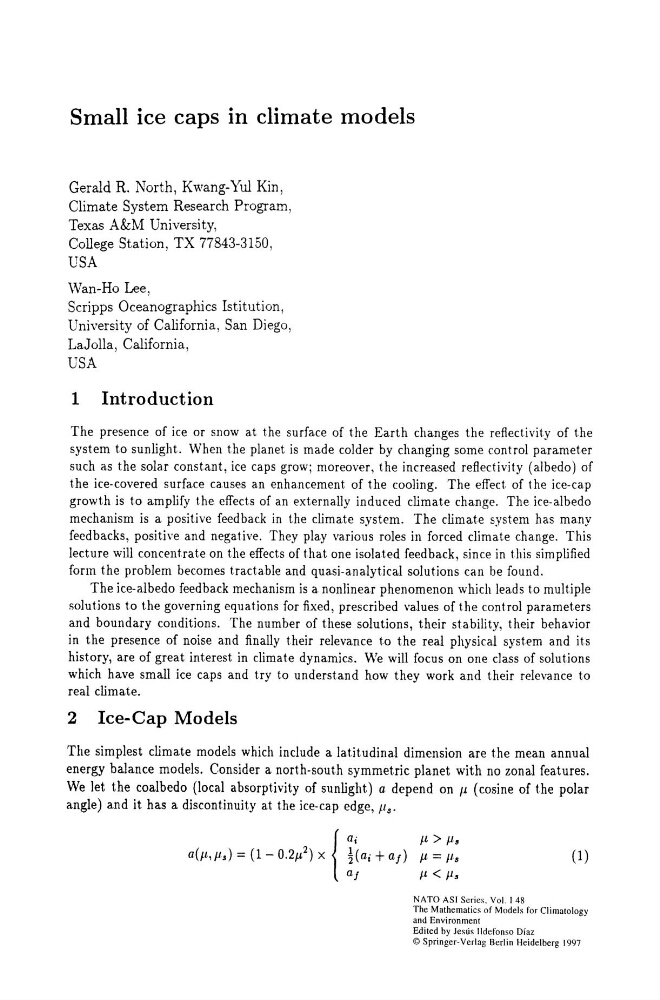
We let the coalbedo (local absorpt.ivity of sunlight) a depend on J1 (cosine of the polar
angle) and it has a discont.inuity at t.he ice-cap edge, Ps(1)
NATO AS! Series. Vol. ! 48
The Mathematics of Models for Climatology
and Environment
Edited by Jesus lIdefonso Diaz
© Springer- Verlag Berlin Heidelberg 1997
Gerald R. North, Kwang-Yul Kin,
Climate System Research Program,
Texas A&M University,
College Station, TX 77843-3150,
USA
Wan-Ho Lee,
Scripps Oceanographics Istitution,
University of California, San Diego,
La Jolla , California,
USA
1 Introduction
The presence of ice or snow at the surface of the Earth changes the reflectivity of the
system to sunlight. When the planet is made colder by changing some control parameter
such as the solar constant, ice caps grow; moreover, the increased reflectivity (albedo) of
the ice-covered surface causes an enhancement. of the cooling. The effect of t he ice-cap
growt.h is to amplify the effects of an externally induced climate change. The ice-albedo
mechanism is a positive feedback in the climate system. The climate system has many
feedbacks, positive and negative. They play various roles in forced climate change. This
lecture will concentrate on the effect.s of that one isolated feedback, since in this simplified
form the problem becomes tractable and quasi-analytical solutions can be found.
The ice-albedo feedback mechanism is a nonlinear phenomenon which leads to multiple
solutions to the governing equations for fixed, prescribed values of the control parameters
and boundary conditions. The number of these solutions, their stability, their behavior
in the presence of noise and finally their relevance to the real physical system and its
history, are of great interest in climate dynamics. We will focus on one class of solutions
which have small ice caps and try to understand how they work and their relevance to
real climate.
2 Ice-Cap Models
The simplest climate models which include a latitudinal dimension are the mean annual
energy balance models. Consider a north-south symmetric planet with no zonal features.
We let the coalbedo (local absorpt.ivity of sunlight) a depend on J1 (cosine of the polar
angle) and it has a discont.inuity at t.he ice-cap edge, Ps(1)
NATO AS! Series. Vol. ! 48
The Mathematics of Models for Climatology
and Environment
Edited by Jesus lIdefonso Diaz
© Springer- Verlag Berlin Heidelberg 1997