

12
Pi denotes a horizontal eddy difi'usivity and ri and Si represent the contributions to species
i into the water column from biochemical reactions and from external discharges and
sedimentation respectively.
In what follows we consider two very simple and useful models: one for dispersion
of pathogenic microoorganisms and another one for coupled evolution of the so-called
biochemical ozigen demand and dissolved ozigen.
Pathogenic microorganisms
Wastewaters contain a great variety of pathogenic bacterias and viruses. Control of
biological pollution is usually done in terms of existence of faecal coliphorIDS because its
concentration in domestic wastewater is much greater than that of other microorganisms.
After discharge, concentration of bacterias or viruses decreases very quickly due to
unfavourable conditions like lack of nutrients, low temperatures, sun rays, etc.
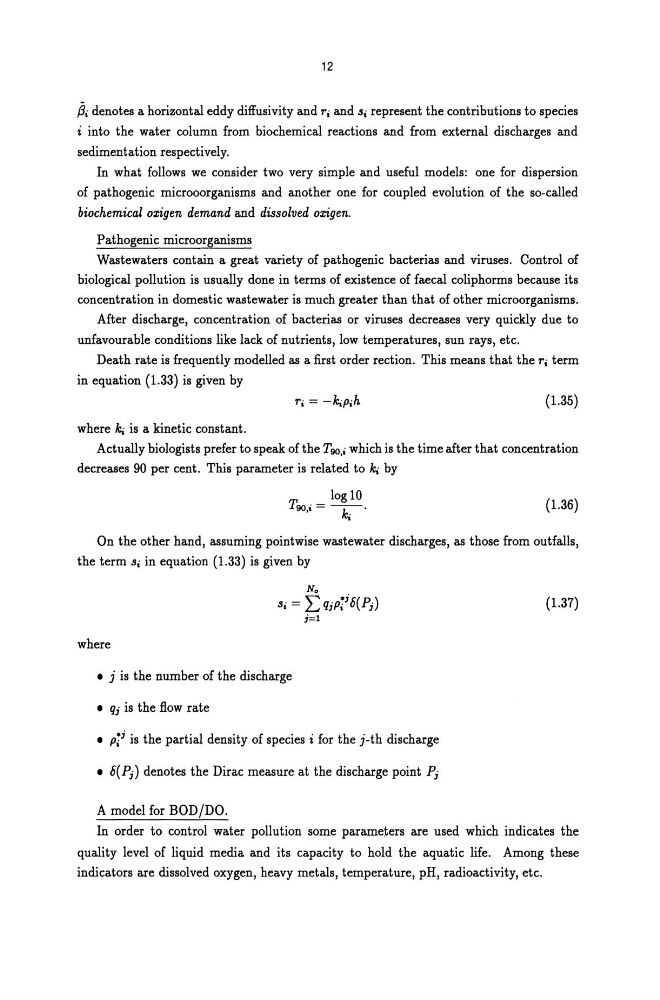
Death rate is frequently modelled as a first order rection. This means that the ri term
in equation (1.33) is given by
(1.35)
where Ie; is a kinetic constant.
Actually biologists prefer to speak of the T90,i which is the time after that concentration
decreases 90 per cent. This parameter is related to Ie; by
(1.36)
On the other hand, assuming pointwise wastewater discharges, as those from outfalls,
the term Si in equation (1.33) is given by
N.
Si = L q;p;;6(P;)
(1.37)
;=1
where
• j is the number of the discharge
• q; is the flow rate
• p;; is the partial density of species i for the j-th discharge
• 5( P;) denotes the Dirac measure at the discharge point P;
A model for BOD/DO.
In order to control water pollution some parameters are used which indicates the
quality level of liquid media and its capacity to hold the aquatic life. Among these
indicators are dissolved oxygen, heavy metals, temperature, pH, radioactivity, etc.
Pi denotes a horizontal eddy difi'usivity and ri and Si represent the contributions to species
i into the water column from biochemical reactions and from external discharges and
sedimentation respectively.
In what follows we consider two very simple and useful models: one for dispersion
of pathogenic microoorganisms and another one for coupled evolution of the so-called
biochemical ozigen demand and dissolved ozigen.
Pathogenic microorganisms
Wastewaters contain a great variety of pathogenic bacterias and viruses. Control of
biological pollution is usually done in terms of existence of faecal coliphorIDS because its
concentration in domestic wastewater is much greater than that of other microorganisms.
After discharge, concentration of bacterias or viruses decreases very quickly due to
unfavourable conditions like lack of nutrients, low temperatures, sun rays, etc.
Death rate is frequently modelled as a first order rection. This means that the ri term
in equation (1.33) is given by
(1.35)
where Ie; is a kinetic constant.
Actually biologists prefer to speak of the T90,i which is the time after that concentration
decreases 90 per cent. This parameter is related to Ie; by
(1.36)
On the other hand, assuming pointwise wastewater discharges, as those from outfalls,
the term Si in equation (1.33) is given by
N.
Si = L q;p;;6(P;)
(1.37)
;=1
where
• j is the number of the discharge
• q; is the flow rate
• p;; is the partial density of species i for the j-th discharge
• 5( P;) denotes the Dirac measure at the discharge point P;
A model for BOD/DO.
In order to control water pollution some parameters are used which indicates the
quality level of liquid media and its capacity to hold the aquatic life. Among these
indicators are dissolved oxygen, heavy metals, temperature, pH, radioactivity, etc.