

11
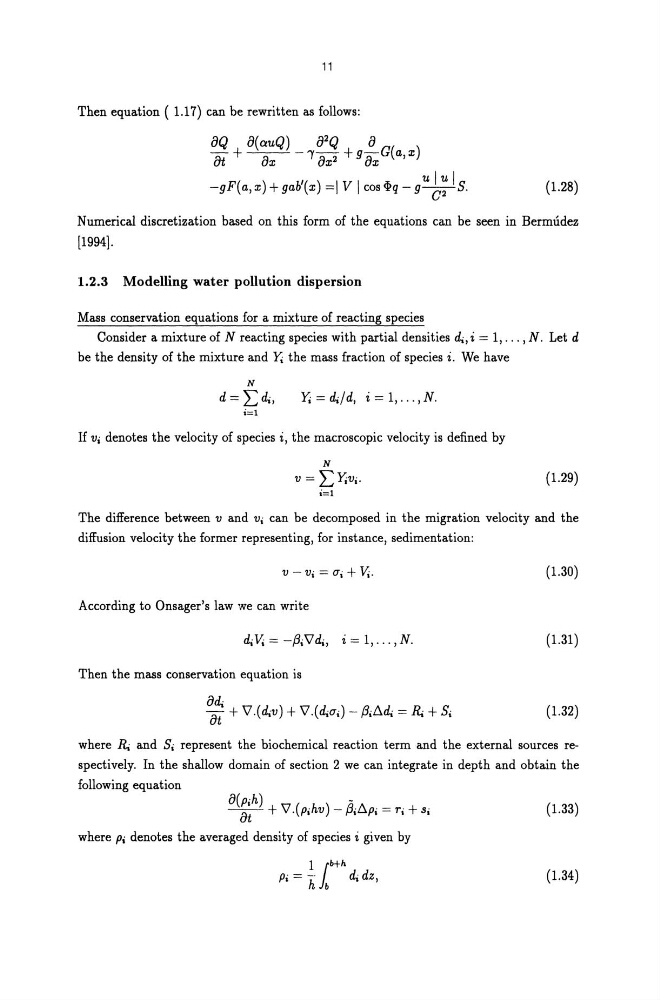
Then equation ( 1.17) can be rewritten as follows:
8Q 8(auQ)
8 2 Q
8
at + --a;- - ' Y 8x2 + g 8x G( a, x)
-gF(a, x) + gab'(x) =1 V 1 cos ~q - g u b~ 1 S.
(1.28)
Numerical discretization based on this form of the equations can be seen in Bermudez
[1994].
1.2.3 Modelling water pollution dispersion
Mass conservation equations for a mixture of reacting species
Consider a mixture of N reacting species with partial densities d;, i = 1, ... ,N. Let d
be the density of the mixture and li the mass fraction of species i. We have
li = d;/d, i = 1, ... ,N.
If Vi denotes the velocity of species i, the macroscopic velocity is defined by
N
V = L:liVi.
i=l
(1.29)
The difference between v and Vi can be decomposed in the migration velocity and the
diffusion velocity the former representing, for instance, sedimentation:
v - Vi = Ui + Vi.
(1.30)
According to Onsager's law we can write
d;Vi=-f3Nd;, i=I, ... ,N.
(1.31 )
Then the mass conservation equation is
8d;
fit + V.(d.;v) + V.(d;Ui) - f3Jld.; = R. + Si
(1.32)
where R. and Si represent the biochemical reaction term and the external sources respectively. In the shallow domain of section 2 we can integrate in depth and obtain the
following equation
8(pih)
-
---at + V·(Pi hv ) - f3i APi = Ti + Si
(1.33)
where Pi denotes the averaged density of species i given by
1 fb+ h
Pi = h Jb d; dz,
(1.34)
Then equation ( 1.17) can be rewritten as follows:
8Q 8(auQ)
8 2 Q
8
at + --a;- - ' Y 8x2 + g 8x G( a, x)
-gF(a, x) + gab'(x) =1 V 1 cos ~q - g u b~ 1 S.
(1.28)
Numerical discretization based on this form of the equations can be seen in Bermudez
[1994].
1.2.3 Modelling water pollution dispersion
Mass conservation equations for a mixture of reacting species
Consider a mixture of N reacting species with partial densities d;, i = 1, ... ,N. Let d
be the density of the mixture and li the mass fraction of species i. We have
li = d;/d, i = 1, ... ,N.
If Vi denotes the velocity of species i, the macroscopic velocity is defined by
N
V = L:liVi.
i=l
(1.29)
The difference between v and Vi can be decomposed in the migration velocity and the
diffusion velocity the former representing, for instance, sedimentation:
v - Vi = Ui + Vi.
(1.30)
According to Onsager's law we can write
d;Vi=-f3Nd;, i=I, ... ,N.
(1.31 )
Then the mass conservation equation is
8d;
fit + V.(d.;v) + V.(d;Ui) - f3Jld.; = R. + Si
(1.32)
where R. and Si represent the biochemical reaction term and the external sources respectively. In the shallow domain of section 2 we can integrate in depth and obtain the
following equation
8(pih)
-
---at + V·(Pi hv ) - f3i APi = Ti + Si
(1.33)
where Pi denotes the averaged density of species i given by
1 fb+ h
Pi = h Jb d; dz,
(1.34)