

10
• q(x, t) is the flow rate per unit length of external discharges at point x and time t
from effluents, rain, etc.,
• V(x, t) is the velocity of this flow,
• q. is the angle between the vector V and the river,
• a is a shape function,
• ' Y is a dispersion coefficient,
• 9 is gravity,
• C is the Chezy coefficient,
• S(x, t) is the length of the wet perimeter of the section n(x, t).
We also have boundary and initial conditions. Assume for instance
Q(O, t) = fo(t)
Q(L, t) = fL(t)
a(x,O) = ao(x)
Q(x,O) = Qo(x).
(1.19)
(1.20)
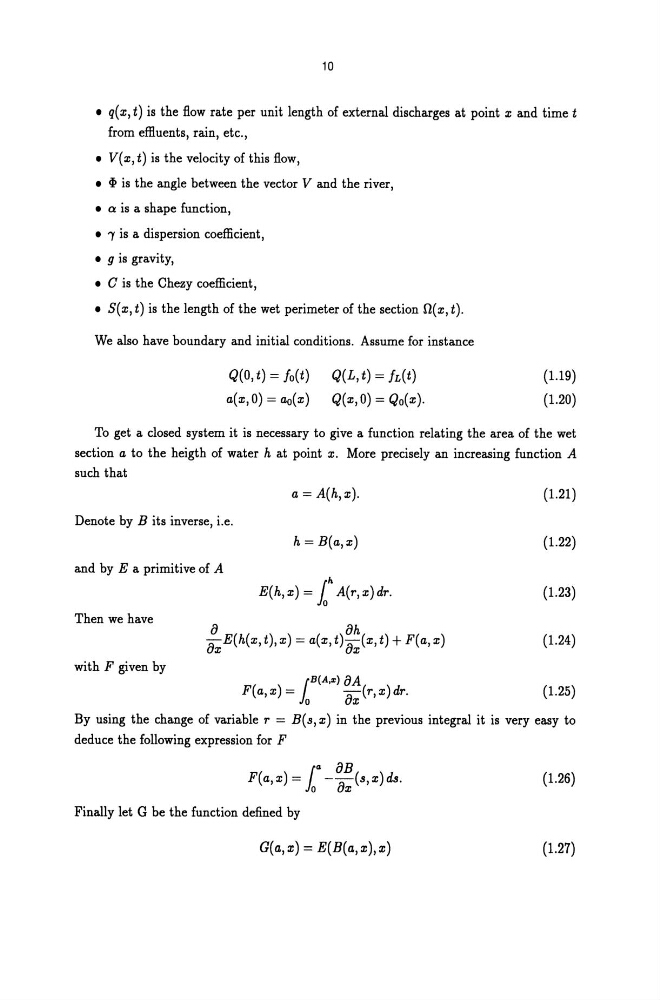
To get a closed system it is necessary to give a function relating the area of the wet
section a to the heigth of water h at point x. More precisely an increasing function A
such that
a = A(h,x).
(1.21 )
Denote by B its inverse, i.e.
h = B(a,x)
(1.22)
and by E a primitive of A
E(h,x) = [ A(r, x) dr.
(1.23)
Then we have
o
oh
ox E(h(x, t), x) = a(x, t) ox(x, t) + F(a, x)
(1.24)
with F given by
[B(A,.,) oA
F(a,x)=Jo
ox (r,x) dr.
(1.25)
By using the change of variable r = B( s, x) in the previous integral it is very easy to
deduce the following expression for F
[a oB
F(a,x) = Jo - ox(s,x)ds.
(1.26)
Finally let G be the function defined by
G(a,x) = E(B(a,x),x)
(1.27)
• q(x, t) is the flow rate per unit length of external discharges at point x and time t
from effluents, rain, etc.,
• V(x, t) is the velocity of this flow,
• q. is the angle between the vector V and the river,
• a is a shape function,
• ' Y is a dispersion coefficient,
• 9 is gravity,
• C is the Chezy coefficient,
• S(x, t) is the length of the wet perimeter of the section n(x, t).
We also have boundary and initial conditions. Assume for instance
Q(O, t) = fo(t)
Q(L, t) = fL(t)
a(x,O) = ao(x)
Q(x,O) = Qo(x).
(1.19)
(1.20)
To get a closed system it is necessary to give a function relating the area of the wet
section a to the heigth of water h at point x. More precisely an increasing function A
such that
a = A(h,x).
(1.21 )
Denote by B its inverse, i.e.
h = B(a,x)
(1.22)
and by E a primitive of A
E(h,x) = [ A(r, x) dr.
(1.23)
Then we have
o
oh
ox E(h(x, t), x) = a(x, t) ox(x, t) + F(a, x)
(1.24)
with F given by
[B(A,.,) oA
F(a,x)=Jo
ox (r,x) dr.
(1.25)
By using the change of variable r = B( s, x) in the previous integral it is very easy to
deduce the following expression for F
[a oB
F(a,x) = Jo - ox(s,x)ds.
(1.26)
Finally let G be the function defined by
G(a,x) = E(B(a,x),x)
(1.27)