

9
h(x ,t} 1
_m-tT
b(x)
!
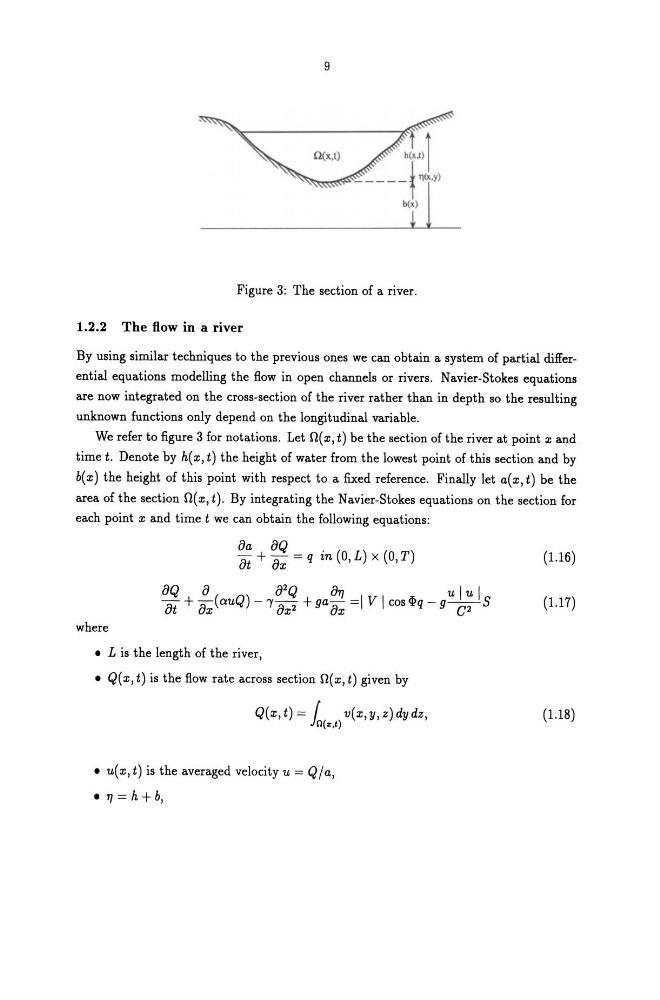
Figure 3: The section of a river.
1.2.2 The How in a river
By using similar techniques to the previous ones we can obtain a system of partial differential equations modelling the flow in open channels or rivers . Navier-Stokes equations
are now integrated on the cross-section of the river rather than in depth so the resulting
unknown functions only depend on the longitudinal variable.
We refer to figure 3 for notations . Let n(x, t) be the section of the river at point x and
time t. Denote by h(x, t) the height of water from the lowest point of this section and by
b( x) the height of this point with respect to a fixed reference. Finally let a( x, t) be the
area of the section n(x, t). By integrating the Navier-Stokes equations on the section for
each point x and time t we can obtain the following equations:
8a 8Q
.
8t + 8x = q m (0,£) x (O,T)
8Q
8
8 2 Q
87]
u 1 u 1
at + 8x(au Q ) - , 8x2 + ga ax =1 v 1 coscI>q - gC2 S
where
• £ is the length of the river,
• Q(x, t) is the flow rate across section n(x, t) given by
Q(x,t) = (
v(x,y,z)dydz,
JO(."I)
• u( x, t) is the averaged velocity u = Q / a,
• 7] = h + b,
(1.16)
(1.17)
(1.18)
h(x ,t} 1
_m-tT
b(x)
!
Figure 3: The section of a river.
1.2.2 The How in a river
By using similar techniques to the previous ones we can obtain a system of partial differential equations modelling the flow in open channels or rivers . Navier-Stokes equations
are now integrated on the cross-section of the river rather than in depth so the resulting
unknown functions only depend on the longitudinal variable.
We refer to figure 3 for notations . Let n(x, t) be the section of the river at point x and
time t. Denote by h(x, t) the height of water from the lowest point of this section and by
b( x) the height of this point with respect to a fixed reference. Finally let a( x, t) be the
area of the section n(x, t). By integrating the Navier-Stokes equations on the section for
each point x and time t we can obtain the following equations:
8a 8Q
.
8t + 8x = q m (0,£) x (O,T)
8Q
8
8 2 Q
87]
u 1 u 1
at + 8x(au Q ) - , 8x2 + ga ax =1 v 1 coscI>q - gC2 S
where
• £ is the length of the river,
• Q(x, t) is the flow rate across section n(x, t) given by
Q(x,t) = (
v(x,y,z)dydz,
JO(."I)
• u( x, t) is the averaged velocity u = Q / a,
• 7] = h + b,
(1.16)
(1.17)
(1.18)