

8
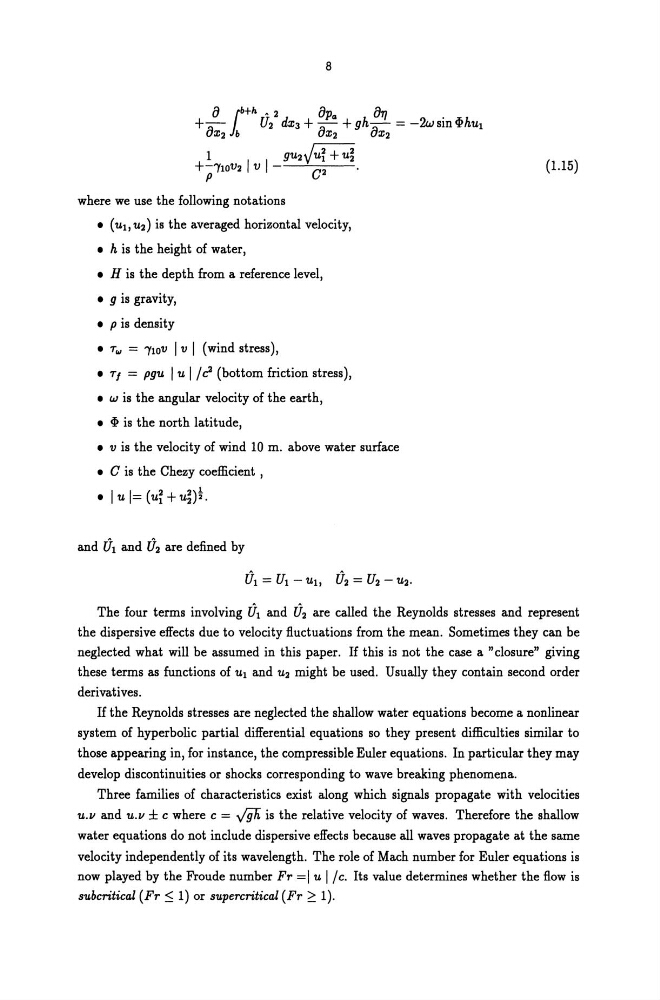
(1.15)
where we use the following notations
• (11.1,11.2) is the averaged horizontal velocity,
• h is the height of water,
• H is the depth from a reference level,
• 9 is gravity,
• p is density
• TO! = 'Y10V I V I (wind stress),
• Tf = pgu 111. I /c2 (bottom friction stress),
• w is the angular velocity of the earth,
• ~ is the north latitude,
• v is the velocity of wind 10 m. above water surface
• C is the Chezy coefficient ,
• 111. 1= (u~ +un~·
and U1 and U a are defined by
The four terms involving U1 and Ua are called the Reynolds stresses and represent
the dispersive effects due to velocity fluctuations from the mean. Sometimes they can be
neglected what will be assumed in this paper. If this is not the case a "closure" giving
these terms as functions of 11.1 and 11.2 might be used. Usually they contain second order
derivatives.
If the Reynolds stresses are neglected the shallow water equations become a nonlinear
system of hyperbolic partial differential equations so they present difficulties similar to
those appearing in, for instance, the compressible Euler equations. In particular they may
develop discontinuities or shocks corresponding to wave breaking phenomena.
Three families of characteristics exist along which signals propagate with velocities
U.V and U.V ± c where c = ..;gTi. is the relative velocity of waves. Therefore the shallow
water equations do not include dispersive effects because all waves propagate at the same
velocity independently of its wavelength. The role of Mach number for Euler equations is
now played by the Froude number Fr = 1 11. 1 / c. Its value determines whether the flow is
subcritical (Fr ~ 1) or supercritical (Fr ;::: 1).
(1.15)
where we use the following notations
• (11.1,11.2) is the averaged horizontal velocity,
• h is the height of water,
• H is the depth from a reference level,
• 9 is gravity,
• p is density
• TO! = 'Y10V I V I (wind stress),
• Tf = pgu 111. I /c2 (bottom friction stress),
• w is the angular velocity of the earth,
• ~ is the north latitude,
• v is the velocity of wind 10 m. above water surface
• C is the Chezy coefficient ,
• 111. 1= (u~ +un~·
and U1 and U a are defined by
The four terms involving U1 and Ua are called the Reynolds stresses and represent
the dispersive effects due to velocity fluctuations from the mean. Sometimes they can be
neglected what will be assumed in this paper. If this is not the case a "closure" giving
these terms as functions of 11.1 and 11.2 might be used. Usually they contain second order
derivatives.
If the Reynolds stresses are neglected the shallow water equations become a nonlinear
system of hyperbolic partial differential equations so they present difficulties similar to
those appearing in, for instance, the compressible Euler equations. In particular they may
develop discontinuities or shocks corresponding to wave breaking phenomena.
Three families of characteristics exist along which signals propagate with velocities
U.V and U.V ± c where c = ..;gTi. is the relative velocity of waves. Therefore the shallow
water equations do not include dispersive effects because all waves propagate at the same
velocity independently of its wavelength. The role of Mach number for Euler equations is
now played by the Froude number Fr = 1 11. 1 / c. Its value determines whether the flow is
subcritical (Fr ~ 1) or supercritical (Fr ;::: 1).