

13
Oxygen plays a major role in all kinds of life. In particular it is used by bacterias to
decompose the organic matter. If the oxygen demand is not satisfied plancton and other
higher forms of animal life disappear. However decomposition of organic matter goes on
by anaerobic processes which do not use oxygen but produce sulfure of hydrogen and
methane both having a nauseous smell.
The level of dissolved oxygen depends on two categories of factors:
1. the quantity of organic matter in the water to be decomposed and the mechanism
for this decomposition.
2. some physical conditions as temperature, depth, turbulence, etc.
The organic matter can be measured in terms of the need of oxygen to decompose it,
the so-called biological ozygen demand (BOD).
If the pollution level is not too high this need can be satisfied by the dissolved oxygen.
Notice that the dissolved oxygen is very sensitive to wastewater discharges namely to the
thermal ones. Indeed, at high temperatures solubility of oxygen decreases while activity
of microorganisms which is oxygen consuming increases.
If the quantity of organic matter increases beyond a maximun value the dissolved
oxygen is not enough to decompose it leading to modifications in the ecosystem. To avoid
this phenomena some phisyco-chemical and/or biological treatments prior to discharge
have to be made. Optimization of both design and management of wastewater treatment
systems can be done by using mathematical models and programming techniques.
In what follows we recall a model for the evolution of BOD and DO. We use subscripts
1 and 3 for the BOD and the bacterias involved in the estabilization of the organic matter,
respectively. Accordingly let d1 be the density of BOD and da the density of bacterias.
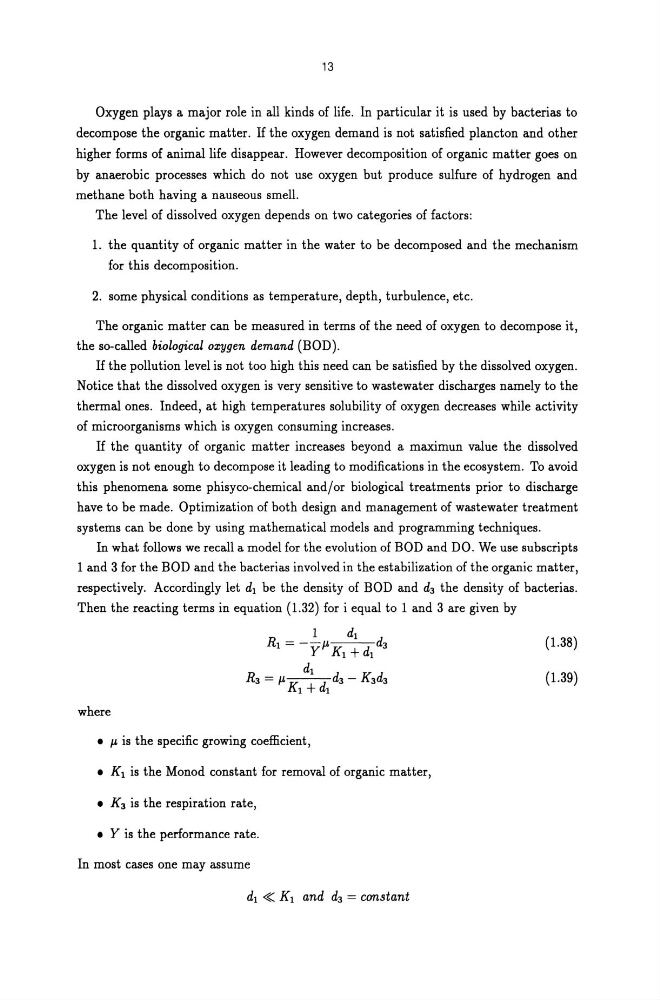
Then the reacting terms in equation (1.32) for i equal to 1 and 3 are given by
1
d1
Rl = --po---da
Y Kl +d1
d1
Ra = po-K d da - K3da
1 + 1
where
• po is the specific growing coefficient,
• Kl is the Monod constant for removal of organic matter,
• Ka is the respiration rate,
• Y is the performance rate.
In most cases one may assume
d1 < Kl and da = constant
(1.38)
(1.39)
Oxygen plays a major role in all kinds of life. In particular it is used by bacterias to
decompose the organic matter. If the oxygen demand is not satisfied plancton and other
higher forms of animal life disappear. However decomposition of organic matter goes on
by anaerobic processes which do not use oxygen but produce sulfure of hydrogen and
methane both having a nauseous smell.
The level of dissolved oxygen depends on two categories of factors:
1. the quantity of organic matter in the water to be decomposed and the mechanism
for this decomposition.
2. some physical conditions as temperature, depth, turbulence, etc.
The organic matter can be measured in terms of the need of oxygen to decompose it,
the so-called biological ozygen demand (BOD).
If the pollution level is not too high this need can be satisfied by the dissolved oxygen.
Notice that the dissolved oxygen is very sensitive to wastewater discharges namely to the
thermal ones. Indeed, at high temperatures solubility of oxygen decreases while activity
of microorganisms which is oxygen consuming increases.
If the quantity of organic matter increases beyond a maximun value the dissolved
oxygen is not enough to decompose it leading to modifications in the ecosystem. To avoid
this phenomena some phisyco-chemical and/or biological treatments prior to discharge
have to be made. Optimization of both design and management of wastewater treatment
systems can be done by using mathematical models and programming techniques.
In what follows we recall a model for the evolution of BOD and DO. We use subscripts
1 and 3 for the BOD and the bacterias involved in the estabilization of the organic matter,
respectively. Accordingly let d1 be the density of BOD and da the density of bacterias.
Then the reacting terms in equation (1.32) for i equal to 1 and 3 are given by
1
d1
Rl = --po---da
Y Kl +d1
d1
Ra = po-K d da - K3da
1 + 1
where
• po is the specific growing coefficient,
• Kl is the Monod constant for removal of organic matter,
• Ka is the respiration rate,
• Y is the performance rate.
In most cases one may assume
d1 < Kl and da = constant
(1.38)
(1.39)