

243
Theorem 10
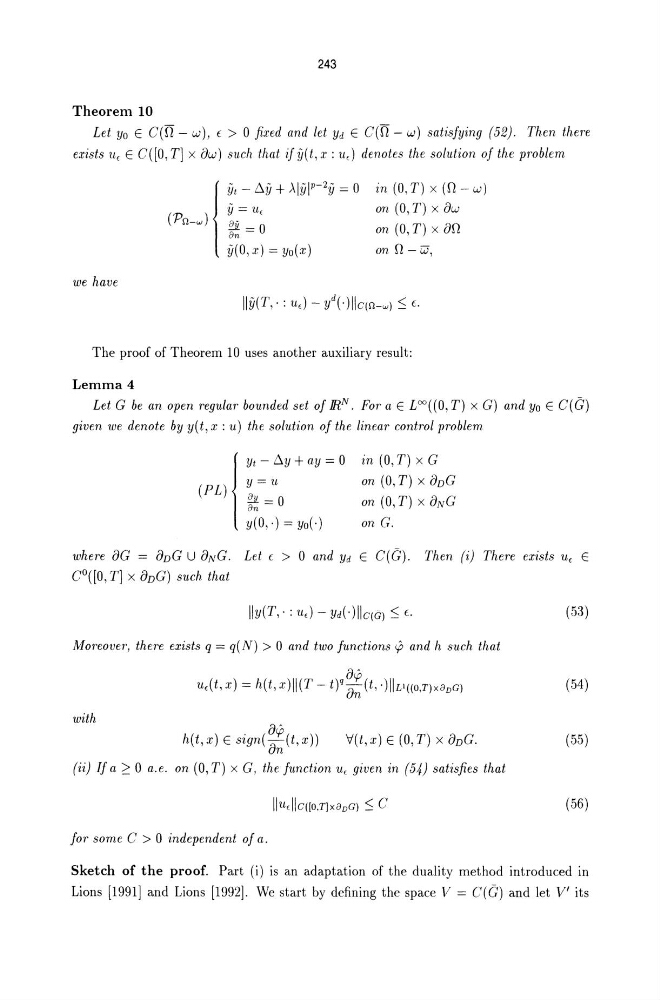
Let Yo E C (IT - w), ( > ° fixed and let Yd E C (IT - w) satisfying (52). Then there
exists u, E C([O, T] x ow) such that if fj(t, x : u,) denotes the solution of the problem
{
~t - t:.fj + ,\lfjlp-2fj = °
Y = u,
(Po- w ) £i - °
an -
fj(O,x) = Yo(x)
we have
in (0, T) x (n - w)
on (O,T) x Ow
on (0, T) x on
on n -w,
The proof of Theorem 10 uses another auxiliary result:
Lemma 4
Let G be an open regular bounded set of JRN. For a E LOO((O, T) x G) and Yo E C(G)
given we denote by y( t, x : u) the solution of the linear control problem
{
Yt - t:.y + ay = °
( PL) y=u
By = °
on
y(O,·) = Yo(-)
in (0, T) x G
on (0, T) x ODG
on (0, T) x ONG
on G.
where oG = ODG U ONG. Let ( > ° and Yd E C(G). Then (i) There exists u, E
CO([O, T] x ODG) such that
(53)
Moreover, there exists q = q(N) > ° and two functions r{; and h such that
(54)
with
h(t,x) E Sign(~~(t,x)) 't/(t, x) E (O,T) x ODG.
(55)
(ii) If a ~ ° a.e. on (0, T) x G, the function u, given in (54) satisfies that
Ilu,IIc([o.T)XODG) ~ C
(56)
for some C > ° independent of a.
Sketch of the proof. Part (i) is an adaptation of the duality method introduced in
Lions [1991] and Lions [1992]. We start by defining the space V = C(G) and let V' its
Theorem 10
Let Yo E C (IT - w), ( > ° fixed and let Yd E C (IT - w) satisfying (52). Then there
exists u, E C([O, T] x ow) such that if fj(t, x : u,) denotes the solution of the problem
{
~t - t:.fj + ,\lfjlp-2fj = °
Y = u,
(Po- w ) £i - °
an -
fj(O,x) = Yo(x)
we have
in (0, T) x (n - w)
on (O,T) x Ow
on (0, T) x on
on n -w,
The proof of Theorem 10 uses another auxiliary result:
Lemma 4
Let G be an open regular bounded set of JRN. For a E LOO((O, T) x G) and Yo E C(G)
given we denote by y( t, x : u) the solution of the linear control problem
{
Yt - t:.y + ay = °
( PL) y=u
By = °
on
y(O,·) = Yo(-)
in (0, T) x G
on (0, T) x ODG
on (0, T) x ONG
on G.
where oG = ODG U ONG. Let ( > ° and Yd E C(G). Then (i) There exists u, E
CO([O, T] x ODG) such that
(53)
Moreover, there exists q = q(N) > ° and two functions r{; and h such that
(54)
with
h(t,x) E Sign(~~(t,x)) 't/(t, x) E (O,T) x ODG.
(55)
(ii) If a ~ ° a.e. on (0, T) x G, the function u, given in (54) satisfies that
Ilu,IIc([o.T)XODG) ~ C
(56)
for some C > ° independent of a.
Sketch of the proof. Part (i) is an adaptation of the duality method introduced in
Lions [1991] and Lions [1992]. We start by defining the space V = C(G) and let V' its