

242
where (Yo)-(x) = inf {yo(x), OJ. Using the maximum principle and the assumption p > 1
it is easy to see that there exists Zoo E C((O, T) x (0 - w)) such that Zoo ~ .... ~ 1::.2 ~
1::.1 ~ o. Then we can define roo(t, x) == limN-+oo 1::.N (t, x) and by duality arguments it is
proven that roo satisfies the requiered conditions. The arguments for roo are completely
similar.
•
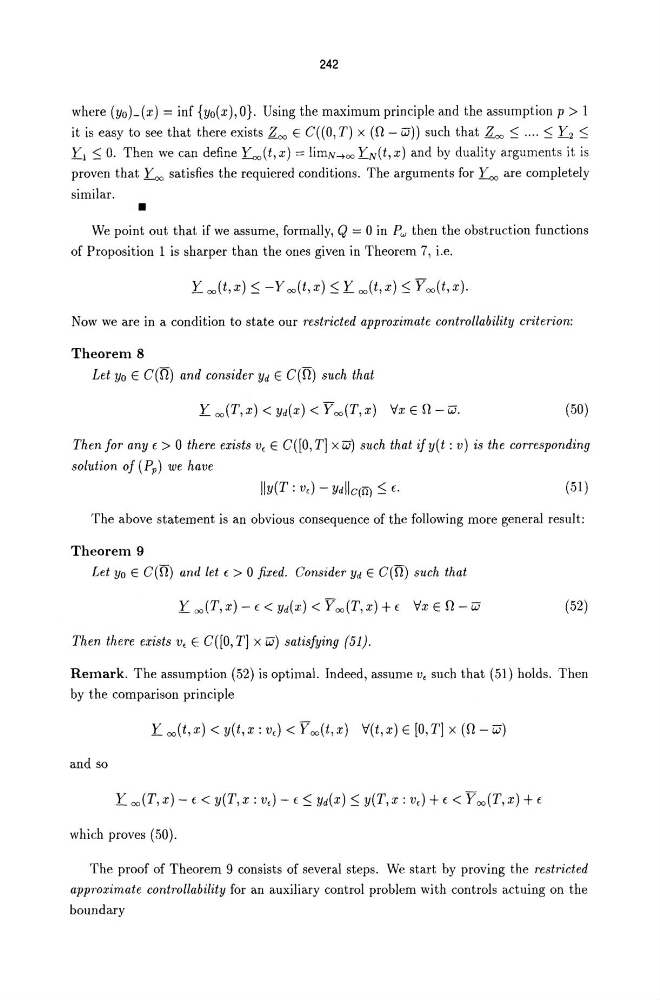
We point out that if we assume, formally, Q == 0 in Pw then the obstruction functions
of Proposition 1 is sharper than the ones given in Theorem 7, i.e.
Now we are in a condition to state our restricted approximate controllability criterion:
Theorem 8
Let Yo E C (IT) and consider Yd E C (IT) such that
(50)
Then for any f > 0 there exists v. E C([O, T] x w) such that if y(t : v) is the corresponding
solution of (Pp) we have
(51 )
The above statement is an obvious consequence of the following more general result:
Theorem 9
Let Yo E C(IT) and let f. > 0 fixed. Consider Yd E C(IT) such that
(52)
Then there exists v. E C([O, T] x w) satisfying (51).
Remark. The assumption (52) is optimal. Indeed, assume v. such that (51) holds. Then
by the comparison principle
1::. oo(t,x) < y(t,x: v.) < Y oo(t, x) V(t,x) E [O,T] x (0 - w)
and so
1::. oo(T, x) - f. < y(T, x : v.) - f. ~ Yd(X)::; y(T,x: v.) + f < Y oo(T, x) + f
which proves (50).
The proof of Theorem 9 consists of several steps. We start by proving the restricted
approximate controllability for an auxiliary control problem with controls actuing on the
boundary
where (Yo)-(x) = inf {yo(x), OJ. Using the maximum principle and the assumption p > 1
it is easy to see that there exists Zoo E C((O, T) x (0 - w)) such that Zoo ~ .... ~ 1::.2 ~
1::.1 ~ o. Then we can define roo(t, x) == limN-+oo 1::.N (t, x) and by duality arguments it is
proven that roo satisfies the requiered conditions. The arguments for roo are completely
similar.
•
We point out that if we assume, formally, Q == 0 in Pw then the obstruction functions
of Proposition 1 is sharper than the ones given in Theorem 7, i.e.
Now we are in a condition to state our restricted approximate controllability criterion:
Theorem 8
Let Yo E C (IT) and consider Yd E C (IT) such that
(50)
Then for any f > 0 there exists v. E C([O, T] x w) such that if y(t : v) is the corresponding
solution of (Pp) we have
(51 )
The above statement is an obvious consequence of the following more general result:
Theorem 9
Let Yo E C(IT) and let f. > 0 fixed. Consider Yd E C(IT) such that
(52)
Then there exists v. E C([O, T] x w) satisfying (51).
Remark. The assumption (52) is optimal. Indeed, assume v. such that (51) holds. Then
by the comparison principle
1::. oo(t,x) < y(t,x: v.) < Y oo(t, x) V(t,x) E [O,T] x (0 - w)
and so
1::. oo(T, x) - f. < y(T, x : v.) - f. ~ Yd(X)::; y(T,x: v.) + f < Y oo(T, x) + f
which proves (50).
The proof of Theorem 9 consists of several steps. We start by proving the restricted
approximate controllability for an auxiliary control problem with controls actuing on the
boundary