

244
dual (i.e. the set of Baire measures of bounded variation: Yosida [1974] p. 119). Given
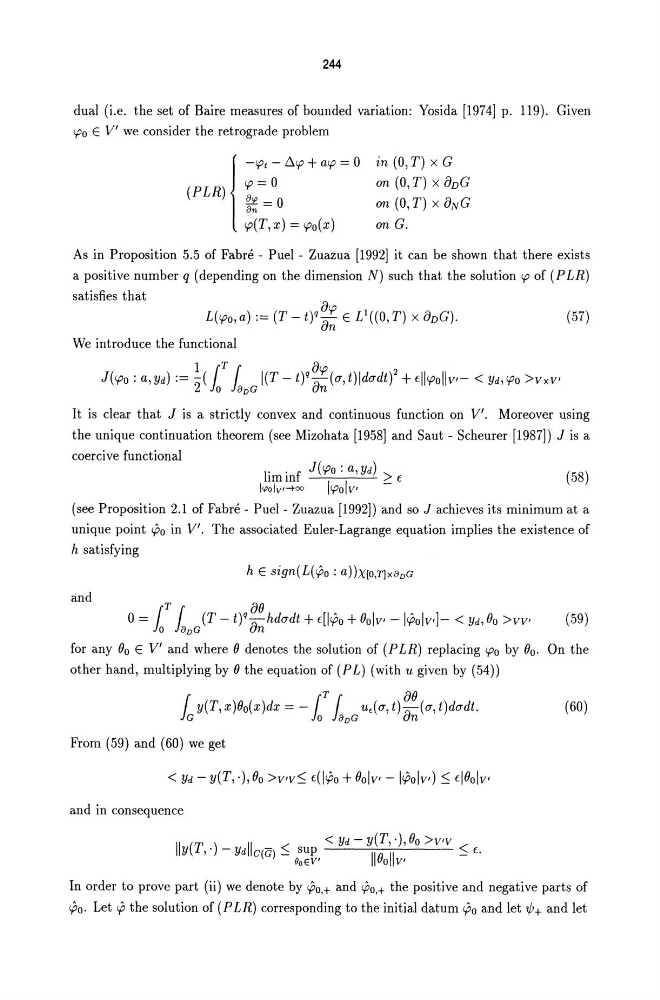
~o E V' we consider the retrograde problem
l
-~t - 6.~ + a~ = 0
( PLR)
~=O
& ;(;'x) = ~o(x)
in (0, T) x G
on (0, T) x ODG
on (0, T) x ONG
on G.
As in Proposition 5.5 of Fabre - Puel - Zuazua [1992] it can be shown that there exists
a positive number q (depending on the dimension N) such that the solution ~ of (PLR)
satisfies that
O~
L(~o, a) := (T - tF on E Ll((O, T) x ODG).
(57)
We introduce the functional
1 iT 1
O'P
2
J(~o: a,Yd):= -2(
I(T - t)q-o (O',t)ldO'dt) + EII'Pollv'- < Yd,'PO >VxV'
o &DG
n
It is clear that J is a strictly convex and continuous function on V'. Moreover using
the unique continuation theorem (see Mizohata [1958] and Saut - Scheurer [1987]) J is a
coercive functional
(58)
(see Proposition 2.1 of Fabre - Puel- Zuazua [1992]) and so J achieves its minimum at a
unique point ~o in V'. The associated Euler-Lagrange equation implies the existence of
h satisfying
h E sign(L(~o : a))X[O,Tjx&DG
and
0= r
T
r (T - t)qoOO hdO'dt + E[I~o + Oolvl -1~olvl]- < Yd,OO >VV'
Jo J&DG
n
(59)
for any 00 E V' and where 0 denotes the solution of (P LR) replacing ~o by 00 . On the
other hand, multiplying by 0 the equation of (PL) (with u given by (54))
r y(T,x)Oo(x)dx = _ r
T
r u,(O',t)OOO (O',t)dO'dt.
JG
Jo J&DG
n
(60)
From (59) and (60) we get
< Yd - y(T,'), 00 >VIV:::; E(I~o + Oolvl - l~olvl) :::; EIOolvl
and in consequence
< Yd - y(T,'), 00 >V'V
Ily(T,·) - YdllC(G) :::; sup
110 I I
:::; Eo
BoEV'
0 v'
In order to prove part (ii) we denote by ~o,+ and ~o,+ the positive and negative parts of
~o. Let ~ the solution of (P LR) corresponding to the initial datum ~o and let 1/J+ and let
dual (i.e. the set of Baire measures of bounded variation: Yosida [1974] p. 119). Given
~o E V' we consider the retrograde problem
l
-~t - 6.~ + a~ = 0
( PLR)
~=O
& ;(;'x) = ~o(x)
in (0, T) x G
on (0, T) x ODG
on (0, T) x ONG
on G.
As in Proposition 5.5 of Fabre - Puel - Zuazua [1992] it can be shown that there exists
a positive number q (depending on the dimension N) such that the solution ~ of (PLR)
satisfies that
O~
L(~o, a) := (T - tF on E Ll((O, T) x ODG).
(57)
We introduce the functional
1 iT 1
O'P
2
J(~o: a,Yd):= -2(
I(T - t)q-o (O',t)ldO'dt) + EII'Pollv'- < Yd,'PO >VxV'
o &DG
n
It is clear that J is a strictly convex and continuous function on V'. Moreover using
the unique continuation theorem (see Mizohata [1958] and Saut - Scheurer [1987]) J is a
coercive functional
(58)
(see Proposition 2.1 of Fabre - Puel- Zuazua [1992]) and so J achieves its minimum at a
unique point ~o in V'. The associated Euler-Lagrange equation implies the existence of
h satisfying
h E sign(L(~o : a))X[O,Tjx&DG
and
0= r
T
r (T - t)qoOO hdO'dt + E[I~o + Oolvl -1~olvl]- < Yd,OO >VV'
Jo J&DG
n
(59)
for any 00 E V' and where 0 denotes the solution of (P LR) replacing ~o by 00 . On the
other hand, multiplying by 0 the equation of (PL) (with u given by (54))
r y(T,x)Oo(x)dx = _ r
T
r u,(O',t)OOO (O',t)dO'dt.
JG
Jo J&DG
n
(60)
From (59) and (60) we get
< Yd - y(T,'), 00 >VIV:::; E(I~o + Oolvl - l~olvl) :::; EIOolvl
and in consequence
< Yd - y(T,'), 00 >V'V
Ily(T,·) - YdllC(G) :::; sup
110 I I
:::; Eo
BoEV'
0 v'
In order to prove part (ii) we denote by ~o,+ and ~o,+ the positive and negative parts of
~o. Let ~ the solution of (P LR) corresponding to the initial datum ~o and let 1/J+ and let