

193
the graph M of is positively invariant by the semigroup {S(t)}t~O' which was the
idea behind this construction.
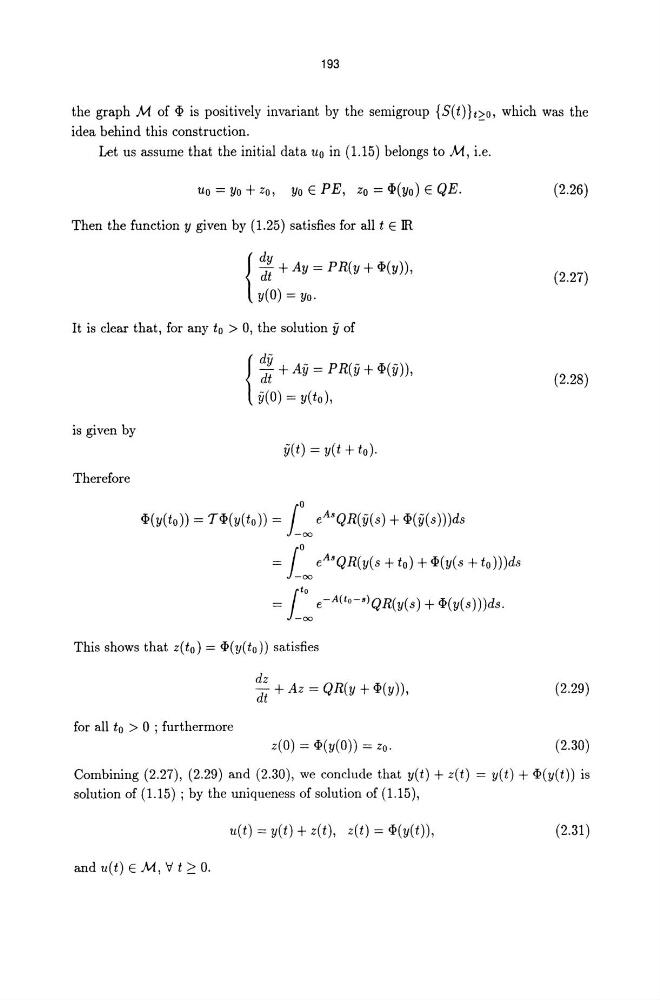
Let us assume that the initial data uo in (1.15) belongs to M, i.e.
uo = Yo + Zo, Yo E PE, Zo =(yo) E QE.
Then the function y given by (1.25) satisfies for all t E lR
{
dy
dt + Ay = PRey +(y)),
yeO) = Yo.
It is clear that, for any to > 0, the solution y of
is given by
Therefore
{ ~; + Ay = P R(y +(fj)),
yeO) = y( to),
yet) = yet + to).
(y(to)) = T(y(to)) = lOoo eASQR(y(s) + (y(s)))ds
= lOoo e As Q R(y( s + to) +(y( s + to) ))ds
l
t~
= -00 e-A(to-S)QR(y(s) +(y(s)))ds.
This shows that z( to) =(y( to)) satisfies
dz
dt + Az = QR(y +(y)),
for all to > 0 ; furthermore
z(O) =(y(O)) = zoo
(2.26)
(2.27)
(2.28)
(2.29)
(2.30)
Combining (2.27), (2.29) and (2.30), we conclude that yet) + z(t) = yet) + 4>(y(t)) is
solution of (1.15) ; by the uniqueness of solution of (1.15),
u(t) = yet) + z(t), z(t) =(y(t)),
(2.31)
and u(t) E M, V t ~ o.
the graph M of
idea behind this construction.
Let us assume that the initial data uo in (1.15) belongs to M, i.e.
uo = Yo + Zo, Yo E PE, Zo =
Then the function y given by (1.25) satisfies for all t E lR
{
dy
dt + Ay = PRey +
yeO) = Yo.
It is clear that, for any to > 0, the solution y of
is given by
Therefore
{ ~; + Ay = P R(y +
yeO) = y( to),
yet) = yet + to).
= lOoo e As Q R(y( s + to) +
l
t~
= -00 e-A(to-S)QR(y(s) +
This shows that z( to) =
dz
dt + Az = QR(y +
for all to > 0 ; furthermore
z(O) =
(2.26)
(2.27)
(2.28)
(2.29)
(2.30)
Combining (2.27), (2.29) and (2.30), we conclude that yet) + z(t) = yet) + 4>(y(t)) is
solution of (1.15) ; by the uniqueness of solution of (1.15),
u(t) = yet) + z(t), z(t) =
(2.31)
and u(t) E M, V t ~ o.