

194
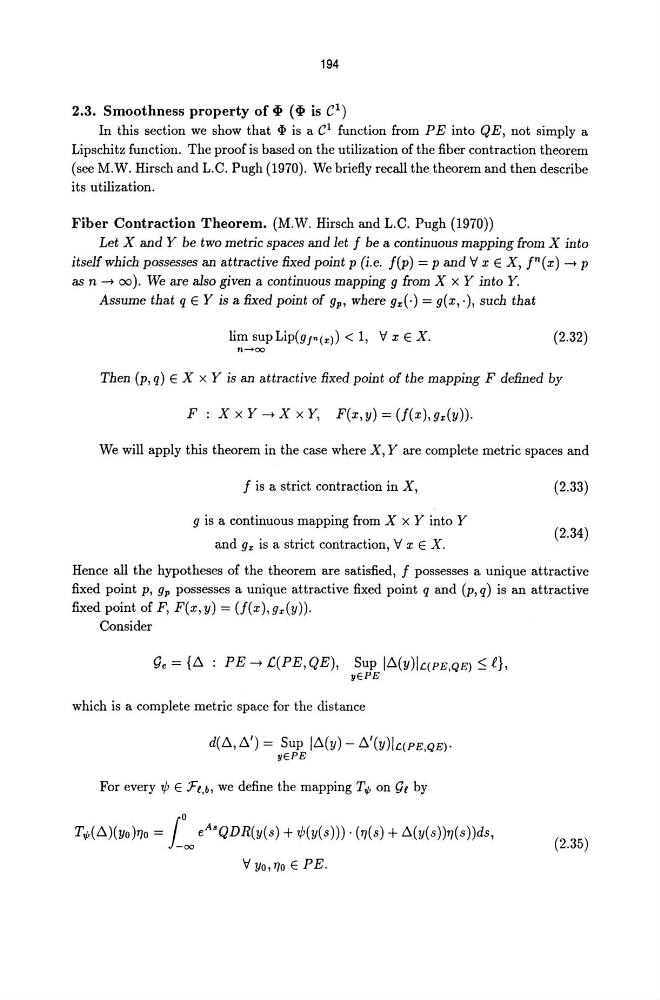
2.3. Smoothness property of cl) (cl) is C 1 )
In this section we show that ~ is a C 1 function from P E into Q E, not simply a
Lipschitz function. The proof is based on the utilization of the fiber contraction theorem
(see M.W. Hirsch and L.C. Pugh (1970). We briefly recall the theorem and then describe
its utilization.
Fiber Contraction Theorem. (M.W. Hirsch and L.C. Pugh (1970))
Let X and Y be two metric spaces and let f be a continuous mapping from X into
itself which possesses an attractive fixed point p (i.e. f(p) = p and V x E X, rex) -+ p
as n -+ (0). We are also given a continuous mapping 9 from X x Y into Y.
Assume that q E Y is a fixed point of gp, where gx(·) = g(x, .), such that
lim sup Lip(g/" (x)) < 1, V x E X.
(2.32)
n ..... oo
Then (p, q) E X x Y is an attractive fixed point of the mapping F defined by
F: XxY-+XxY, F(x,y) = (f(x),gx(y)).
We will apply this theorem in the case where X, Y are complete metric spaces and
f is a strict contraction in X,
(2.33)
9 is a continuous mapping from X x Y into Y
and gx is a strict contraction, V x E X.
(2.34)
Hence all the hypotheses of the theorem are satisfied, f possesses a unique attractive
fixed point p, gp possesses a unique attractive fixed point q and (p, q) is an attractive
fixed point of F, F(x,y) = (f(x),gx(y)).
Consider
ge = {~ : PE -+ .c(PE,QE), Sup 1~(y)IctPE,QE) ~ e},
yEPE
which is a complete metric space for the distance
d(~,~t) = Sup I~(Y) - ~t(y)IC(PE,QE).
yEPE
For every 1j; E Ff,b, we define the mapping T", on 91 by
T"'(~)(YO)7]O = 1°00 eASQDR(y(s) + I/;(y(s)))· (7](S) + ~(y(S))7](s))ds,
V Yo, 7]0 E P E.
(2.35)
2.3. Smoothness property of cl) (cl) is C 1 )
In this section we show that ~ is a C 1 function from P E into Q E, not simply a
Lipschitz function. The proof is based on the utilization of the fiber contraction theorem
(see M.W. Hirsch and L.C. Pugh (1970). We briefly recall the theorem and then describe
its utilization.
Fiber Contraction Theorem. (M.W. Hirsch and L.C. Pugh (1970))
Let X and Y be two metric spaces and let f be a continuous mapping from X into
itself which possesses an attractive fixed point p (i.e. f(p) = p and V x E X, rex) -+ p
as n -+ (0). We are also given a continuous mapping 9 from X x Y into Y.
Assume that q E Y is a fixed point of gp, where gx(·) = g(x, .), such that
lim sup Lip(g/" (x)) < 1, V x E X.
(2.32)
n ..... oo
Then (p, q) E X x Y is an attractive fixed point of the mapping F defined by
F: XxY-+XxY, F(x,y) = (f(x),gx(y)).
We will apply this theorem in the case where X, Y are complete metric spaces and
f is a strict contraction in X,
(2.33)
9 is a continuous mapping from X x Y into Y
and gx is a strict contraction, V x E X.
(2.34)
Hence all the hypotheses of the theorem are satisfied, f possesses a unique attractive
fixed point p, gp possesses a unique attractive fixed point q and (p, q) is an attractive
fixed point of F, F(x,y) = (f(x),gx(y)).
Consider
ge = {~ : PE -+ .c(PE,QE), Sup 1~(y)IctPE,QE) ~ e},
yEPE
which is a complete metric space for the distance
d(~,~t) = Sup I~(Y) - ~t(y)IC(PE,QE).
yEPE
For every 1j; E Ff,b, we define the mapping T", on 91 by
T"'(~)(YO)7]O = 1°00 eASQDR(y(s) + I/;(y(s)))· (7](S) + ~(y(S))7](s))ds,
V Yo, 7]0 E P E.
(2.35)