

192
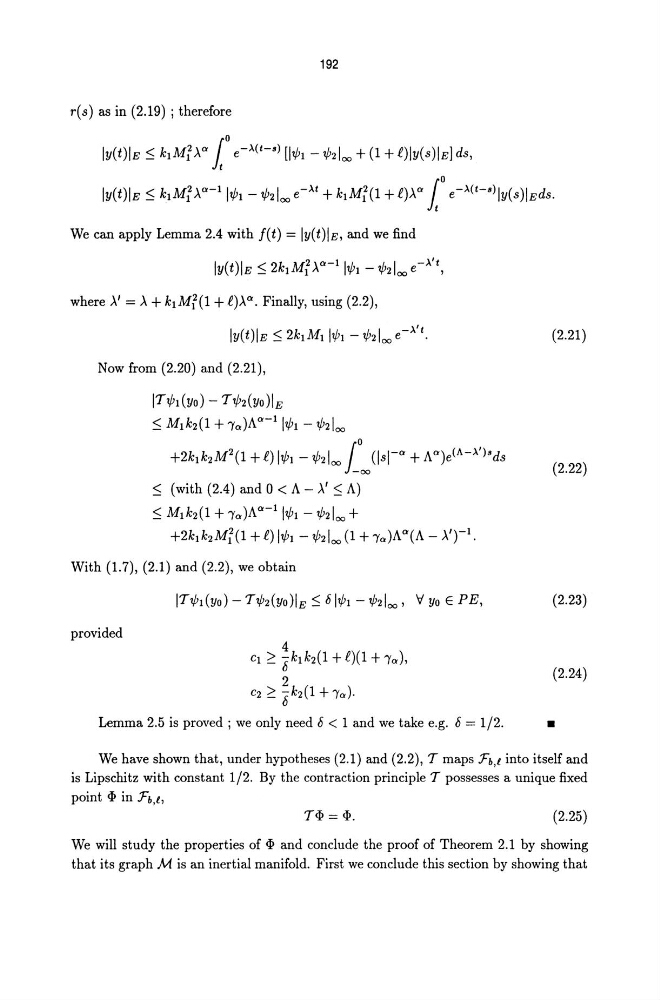
res) as in (2.19) ; therefore
ly(t)IE :::; k1Ml).a 1° e--X(t-s) IItPl - tP2100 + (1 + l)ly(s)IEl ds,
ly(t)IE :::; klMl ).a-l ItPl - tP2100 e--Xt + k1Mf(1 + l).a 1° e--X(t-8)ly(s )IEds.
We can apply Lemma 2.4 with J(t) = ly(t)IE, and we find
ly(t)IE :::; 2k1Mf ).a-l ItPl - tP2100 e--X't,
where).' =). + klM;(l + l).a. Finally, using (2.2),
ly(t)IE :::; 2klMl I!/Jl - !/J2100 e--X't.
Now from (2.20) and (2.21),
IT tPl(YO) - TtP2(yo)I E
:::; Mlk2(1 + ,a)A a-I ItPl - !/J2100
+2klk2M2(1 + l) ItPl - !/J2100 1°00 (lsi-a + A a)e(A--X')sds
:::; (with (2.4) and 0 < A - ).' :::; A)
:::; Mlk2(1 + la)A a - 1 1!/Jl - tP2100 +
+2k1k2Mf(1 + l) ItPl - tP2100 (1 + la)Aa(A _ ).')-1.
With (1.7), (2.1) and (2.2), we obtain
provided
4
Cl ~ ;5klk2(1 + l)(l + la),
2
C2 ~ ;5k2(1 + la).
Lemma 2.5 is proved; we only need 8 < 1 and we take e.g. 8 = 1/2.
(2.21)
(2.22)
(2.24)
•
We have shown that, under hypotheses (2.1) and (2.2), T maps Fb,l into itself and
is Lipschitz with constant 1/2. By the contraction principle T possesses a unique fixed
point ell in Fb,l,
Tell = ell.
(2.25)
We will study the properties of ell and conclude the proof of Theorem 2.1 by showing
that its graph M is an inertial manifold. First we conclude this section by showing that
res) as in (2.19) ; therefore
ly(t)IE :::; k1Ml).a 1° e--X(t-s) IItPl - tP2100 + (1 + l)ly(s)IEl ds,
ly(t)IE :::; klMl ).a-l ItPl - tP2100 e--Xt + k1Mf(1 + l).a 1° e--X(t-8)ly(s )IEds.
We can apply Lemma 2.4 with J(t) = ly(t)IE, and we find
ly(t)IE :::; 2k1Mf ).a-l ItPl - tP2100 e--X't,
where).' =). + klM;(l + l).a. Finally, using (2.2),
ly(t)IE :::; 2klMl I!/Jl - !/J2100 e--X't.
Now from (2.20) and (2.21),
IT tPl(YO) - TtP2(yo)I E
:::; Mlk2(1 + ,a)A a-I ItPl - !/J2100
+2klk2M2(1 + l) ItPl - !/J2100 1°00 (lsi-a + A a)e(A--X')sds
:::; (with (2.4) and 0 < A - ).' :::; A)
:::; Mlk2(1 + la)A a - 1 1!/Jl - tP2100 +
+2k1k2Mf(1 + l) ItPl - tP2100 (1 + la)Aa(A _ ).')-1.
With (1.7), (2.1) and (2.2), we obtain
provided
4
Cl ~ ;5klk2(1 + l)(l + la),
2
C2 ~ ;5k2(1 + la).
Lemma 2.5 is proved; we only need 8 < 1 and we take e.g. 8 = 1/2.
(2.21)
(2.22)
(2.24)
•
We have shown that, under hypotheses (2.1) and (2.2), T maps Fb,l into itself and
is Lipschitz with constant 1/2. By the contraction principle T possesses a unique fixed
point ell in Fb,l,
Tell = ell.
(2.25)
We will study the properties of ell and conclude the proof of Theorem 2.1 by showing
that its graph M is an inertial manifold. First we conclude this section by showing that