

5
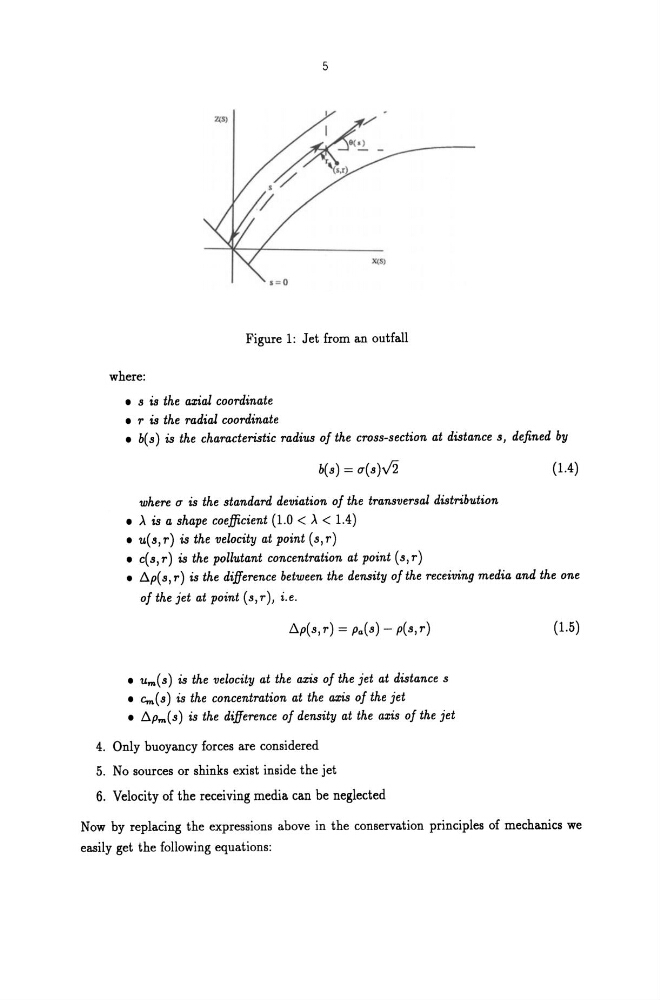
Figure 1: Jet from an outfall
where:
• s is the azial coordinate
• r is the radial coordinate
• b( s) is the characteristic radius of the cross-section at distance s, defined by
b(s) = u(s)J2
(1.4)
where u is the standard deviation of the transversal distribution
• A is a shape coefficient (1.0 < A < 1.4)
• u( s, r) is the velocity at point (s, r)
• c( s, r) is the pollutant concentration at point (s, r)
• t.p(s,r) is the difference between the density of the receiving media and the one
of the jet at point (s, r), i. e.
t.p( s, r) = Pa( s) - p( s, r)
(1.5)
• tl.m(s) is the velocity at the axis of the jet at distance s
• c".( s) is the concentration at the axis of the jet
• t.pm( s) is the difference of density at the axis of the jet
4. Only buoyancy forces are considered
5. No sources or shinks exist inside the jet
6. Velocity of the receiving media can be neglected
Now by replacing the expressions above in the conservation principles of mechanics we
easily get the following equations:
Figure 1: Jet from an outfall
where:
• s is the azial coordinate
• r is the radial coordinate
• b( s) is the characteristic radius of the cross-section at distance s, defined by
b(s) = u(s)J2
(1.4)
where u is the standard deviation of the transversal distribution
• A is a shape coefficient (1.0 < A < 1.4)
• u( s, r) is the velocity at point (s, r)
• c( s, r) is the pollutant concentration at point (s, r)
• t.p(s,r) is the difference between the density of the receiving media and the one
of the jet at point (s, r), i. e.
t.p( s, r) = Pa( s) - p( s, r)
(1.5)
• tl.m(s) is the velocity at the axis of the jet at distance s
• c".( s) is the concentration at the axis of the jet
• t.pm( s) is the difference of density at the axis of the jet
4. Only buoyancy forces are considered
5. No sources or shinks exist inside the jet
6. Velocity of the receiving media can be neglected
Now by replacing the expressions above in the conservation principles of mechanics we
easily get the following equations: