

6
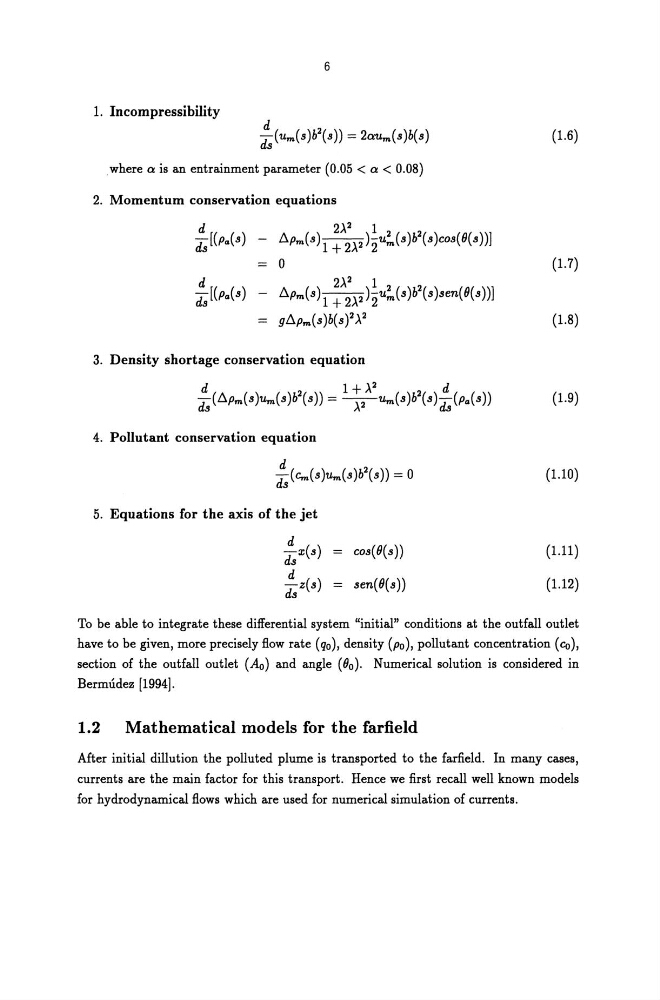
1. Incompressibility
(1.6)
where a is an entrainment parameter (0.05 < a < 0.08)
2. Momentum conservation equations
~[(p,,(s) - ~Pm(S)l !A;A2)~U!.(s)b2(S)cos(9(s))J
= 0
(1.7)
3. Density shortage conservation equation
4. Pollutant conservation equation
5. Equations for the axis of the jet
cos(9(s))
sen(9(s ))
(1.8)
(1.10)
(1.11 )
(1.12)
To be able to integrate these differential system "initial" conditions at the outfall outlet
have to be given, more precisely flow rate (qo), density (Po), pollutant concentration (eo),
section of the outfall outlet (.40) and angle (90 ), Numerical solution is considered in
Bermudez [1994J.
1.2 Mathematical models for the farfield
After initial dillution the polluted plume is transported to the farfield. In many cases,
currents are the main factor for this transport. Hence we first recall well known models
for hydrodynamical flows which are used for numerical simulation of currents.
1. Incompressibility
(1.6)
where a is an entrainment parameter (0.05 < a < 0.08)
2. Momentum conservation equations
~[(p,,(s) - ~Pm(S)l !A;A2)~U!.(s)b2(S)cos(9(s))J
= 0
(1.7)
3. Density shortage conservation equation
4. Pollutant conservation equation
5. Equations for the axis of the jet
cos(9(s))
sen(9(s ))
(1.8)
(1.10)
(1.11 )
(1.12)
To be able to integrate these differential system "initial" conditions at the outfall outlet
have to be given, more precisely flow rate (qo), density (Po), pollutant concentration (eo),
section of the outfall outlet (.40) and angle (90 ), Numerical solution is considered in
Bermudez [1994J.
1.2 Mathematical models for the farfield
After initial dillution the polluted plume is transported to the farfield. In many cases,
currents are the main factor for this transport. Hence we first recall well known models
for hydrodynamical flows which are used for numerical simulation of currents.