

4
Next we consider some mathematical models which can be used to simulate the dispersion of pollutants. In particular the well known system of partial differential equations
governing the evolution of the Biochemical Ozigen Demand (BOD) and the Dissolved
Ozigen (DO) will be considered.
Then, in section 2, we deal with numerical solution of these models by using finite
element an finite volume methods.
Very often, several sewage plants discharge wastewaters through outfalls which are
placed at the same area (estuary, lake, etc.). Thus all of them contribute to pollute
any given point of this area. In these circumstances the problem of design and management of the whole sytem arises. Optimization methods can be used to help decision
makers in formulating rational policies for water pollution control by minimizing costs of
wastewater treatment facilities while keeping the prescribed levels of water quality (see
Haimes [1976], Loucks, Stedinger & Haith [1978], Antonios [1989], Bermudez, MartInez
& RodrIguez [1991], Bogobowicz [1991]). This is the subject of section 3 where, after a
general overview on optimal control theory, we present two applications related to the
design and management of wastewaters treatment systems.
1 Mathematical modelling
In this section we recall some mathematical models which are used for numerical simulation of pollutant dispersion from an outfall. We deal with both the nearfield and the
farfield
1.1 A mathematical model for the nearfield
It consists of a system of nonlinear ordinary differential equations for velocity, density
and pollutant concentration along the axis of the jet which can be obtained from the
conservation principles of mechanics.
There are three main forces acting on eflluent discharge: its initial momentum, buoyancy due to difference in density between eflluent and receiving water, and friction against
surrounding water leading to entrainment of it and, consequently, to dillution of pollutant.
In order to get a simple mathematical model we make the following assumptions on
the flow (see figure 1):
1. Transversal cross section of the jet are circles
2. Velocities are orthogonal to transversal cross-sections
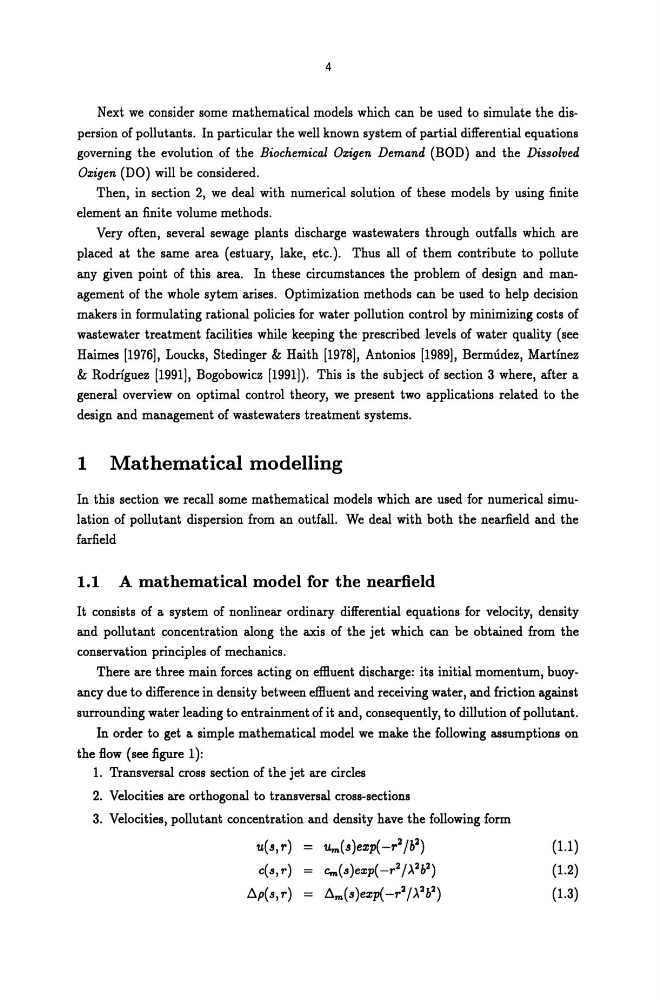
3. Velocities, pollutant concentration and density have the following form
u(s,r)
c(s,r)
t.p(s, r)
= u".(s)e:J:p( _r2 jb 2 )
c".(s)e:z;p( _r2 jA 2 b 2 )
t.m ( s )e:z;p( _r2 j A 2 b 2 )
(1.1)
(1.2)
(1.3)
Next we consider some mathematical models which can be used to simulate the dispersion of pollutants. In particular the well known system of partial differential equations
governing the evolution of the Biochemical Ozigen Demand (BOD) and the Dissolved
Ozigen (DO) will be considered.
Then, in section 2, we deal with numerical solution of these models by using finite
element an finite volume methods.
Very often, several sewage plants discharge wastewaters through outfalls which are
placed at the same area (estuary, lake, etc.). Thus all of them contribute to pollute
any given point of this area. In these circumstances the problem of design and management of the whole sytem arises. Optimization methods can be used to help decision
makers in formulating rational policies for water pollution control by minimizing costs of
wastewater treatment facilities while keeping the prescribed levels of water quality (see
Haimes [1976], Loucks, Stedinger & Haith [1978], Antonios [1989], Bermudez, MartInez
& RodrIguez [1991], Bogobowicz [1991]). This is the subject of section 3 where, after a
general overview on optimal control theory, we present two applications related to the
design and management of wastewaters treatment systems.
1 Mathematical modelling
In this section we recall some mathematical models which are used for numerical simulation of pollutant dispersion from an outfall. We deal with both the nearfield and the
farfield
1.1 A mathematical model for the nearfield
It consists of a system of nonlinear ordinary differential equations for velocity, density
and pollutant concentration along the axis of the jet which can be obtained from the
conservation principles of mechanics.
There are three main forces acting on eflluent discharge: its initial momentum, buoyancy due to difference in density between eflluent and receiving water, and friction against
surrounding water leading to entrainment of it and, consequently, to dillution of pollutant.
In order to get a simple mathematical model we make the following assumptions on
the flow (see figure 1):
1. Transversal cross section of the jet are circles
2. Velocities are orthogonal to transversal cross-sections
3. Velocities, pollutant concentration and density have the following form
u(s,r)
c(s,r)
t.p(s, r)
= u".(s)e:J:p( _r2 jb 2 )
c".(s)e:z;p( _r2 jA 2 b 2 )
t.m ( s )e:z;p( _r2 j A 2 b 2 )
(1.1)
(1.2)
(1.3)