

168
The domain filled by the fluid after the sigma transformation is thus a cylinder of base
.Qx and of height equal to one, that we will call Q :
D =.Qx x ]D,ll
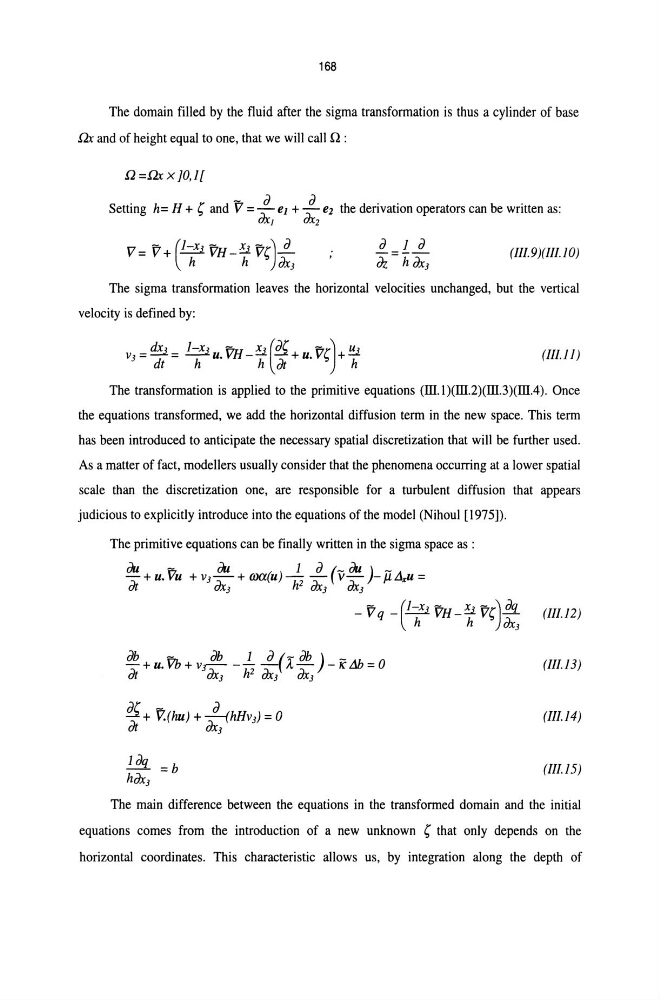
Setting h= H + , and V = ~J e1 + ~2 e2 the derivation operators can be written as:
(lJl.9)( 111.1 D)
The sigma transformation leaves the horizontal velocities unchanged, but the vertical
velocity is defined by:
_~_ l-x3 -
:!!(~
-r) ~
V3- dt - h u.VH- h Jt +u.v .. + h
(lll.ll)
The transformation is applied to the primitive equations (ill.l)(ill.2)(ill.3)(III.4). Once
the equations transformed, we add the horizontal diffusion term in the new space. This term
has been introduced to anticipate the necessary spatial discretization that will be further used.
As a matter of fact, modellers usually consider that the phenomena occurring at a lower spatial
scale than the discretization one, are responsible for a turbulent diffusion that appears
judicious to explicitly introduce into the equations of the model (Nihoul [1975]).
The primitive equations can be finally written in the sigma space as :
(111.12)
db -
db 1 a (- ab) -
Jt + U. Vb + Vj ax 3 - h2 ax 3 A ax 3 - /( &J = D
(lJl.J3)
(111.14)
(111.15)
The main difference between the equations in the transformed domain and the initial
equations comes from the introduction of a new unknown , that only depends on the
horizontal coordinates. This characteristic allows us, by integration along the depth of
The domain filled by the fluid after the sigma transformation is thus a cylinder of base
.Qx and of height equal to one, that we will call Q :
D =.Qx x ]D,ll
Setting h= H + , and V = ~J e1 + ~2 e2 the derivation operators can be written as:
(lJl.9)( 111.1 D)
The sigma transformation leaves the horizontal velocities unchanged, but the vertical
velocity is defined by:
_~_ l-x3 -
:!!(~
-r) ~
V3- dt - h u.VH- h Jt +u.v .. + h
(lll.ll)
The transformation is applied to the primitive equations (ill.l)(ill.2)(ill.3)(III.4). Once
the equations transformed, we add the horizontal diffusion term in the new space. This term
has been introduced to anticipate the necessary spatial discretization that will be further used.
As a matter of fact, modellers usually consider that the phenomena occurring at a lower spatial
scale than the discretization one, are responsible for a turbulent diffusion that appears
judicious to explicitly introduce into the equations of the model (Nihoul [1975]).
The primitive equations can be finally written in the sigma space as :
(111.12)
db -
db 1 a (- ab) -
Jt + U. Vb + Vj ax 3 - h2 ax 3 A ax 3 - /( &J = D
(lJl.J3)
(111.14)
(111.15)
The main difference between the equations in the transformed domain and the initial
equations comes from the introduction of a new unknown , that only depends on the
horizontal coordinates. This characteristic allows us, by integration along the depth of