

167
At this condition, we usually add dissipation conditions for the horizontal velocity and
the buoyancy :
i b =0
(}z
and
for z =-H
The fact that the surface of the ocean is a free boundary makes the study of this problem
particularly complicated. One approximation usually used consists then in imposing a fixed
upper surface of the sea and is called the rigid-lid approximation. In that case the conditions
for the vertical velocity at the surface are of homogeneous Dirichlet's type, and the integration
of the diagnostic equations provides an evolution system with a non local constraint that
makes the system overdetermined. So we generally introduce the pressure at the surface q., as
a two variables unknown function and the term Vqs, which appear in the momentum equation,
is considered as the Lagrange's multiplier associated with this constraint (lL. Lions,
R.Temam and S. Wang [1992]). The resulting system is called the rigid-lid equations.
Another approach consists in performing a transformation of the coordinates in such a
way that, in the transformed space, the domain filled by the fluid has fixed boundaries. In this
method, the equations obtained after the transformation are of Cauchy-Kowalevsky type for u,
band " and the pressure at the surface can be considered as a given function (J.M. Beckers
[1991]). The system obtained is called the sigma equations.
In this work we establish the variational formulation associated with these two
problems, and then we present a basis of eigenfunctions allowing to resolve by the Galerkin's
method the rigid-lid equations if we assume a constant depth, and the sigma equations
wathever the depth. By construction, this base is very well suited to the numerical treatment of
the non linear terms, and to the integration of the diagnostic equations. Moreover, this base is
very useful to determine initial conditions and to compute the depth integrated velocity which
play an active role in the equations.
111.2 Sigma equations
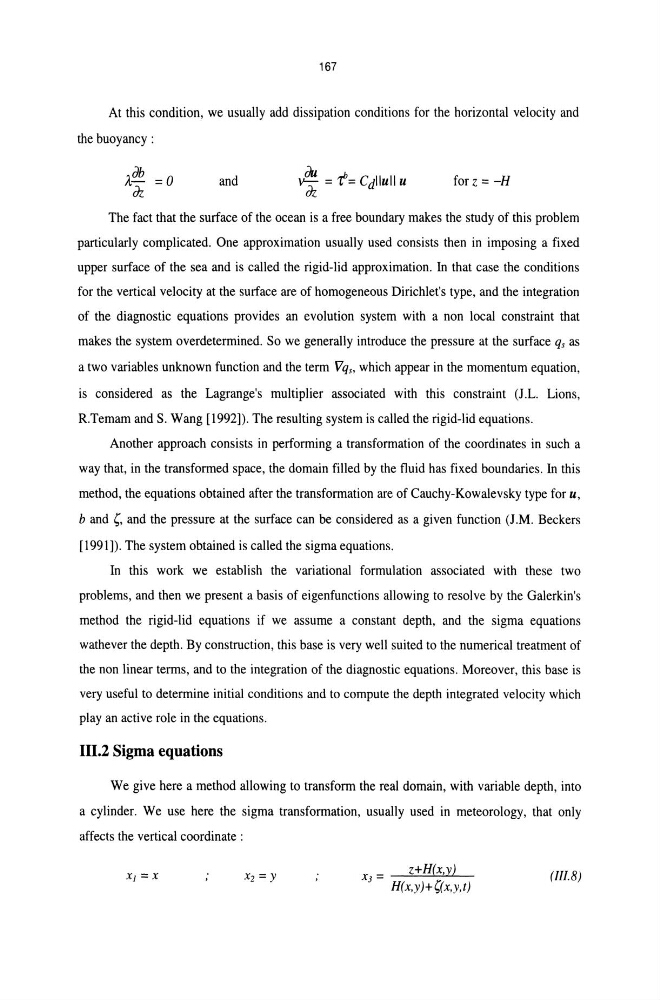
We give here a method allowing to transform the real domain, with variable depth, into
a cylinder. We use here the sigma transformation, usually used in meteorology, that only
affects the vertical coordinate :
Xl =x
X2 = Y
_
z+H(x,y)
X3 - H(x,y)+,(x,y,t)
(Ill. 8)
At this condition, we usually add dissipation conditions for the horizontal velocity and
the buoyancy :
i b =0
(}z
and
for z =-H
The fact that the surface of the ocean is a free boundary makes the study of this problem
particularly complicated. One approximation usually used consists then in imposing a fixed
upper surface of the sea and is called the rigid-lid approximation. In that case the conditions
for the vertical velocity at the surface are of homogeneous Dirichlet's type, and the integration
of the diagnostic equations provides an evolution system with a non local constraint that
makes the system overdetermined. So we generally introduce the pressure at the surface q., as
a two variables unknown function and the term Vqs, which appear in the momentum equation,
is considered as the Lagrange's multiplier associated with this constraint (lL. Lions,
R.Temam and S. Wang [1992]). The resulting system is called the rigid-lid equations.
Another approach consists in performing a transformation of the coordinates in such a
way that, in the transformed space, the domain filled by the fluid has fixed boundaries. In this
method, the equations obtained after the transformation are of Cauchy-Kowalevsky type for u,
band " and the pressure at the surface can be considered as a given function (J.M. Beckers
[1991]). The system obtained is called the sigma equations.
In this work we establish the variational formulation associated with these two
problems, and then we present a basis of eigenfunctions allowing to resolve by the Galerkin's
method the rigid-lid equations if we assume a constant depth, and the sigma equations
wathever the depth. By construction, this base is very well suited to the numerical treatment of
the non linear terms, and to the integration of the diagnostic equations. Moreover, this base is
very useful to determine initial conditions and to compute the depth integrated velocity which
play an active role in the equations.
111.2 Sigma equations
We give here a method allowing to transform the real domain, with variable depth, into
a cylinder. We use here the sigma transformation, usually used in meteorology, that only
affects the vertical coordinate :
Xl =x
X2 = Y
_
z+H(x,y)
X3 - H(x,y)+,(x,y,t)
(Ill. 8)