

169
equation (ID.14), to express' in function of the depth integrated velocity. Before to detail the
system obtained after these integrations, we specify the boundary conditions in the sigma
space.
Ill.2.l Boundary conditions
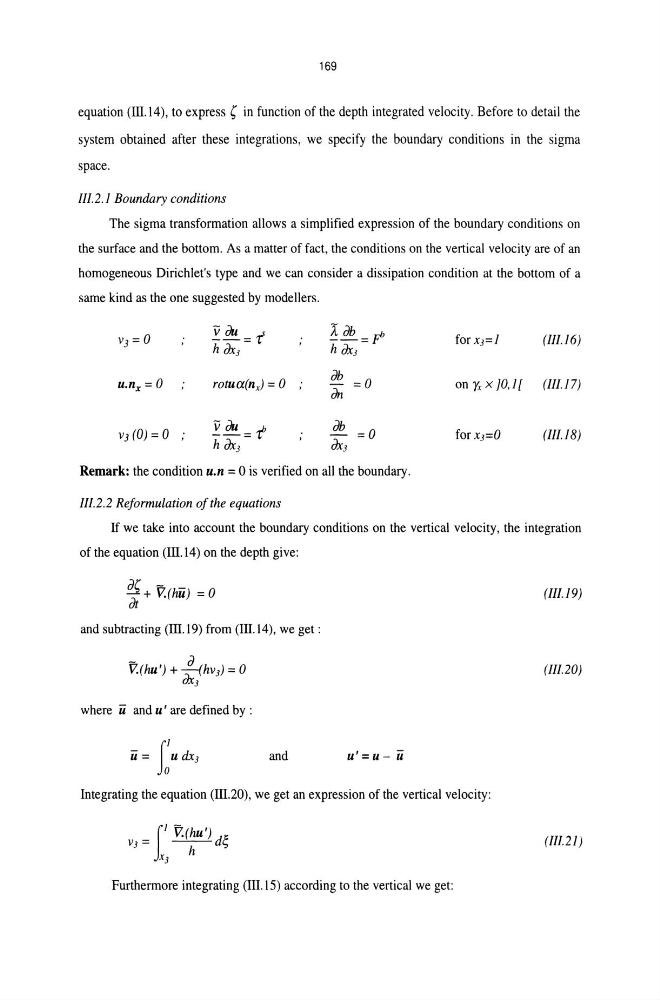
The sigma transformation allows a simplified expression of the boundary conditions on
the surface and the bottom. As a matter of fact, the conditions on the vertical velocity are of an
homogeneous Dirichlet's type and we can consider a dissipation condition at the bottom of a
same kind as the one suggested by modellers.
u.nx = 0
rotua(nx) = 0
'!:.~=F'
h ax3
db =0
an
Remark: the condition u.n = 0 is verified on all the boundary.
III.2.2 Reformulation of the equations
for x3=l
(Ill.l6)
on Yx x lO,l [ (Ill.l7)
for X3=0
(Ill.l8)
If we take into account the boundary conditions on the vertical velocity, the integration
of the equation (m.l4) on the depth give:
~+ V,(hU) = 0
Jt
and subtracting (m.l9) from (m.14), we get:
where u and u' are defined by :
u= f:Udx3
and
u' = u - U
Integrating the equation (m.20), we get an expression of the vertical velocity:
V3 = e v'(hu') d~
JX3 h
Furthermore integrating (m.IS) according to the vertical we get:
(III.J9)
(lI1.20)
(lIl.2l)
equation (ID.14), to express' in function of the depth integrated velocity. Before to detail the
system obtained after these integrations, we specify the boundary conditions in the sigma
space.
Ill.2.l Boundary conditions
The sigma transformation allows a simplified expression of the boundary conditions on
the surface and the bottom. As a matter of fact, the conditions on the vertical velocity are of an
homogeneous Dirichlet's type and we can consider a dissipation condition at the bottom of a
same kind as the one suggested by modellers.
u.nx = 0
rotua(nx) = 0
'!:.~=F'
h ax3
db =0
an
Remark: the condition u.n = 0 is verified on all the boundary.
III.2.2 Reformulation of the equations
for x3=l
(Ill.l6)
on Yx x lO,l [ (Ill.l7)
for X3=0
(Ill.l8)
If we take into account the boundary conditions on the vertical velocity, the integration
of the equation (m.l4) on the depth give:
~+ V,(hU) = 0
Jt
and subtracting (m.l9) from (m.14), we get:
where u and u' are defined by :
u= f:Udx3
and
u' = u - U
Integrating the equation (m.20), we get an expression of the vertical velocity:
V3 = e v'(hu') d~
JX3 h
Furthermore integrating (m.IS) according to the vertical we get:
(III.J9)
(lI1.20)
(lIl.2l)