

148
We define the map II2 that associates to kn E L oo (0,T;L 2 (0,)) the solution of the
problem (U), Vn E L2(0, Tj Vn)' Then we consider the map II = II2 0 II,. We are going to
demonstrate that this map verifies kakutani's theorem hypothesis and then has a fixed point.
This map II must be continuous and must apply a compact convex into himself. We can
note that thanks to the basis regularity, £Z( 0, Tj Vn) and L2 (0, Tj W"OO(Q)2) are algebrically
and topologically equal. Then we can obtain conditions onto II for the weak topology of
L2 (0, Tj WI'OO(Q)2), that is metrisable into a finite dimensional space.
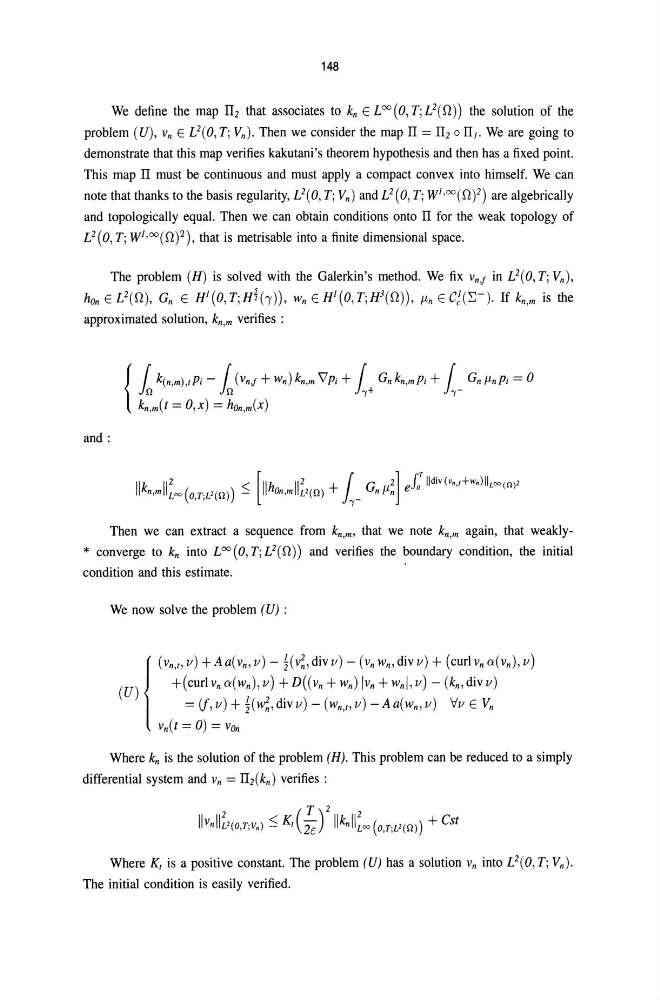
The problem (H) is solved with the Galerkin's method. We fix vnJ in L2( 0, Tj Vn),
hon E L2(0,), Gn E H'(O,TjH~(-y)), Wn E HI(0,TjH3(Q)), J-ln E C!(~-). If kn,m is the
approximated solution, kn,m verifies :
and:
Il k 112
< [llh 112 + 1 G 1/ 2 ] eIvTlldiV(Vn.r+wn)IILOO(n)2
n,m LOO (0,T;L2(Q)) -
On,m L2(Q)
-y_
n '-n
Then we can extract a sequence from kn,m' that we note kn,m again. that weakly* converge to kn into LOO(O, TjL2(Q)) and verifies the boundary condition, the initial
condition and this estimate.
We now solve the problem (U) :
(U)
+ (curl Vn a(w;), v) ~ D((vn + wn) IVn + wnl, v) - (kn, dlV v)
{
(vn,r,v) +Aa(vn,v) - ~(v~,divv) - (vnwn,divv) + . (CUrl~na(Vn),V)
= (j,v) + 2(~,dlVV) - (wn,r,v) -Aa(w,,,v) \Iv EVil
vn(t = 0) = VOn
Where kn is the solution of the problem (H). This problem can be reduced to a simply
differential system and Vn = II2(kn) verifies:
Where Kr is a positive constant. The problem (U) has a solution Vn into L 2 (0, Tj Vn)'
The initial condition is easily verified.
We define the map II2 that associates to kn E L oo (0,T;L 2 (0,)) the solution of the
problem (U), Vn E L2(0, Tj Vn)' Then we consider the map II = II2 0 II,. We are going to
demonstrate that this map verifies kakutani's theorem hypothesis and then has a fixed point.
This map II must be continuous and must apply a compact convex into himself. We can
note that thanks to the basis regularity, £Z( 0, Tj Vn) and L2 (0, Tj W"OO(Q)2) are algebrically
and topologically equal. Then we can obtain conditions onto II for the weak topology of
L2 (0, Tj WI'OO(Q)2), that is metrisable into a finite dimensional space.
The problem (H) is solved with the Galerkin's method. We fix vnJ in L2( 0, Tj Vn),
hon E L2(0,), Gn E H'(O,TjH~(-y)), Wn E HI(0,TjH3(Q)), J-ln E C!(~-). If kn,m is the
approximated solution, kn,m verifies :
and:
Il k 112
< [llh 112 + 1 G 1/ 2 ] eIvTlldiV(Vn.r+wn)IILOO(n)2
n,m LOO (0,T;L2(Q)) -
On,m L2(Q)
-y_
n '-n
Then we can extract a sequence from kn,m' that we note kn,m again. that weakly* converge to kn into LOO(O, TjL2(Q)) and verifies the boundary condition, the initial
condition and this estimate.
We now solve the problem (U) :
(U)
+ (curl Vn a(w;), v) ~ D((vn + wn) IVn + wnl, v) - (kn, dlV v)
{
(vn,r,v) +Aa(vn,v) - ~(v~,divv) - (vnwn,divv) + . (CUrl~na(Vn),V)
= (j,v) + 2(~,dlVV) - (wn,r,v) -Aa(w,,,v) \Iv EVil
vn(t = 0) = VOn
Where kn is the solution of the problem (H). This problem can be reduced to a simply
differential system and Vn = II2(kn) verifies:
Where Kr is a positive constant. The problem (U) has a solution Vn into L 2 (0, Tj Vn)'
The initial condition is easily verified.