

147
where the data and the constants verify the theorem hypothesis. To prove that hn E C i (Q),
we argue as in the first lemma and we obtain the solution h" in function of the data on
~- U D x {O}. This solution h" is C i (Q) if we choose ho" E C: (D) and jln E C~ (~-).
Lemma 2.-. The problem (Vn) has a solution verifying
And the estimate given in the first lemma:
IIVnll~=(0,T;L2(0)') +2s~p in h"loghn
Proof ,-,
+ Ilvnlli2(0,T;V) (B - 2Ci(llwnll~2 (0,T;L4(0)2) + 2DllwnllL= (0,T;L'10)2))
-Cllvnll=( .2( 2))+2{ Gnhnloghn:'::Cst
L O,T,L ,n)
}E+
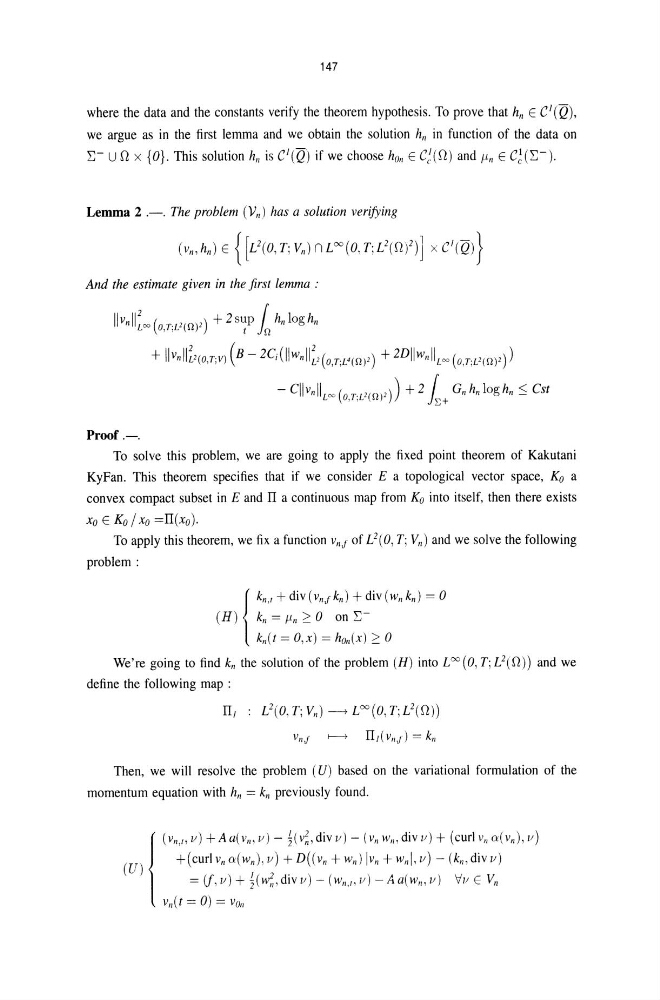
To solve this problem, we are going to apply the fixed point theorem of Kakutani
KyFan. This theorem specifies that if we consider E a topological vector space, Ko a
convex compact subset in E and II a continuous map from Ko into itself, then there exists
Xo E Ko / Xo =II(xo).
To apply this theorem, we fix a function vnJ of L2 (0, T; Vn ) and we solve the following
problem:
f kn" + div (v",( knl + div (wn kn) = 0
(H) t k,,=!1'n;:::O on~k,,(t = O,x) = ho,,(x) ;::: 0
We're going to find k" the solution of the problem (H) into V'>o (0, T; L 2 C D)) and we
define the following map :
Then, we will resolve the problem (V) based on the variational formulation of the
momentum equation with h" = kn previously found.
(V)
+(curlvna(wn),v) +D((vn +wn) IVn +wnl,v) - (k",dlVV)
{
(vn,I1 v) +Aa( v,,, v) ~ ~(v~,divv) -, (v" wn,div v) + (curl 11" a(vn), 11)
= (1, v) + ~(w~, div v) - (WnJ .1J ) - Aa(wn• II) V]! E Vn
v,,(t = 0) = vo"
where the data and the constants verify the theorem hypothesis. To prove that hn E C i (Q),
we argue as in the first lemma and we obtain the solution h" in function of the data on
~- U D x {O}. This solution h" is C i (Q) if we choose ho" E C: (D) and jln E C~ (~-).
Lemma 2.-. The problem (Vn) has a solution verifying
And the estimate given in the first lemma:
IIVnll~=(0,T;L2(0)') +2s~p in h"loghn
Proof ,-,
+ Ilvnlli2(0,T;V) (B - 2Ci(llwnll~2 (0,T;L4(0)2) + 2DllwnllL= (0,T;L'10)2))
-Cllvnll=( .2( 2))+2{ Gnhnloghn:'::Cst
L O,T,L ,n)
}E+
To solve this problem, we are going to apply the fixed point theorem of Kakutani
KyFan. This theorem specifies that if we consider E a topological vector space, Ko a
convex compact subset in E and II a continuous map from Ko into itself, then there exists
Xo E Ko / Xo =II(xo).
To apply this theorem, we fix a function vnJ of L2 (0, T; Vn ) and we solve the following
problem:
f kn" + div (v",( knl + div (wn kn) = 0
(H) t k,,=!1'n;:::O on~k,,(t = O,x) = ho,,(x) ;::: 0
We're going to find k" the solution of the problem (H) into V'>o (0, T; L 2 C D)) and we
define the following map :
Then, we will resolve the problem (V) based on the variational formulation of the
momentum equation with h" = kn previously found.
(V)
+(curlvna(wn),v) +D((vn +wn) IVn +wnl,v) - (k",dlVV)
{
(vn,I1 v) +Aa( v,,, v) ~ ~(v~,divv) -, (v" wn,div v) + (curl 11" a(vn), 11)
= (1, v) + ~(w~, div v) - (WnJ .1J ) - Aa(wn• II) V]! E Vn
v,,(t = 0) = vo"