

149
Moreover, Vn = Il( VII,!) verifies:
[[ [[ 2
<: K' ( T)2 fT Iidiv ""..r+ div
+ C,pt
VII L2(O.T: V,),
2c: e ()
,
T fT
< K' ( 2c:) 2 e () 111"1 III" + Cst
If we choose T small, the last estimate proves there exists R such as :
Il(B(O,R)) C B(O,R)
and it is easy to prove that the map II is continuous (see Orenga (1995)),
We have proved all the conditions of the Kakutani KyFan theorem. The problem
Vn = Il(vn ) has got a solution into L2(0, T; WI,OO(n)2). Since Vn is solution of (U) and hn
solution of (H), we have vlIU = 0) = Van and hnU = 0) = hall'
We had obtained an existence of a solution for a small T. This solution verifies the
estimate of the first lemma and then can be extended onto (0, T) whatever T.
The solution of the problem is such as Vn E HI (0, T; Vn), Since the basis elements
belong to H3(n)2, we have V" E HI(O, T;H3(DY, i.e.
The solution hn verifies :
{
h",1 + div (v" hn) +, div (WI! hnl = °
hn = f1n E C/(0) on 2:;hn(t = O,xl = hon(x) E C/(12)
And then (as /Ln is in C/(2:;-)) :
h" E C'(Q)
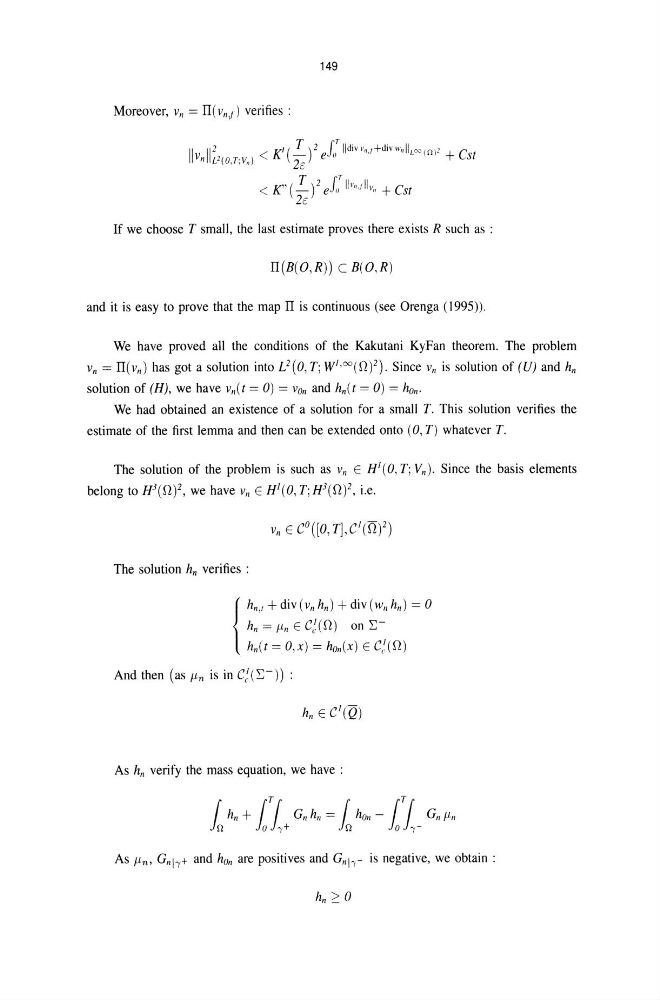
As hn verify the mass equation, we have :
As /Ln, G nh + and han are positives and G nh - is negative, we obtain:
hI! ?::- °
Moreover, Vn = Il( VII,!) verifies:
[[ [[ 2
<: K' ( T)2 fT Iidiv ""..r+ div
+ C,pt
VII L2(O.T: V,),
2c: e ()
,
T fT
< K' ( 2c:) 2 e () 111"1 III" + Cst
If we choose T small, the last estimate proves there exists R such as :
Il(B(O,R)) C B(O,R)
and it is easy to prove that the map II is continuous (see Orenga (1995)),
We have proved all the conditions of the Kakutani KyFan theorem. The problem
Vn = Il(vn ) has got a solution into L2(0, T; WI,OO(n)2). Since Vn is solution of (U) and hn
solution of (H), we have vlIU = 0) = Van and hnU = 0) = hall'
We had obtained an existence of a solution for a small T. This solution verifies the
estimate of the first lemma and then can be extended onto (0, T) whatever T.
The solution of the problem is such as Vn E HI (0, T; Vn), Since the basis elements
belong to H3(n)2, we have V" E HI(O, T;H3(DY, i.e.
The solution hn verifies :
{
h",1 + div (v" hn) +, div (WI! hnl = °
hn = f1n E C/(0) on 2:;hn(t = O,xl = hon(x) E C/(12)
And then (as /Ln is in C/(2:;-)) :
h" E C'(Q)
As hn verify the mass equation, we have :
As /Ln, G nh + and han are positives and G nh - is negative, we obtain:
hI! ?::- °